There's a new sight on the ever-fascinating streets of Tower Hamlets. Not litter bins, because we've had those for ages, but the big yellow stars recently slapped upon them. Tower Hamlets' bins are squat, black and boring, and are therefore very easily overlooked by passers by. Heaven knows how many local pedestrians have carelessly discarded an empty can or burger wrapper onto the pavement simply because they weren't able to spot a nearby bin quickly enough. They don't have this problem nextdoor in Hackney where the bins are bright green [photo], nor in Newham where all the bins are an intrusive shade of scary pink [photo]. But that won't work here. It would cost Tower Hamlets council far too much to replace all of their bins using a vibrant shade of rainbow plastic. Never mind, because a big luminous star-shaped sticker does the job just as effectively. This new campaign has provided maximum impact for minimum outlay. The stellar shape is smart without being tacky, and eye-catching without being over-intrusive. It's now easy to spot a star-stickered bin even from a long way off, as you can see here [photo]. No East End pavement need ever again be scattered with crisp packets, London Lites and chicken wings. It may have taken a month of Saturdays, but the Tower Hamlets Street Management Committee have finally got something right.
Saturday, September 23, 2006
Sign here: Bow Road
I've been keeping an eye on the streetsigns down Bow Road for the last couple of months and, in particular, following the actions of the Tower Hamlets Pointless Streetsign Erection Committee. They've been busy ripping down some of E3's older street nameplates and replacing them with modern accessibility-compliant white rectangles.
This street sign at the end of MorningtonGrove[photo] is their latest target... and about time too. It's stuck to an old wall opposite the local Magistrates Court, a few metres down from Bow Road tube station. The sign looks like an MDF offcut wedged inexpertly into a grimy brick frame, with a wafer-thin layer of white plastic slapped on top. The lettering wasn't so much designed as stencilled, with several of the characters rather too close together and others not quite properly aligned. The faded Tower Hamlets logo in the top left corner is now barely visible, and the surface is peeling in ugly random patches. The whole thing has the look of a temporary street sign which has somehow outlasted its expected shelf life. But no longer. The Tower Hamlets Pointless Streetsign Erection Committee has inspected this wall and found it wanting. The old sign didn't meet stringent inclusivity guidelines and has therefore been removed, to be replaced by one of the council's ultra-new 21st century designs. The new lettering's a bit spindly, and the gleaming white background probably won't survive a winter of lager abuse without creaming up a bit, but it's a big improvement on the old 70s atrocity.
And this signage upgrade has had a rather wonderful side-effect. An original mid 19th century street sign has been magically revealed from its hiding place, and it's a bit of a masterpiece [photo]. Look at that expert chisel work - every character chipped to perfection and not a letter out of place. The surrounding brickwork may now be cracking up, but there's still more craftsmanship on display here than on all the other street signs down Bow Road put together. A shame then that the 150-year-old sign has had to be painted black in an attempt to obscure its heritage features from the eyes of passers-by, because time has moved on since this wall was first erected. Mornington Road has somehow become Mornington Grove, a name change probably enforced by the Tower Hamlets Post-war Street Renaming Committee. The new name hints at a rural lane between orchards and smallholdings, which is what the road used to be, and not a poky backwater street where locals now dump unwanted sofas. The old carved sign may be lovely, but post-war street renaming means it's also outdated, misleading and extinct. I bet it won't be too long before some officious workman comes along and boards over it again, blocking it from view, because councils have "an obligation" not to mislead the travelling public. Which would be a great shame, because this is a rare streetscape jewel in an age of increasingly bland conformity.
• My Bow Road street sign gallery[now 14 different styles along half a mile] • Mornington Road 1830(still fields); 1862(new build); 1872(up and coming); 1885(urban sprawl); Mornington Grove 2006(dead ordinary)
100 things I love about London [because it's five years today since I moved here]
Life, nightlife, the sense of history, the Underground, canalside strolls, the view from Greenwich Park, the fact there's always somewhere new to discover, cutting-edge architecture, classical architecture, Oxford Street, the chimes of Big Ben, nightbuses, world cinema, world cuisine, the world in a city, the 2012 Olympics, the sunlight on the Thames, buying your Sunday paper on Saturday evening, the museums in South Kensington, the museums that aren't in South Kensington, not needing a car, the wobbly Millennium bridge, being able to choose from more than two local radio stations, suburbia, Tate Modern, the view from Hampstead Heath, diversity, acceptance, mind the gap, six of Arsenal's Premiership away matches being nearly at home, strolling along the South Bank, Waterloo sunset, festivals, Trafalgar Square, knowing that you could walk to Trafalgar Square but not having to, piles of arty stuff, 100% style, the top pod on the London Eye, St Pancras station, decent mobile phone reception, free newspapers, cab drivers, memories embedded in every streetscape, Routemasters, blue plaques, global landmarks, taking a shortcut down a back street you've never walked down before, realising that Dr Johnson was right, watching the dawn over Tower Bridge,the forgotten corner of a Victorian cemetery, the West End, the East End, 24 hour bagel shops, culture on your doorstep, Banksy on your wall, deckchairs in Green Park, the Embankment illuminated, eyeballing a famous person in the street, the DLR, 0° longitude, the City, parklife, the view from Primrose Hill, far less fog than everyone imagines, snow on terraced rooftops, Covent Garden, the view from the front seat on the top deck of a bus, alleys, tunnels, being out at 4am, the Gherkin, decent record shops, Soho, pie and mash, street markets, speeding down the river beneath world famous bridges, garden squares, Oyster, always having something to do even when it's raining, urban wildlife, St Paul's Cathedral, walking faster than the traffic, following in Roman footsteps, New Johnston font, crossing Westminster Bridge at night on the back of a bike, the variety of Theatreland, just a short dash to the country, the British Museum, the anonymity of not knowing your neighbours, collective consciousness, common ground, the fact it's not as scary as out-of-towners think it is, Metro-land, moquette, deserted Thames-side beaches, the buzz, infinite choice, the city's constant resilience, feeling alive, just living here.
The Dome: As part of the Open Site programme, members of the public were yesterday permitted rare access behind the scenes at the capital's largest white elephant. This was a unique opportunity to glimpse beneath the Teflon-coated roof before the site reopens next year as an entertainment arena, and was therefore a must-visit for devotees of failed government projects. It was strange to see queues again outside the Dome... almost as strange as it would have been to see them when the place was open.
The Open House brochure had promised a "hard-hat tour", but what we got instead was a walk up to the entrance and back with questions answered inbetween. The first thing we saw was the new piazza between the Dome and the tube station, still being laid out with finest granite. On the far side a "Living Wall" was being constructed... which is a bit rich given that the old Millennium Experience had its own Living Wall on the opposite side of the site which has since been left to decay. This new square was a reminder that the tip of the peninsula is now on its second revamp in under a decade, and has had more millions of pounds thrown at it than almost any other spot in the capital. Still, it'll all be worth it next July when you can come here for a cappucino and a cutting edge pop concert.
Standing just under the rim of Lord Rogers' big tent, we were able to peer into the gloom to where several new buildings are under construction. A curved wall straight ahead shields the new central arena (no trapeze artists this time). To the left is a metal shell which will one day house a casino (eventually, even if Greenwich doesn't win the upcoming super casino licence). To the right is a 10 screen cinema, then a live music venue, and between them a street the length and width of Bond Street. Or there will be. The buildings are merely bricks and steel at the moment, at least from the outside, and there was no hint that any single interior was any nearer completion. Still, I'm sure that the new post-Millennium Experience will open bang on schedule, with a complete range of exciting entertainment opportunities. Because London needs more bars and restaurants. And because nothing on this site has ever been known to fail.
Severndroog Castle[photos]: Hidden amidst the trees on Shooters Hill is a three-cornered brick tower, erected in 1784 in honour of a reformed pirate. William James lived a daring and successful life on the high seas off India, returning home a successful and wealthy man, only to drop dead on the evening of his daughter's wedding. His wife Lady James was understandably distraught, and had this quirky belvedere built to honour his greatest naval success. The volunteers at Severndroog can tell you this story in much greater detail, probably whilst wielding a jangly bucket. By the time you've been round the tower to see what all the fuss is about, you'll probably want to throw a few coins in it yourself.
Severndroog Castle is an endangered structure, not through imminent collapse but through political disinterest. Up until 1986 there was a tearoom inside, plus ready access to the roof for an entrance fee of a few pence. And then Maggie dismantled the GLC, and the tower reverted to the control of Greenwich Council. They couldn't afford to maintain the cafe, which rapidly closed, and (more recently) they've tried to sell the tower off as offices. Thankfully a group of volunteers sprang up, peddled their restoration plans on the BBC's Restoration, and the future now looks a little more promising. Admittance is still only possible on this one weekend every year, but this quirky building is worth the effort of a visit. There's an unexpectedly ornate ceiling on the first floor, beneath which Lady James would mourn her late husband, and it's hoped that this room will one day become a space for public meetings. But the finest views are to be had from the roof, from the top of the western turret, where we were permitted precisely five minutes to gaze out across South London. On a good day you can see seven counties, so we were told. I'd recommend visiting this charming folly before the surrounding trees grow so high that you can only see one.
Donnybrook Quarter: One of the newest housing developments in Bow has brought an unexpected splashof Mediterranean white to the streets of the East End. This isn't your usual social housing - it's a high density mini-estate where every residence is afforded its own front door onto the street. The idea is to foster a sense of community - isn't it always - but here in these two streets it might just work. By removing hallways, lobbies and stairwells the amount of indoor living space is maximised, and there's even room for each building to have its own small outdoor courtyard. Yesterday afternoon the development gleamed in bright sunlight, as residents scuttled in and out wondering what all the fuss was about. The architect was on hand to enthuse about his award-winning project, but always with a sense of reality. Every cutting edge architectural project is a real-time experiment, and it'll take longer than six months for the new occupants to decide how this new living space will evolve. [photo] [photo] [photo]
One final irresistable visit as part of London Open House was the opportunity to survey the 2012 Olympic site from above. A special viewing suite has been established on top of Holden Point, a 21 storey tower block in deepest Stratford. The portakabin on the roof is somewhere warm to take VIPs and and engineers when they need an overview of the Olympic Park (and it's a lot cheaper than hiring a helicopter). Various members of the IOC have been up here, as has Chancellor Gordon Brown, and even the Queen paid a visit last year. I rather like the fact that Her Majesty has been to a very ordinary yellow council block in the East End and travelled up to the 21st floor in a slightly-too-small lift, just like many of her loyal subjects suffer every day.
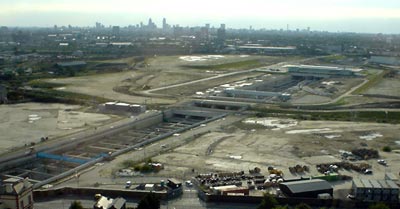
I spent an hour on the roof of Newham, looking out across the future. Directly in front of me was the new StratfordInternational railway station, cut deep in a broad trench running across reclaimed marshland. Eurostar trains will be speeding through here next year, but they won't be stopping for a while because there's nothing surrounding the station shell but a single road and acres of dirt. This dirt will one day be the new Stratford City development, an upmarket office/retail/residential complex (in direct contrast to the existing Poundstretcher/kebab/Woolworths shopping centre to the south). The true Olympic site lay rather further away, somewhere in the middle distance, which was a shame because that made it much harder to see. When the Queen was up here they helped her out by tying big coloured balloons to existing buildings to represent various Olympic proto-stadia. I had to make do with a pair of binoculars and a small map.
As well as enjoying the view out of the window, my group was also informed and entertained by the Olympic Delivery Authority's Head of Stakeholder Engagement. Thankfully his personality was a lot more engaging than his job title. Richard explained, with the aid of a malfunctioning DVD and various maps, how the scene below us would be transformed over the next five years. We're in the middle of a two year planning stage at the moment, which ends next summer when the bulldozers arrive. In July next year, it was confirmed, a big security fence will go up round the perimeter of the site and public access will be closed off. If you want to walk the green spaces of the Lower Lea Valley, or if you're the heron I saw stalking the Pudding Mill River at the weekend, the months are running out.
We spent too much of our hour above Stratford looking in rather than looking out. Maybe that's because there's not yet very much to see apart from the station, no major building work of any great consequence. But in five years time the view from this window will include a Waitrose, an Aquatics Centre and an Olympic Stadium. Within ten years, as the legacy phase kicks in, these should be joined by a giant waterpark and hundreds of acres of affordable housing. The Newham council representatives I met up Holden Point probably still can't believe their luck... just so long as the Olympic Delivery Authority actually delivers. On a good day from up here you can already see the Wembley Arch on the horizon. Let's hope it acts as a wake-up call and not an omen.
Saturday, September 16, 2006
More than five hundred architecturally interesting buildings have been open to the public for free across London this weekend as part of London Open House. Today I managed to visit 1% of them.
Balfron Tower: West London's Trellick Tower has a less famous older brother on the other side of the capital, just north of the Blackwall Tunnel. Both have a similar silhouette, both were designed by ErnoGoldfinger, and both are admired from the outside by people who'd never dream of living on the inside. The architect himself was an exception. Goldfinger and his wife moved into the Balfron Tower soon after it was built, and spent a couple of months living in flat 130 on the top floor to find out what living here was like. This weekend, as part of Open House, Londoners have the chance to take a look inside a flat just along the corridor.
Residents of the BalfronTower were eyeing up the growing queue outside their front door this morning with a certain degree of bafflement. What were these middle-class arty types doing here on a council estate in Poplar, and why were they willing to wait for hours to get inside. But this building is something special, a brutalist architectural masterwork with a highly original construction. I was lucky enough to be in the first small group of the day to gain entrance. The lifts to the top floor were malfunctioning so we could only ride up as far as the 18th floor before having to climb the remaining six storeys via the staircase. All the stairs and liftshafts are housed in a separate tower, joined to the main apartment block by a series of concrete bridges. We crossed the toppermost connecting walkway, our precarious mid-air state mostly shielded from view, and proceeded along to our target flat.
The owner was pleased to show us around, although he may not be quite so keen by the time the umpteenth group traipses round his living space this afternoon. He's only just moved in and is one of the block's rarer upwardly mobile residents. His flat is fairly compact, and very white, with some tasteful Erno-designed features which elevate this above the usual tower block interior. Best of all, however, were the views... or at least they would have been had London not been cursed by low grey cloud yesterday, obscuring the horizon in all directions. Curses. Canary Wharf was near enough to be obvious, as was a large swathe of East London, but the Gherkin was just a ghostly shape in the distant mist. I can definitely see the attraction of living up here inside a design classic, if only for the opportunity to stare out across the capital with a broad smile. But the tortuous journey back down to civilisation convinced me that maybe I'm better off where I am.
Bromley Hall: One of the joys of Open House weekend is discovering unexpected architectural treats on your doorstep. Bromley Hall looks like a very ordinary building beside the Blackwall Tunnel Approach Road, and I must have been past it scores of times without giving it a second look, but at its heart is the oldest brick house in London. In 1485 this was a hunting lodge with royal connections, located at the tidal limit of the River Lea. Later it became home to a series of successful merchants, each of whom made their mark on the structure and design of the building. The architect responsible for the hall's restoration, Paul Latham, was only too pleased to be able to show eager members of the public around inside his pet project. He knows every inch of the property inside out, from the old woodstained floorboards to the scrap of painted 17th century dado rail in the hallway. Particularly impressive are the patchy remains of a Tudor wall painting of a soldier wielding a crossbow, and a preserved wooden doorway carved with hunting scenes. With so many historical periods represented side-by-side, you get a real sense of domestic architectural evolution. I'm particularly astonished that Bromley Hall survived the 20th century, during which time it was damaged by wartime bombs, a passing motorway and bolted-on advertising hoardings, as well as (most recently) its use as a garage store and a carpet warehouse. All praise then to Leaside Regeneration for the sensitive way they've converted the building back to office space... although it would be tough to choose between working here or inside the pile of red containers stacked up nextdoor.
Royal Courts of Justice: If you're particularly naughty you might one day end up here, inside the big gothic building at the top of Fleet Street. The RCJ is the top civil court in the land (with the exception of the House of Lords) and also the criminal Court of Appeal. And until today I'd never quite appreciated from the outside how vast it is inside - a labyrinth of corridors, chambers and court rooms arranged around a long high vaulted hall. The building's open to the public every weekday, but yesterday there were special tours allowing us to tour behind the scenes. It was fascinating to prowl the back corridors and to hear more about the courts and their 8000 staff from some of those who work here. There was even the opportunity to go down into the cells of the Court of Appeal and follow in the footsteps of the country's more famous miscreants. I can now claim to have stood in the VIP holding cell, sat in the back of a 12-seater prison van, and even been taken up to the accused's bench in a dark and dusty courtroom via the back stairs. And next time the Lord Chief Justice gets a mention in the news I'll be able to picture his airy book-lined court room without having to rely on one of those awful artist's impressions.
Also visited • Marx Memorial Library (Clerkenwell): The repository of all things left-ish, including an upper room where Lenin spent a year writing. If you should ever need to refer to a copy of the United Mine Workers Journal (or similar) for research purposes, they'll have it in the basement. • More London (beside City Hall): A new Foster-designed office block overlooking the Thames, with two separate nine-storey wings joined by vertigo-inducing bridges across a central atrium. And filled by a bunch of accountants.
Tuesday, September 12, 2006
The annual London fare rise 'scandal'
Every Autumn, London's Mayor announces next January's fare rises for tubes and buses. Every Autumn, certain sections of the media complain very loudly. Check out the 2007 column of the following tables and you might see why...
Cost of a single central London tube journey
1999
2000
2001
2002
2003
2004
2005
2006
2007
£1.40
£1.50
£1.50
£1.60
£1.60
Oyster
£1.60
£1.70
£1.50
£1.50
Visitor
£2.00
£2.00
£3.00
£4.00
Cost of a single central London bus journey
1999
2000
2001
2002
2003
2004
2005
2006
2007
70p
£1
£1
£1
£1
Oyster
70p
80p
80p
£1
Visitor
£1
£1.20
£1.50
£2
The good news: If you have an Oyster card (and millions of Londoners do), tube and bus fares are still at 2000 prices. The bad news: If you don't have an Oyster card (and the vast majority of visitors and tourists don't), tube and bus prices have doubled in just three years.
The Evening Standard says: "£4 TO GO ONE STOP ON THE TUBE" A rational human being says: Well yes, but you'd have to be pretty stupid to travel one stop on the tube in central London. Or very lazy. Or the sort of Evening Standard reader who doesn't usually travel with the plebs but is sometimes forced against their will to use the tube when there are no taxis. A taxi driver says: Come January, a group of three tourists will be able to take a taxi across town more cheaply than take the tube. Lovely jubbly.
The better news: You can buy an Oyster card online and have it posted to your home address anywhere in the country (offer coming soon to India, Hong Kong, Singapore, Spain, Portugal and the USA) The bottom line: You can't get hold of an Oyster card without paying at least £13 (that's £10 of pre-pay and £3 refundable deposit)
Some background: Cash is now used to pay for only 5% of bus and tube journeys in London. The potentially scary bit: If you have an Oyster card, somebody at Transport for London knows precisely whereabouts in London you were last Saturday morning (and every single day since you bought one). The small print: If you're on pay-as you-go and forget to touch in or out, the amount you'll be charged rises to £4 in November.
The good news: If you have an Oyster card (and millions of Londoners do), tube and bus fares are still at 2000 prices. Which is bloody impressive really.
Sunday, September 10, 2006
Next week is London Open House weekend, when hundreds of the capital's architecturally intriguing buildings are open to the public for free. As a taster, here are some photographs I took inside the Gherkin (30 St Mary Axe) as part of London Open House Weekend 2004.
Back in 2004 it took me three and a half hours of queueing to gain access to the Gherkin [report here] but the stunning views from the top floor of the building were well worth the wait. Thousands of (very patient) people made the journey to the 40th floor during that single weekend, and I'm sure none will forget the experience. The Gherkin's open to the public again for London Open House this year, but with visitor numbers dramatically reduced. The organisers are only allowing pre-booked tours, for nine people at a time, so bad luck if you didn't apply for one of the 500 tickets three weeks ago. And this year's visitors are only getting ten minutes at the top, whereas we weren't timed at all and we got to wander round the 17th floor as well.
Next weekend there'll be crowds of people crawling across London, from the City to the suburbs, trying to take a look inside as many buildings as possible. I fear that London Open House is starting to become a victim of its own success. Every year more people find out about the event, so every year the queues get longer, so more people get to visit fewer properties. A greater number of events now require pre-booking, usually the more interesting ones, restricting access and opportunity. It's no longer possible to give away the 72-page event brochure for free - it's now only available by post or download for £4 a time. And simultaneous opening over just one weekend means it's impossible to visit even a tenth of the architecture on show, and most of these buildings won't be open to the public again for another 12 months.
But Open House is still a fantastic event and a rare opportunity. Without it I'd never have been up the Gherkin, or round the Cabinet Office, or inside the old TV studios at Alexandra Palace, or visited any one of a number of other fascinating locations. This will be my fifth year of Open House-ing, and every year it gets harder to decide where to go. Where's left I haven't been to before? Do I concentrate on the centre of town or attempt to tour the suburbs? Will certain buildings be open again next year or is this my only chance to see? Is it worth queueing to see one amazing building or better to spend the time visiting four less crowded ones? I've got a week to decide.
Some recommendations: Foreign Office (off Whitehall), Crossness Engines House (Bexley), Shri Swaminarayan Mandir (Neasden), Freemason's Hall (Camden), Bank of England (arrive early, the queues get really long), Lloyds of London (City), Severndroog Castle (Greenwich), The 02 site tour (North Greenwich), Hackney Empire, Brixton Windmill, City Hall, More London, 19 Princelet Street (Spitalfields), Portcullis House (Westminster) Some more recommendations (except you had to pre-book, and you didn't): the Gherkin (City), Churchill's Underground Bunker (Neasden), Lincoln's Inn (Camden), Mansion House (City), BBC Television Centre (White City), Grims Dyke (Harrow Weald)
Wednesday, September 06, 2006
Underground, Overground *
London's tube map is about to get more complicated, with even more coloured tentacles snaking around the capital than ever before. And this time they're orange. The Mayor announced yesterday that he's found a cunning way of extending the tube network without forking out billions on new tunnels. He's taking a couple of existing rail services - namely Silverlink's North London line and TfL's East London line - and now plans to link the two together by adding in a short stretch of relatively cheap connecting track in the Dalston area. Throw in some new trains and some revamped stations and, hey presto, you have a brand new rebranded railway. Starting in November next year. And it's to be called the "LondonOverground".
It's about time it was easier to travel by rail around non-central London. If you want to get from London outskirts to London outskirts today, you usually have to go right into the middle and back again. Or ride on a ramshackle old line with grim carriages and an infrequent service. Or take the bus. Or even (shudder) get yourself a car. The new London Overground hopes to change all that. From 2010 you'll be able to travel from Croydon to Canonbury, or Wapping to West Hampstead, or any one of hundreds of other improbable journeys, all on one train. Travelling 90 degrees round the capital will never have been easier.
Except that, as is usual with such developments, South London is missing out. Almost all of the new London Overground is north of the river, and the southern extension from Surrey Quays to Clapham Junction is the only part of the project not yet promised funding. Until that can be built, a proper outer orbital railway remains just a pipedream. Half of London will have to continue to endure less regular, less well-connected National Rail services for the foreseeable future. And the whole of London is going to have to put up with a much more complicated tube map, scarred by orange lines that aren't really tube lines at all. The future's Overground. The future's orange.
1) thelondonpaper Born: 4 September 2006 Cost: free Published by: News International (ie Rupert, Sky, the Sun) Given out by: blokes in glitzy lilac, who really weren't trying hard enough modus operandi: "Could you write the paper for us please, because we haven't got enough journalists to do it for you" The editor says: "Every day thelondonpaper.com's team will be bringing you stories about the city you live in, work in and play in. The city you love as much as we do. We'll also have guides to everything – from bars and restaurants to cinemas and the latest exhibitions. We'll have survival guides and the latest London gossip. Oh, and more reviews than there are tourists in Piccadilly Circus." And are there "more reviews than there are tourists in Piccadilly Circus"? no, not unless it's 5am Front cover: clean; well-designed; colourful enough; big photo of Bow Road (but only because Pete Doherty was being sentenced at the court there); seriously patronising weather forecast ("don't forget your umbrella") Plenty of news to read: yes, 17 pages worth, near enough Number of press releases magically transformed into 'news' items: plenty Typical features: "your views" (a quick quote from typical young Londoners); pet of the day; ask the Urban Doc; look good feel good; irrelevant statistic at top of page; thelondonbuzz City news: barely any Sports news: a bit thin, especially on local teams Number of sudoku: 3 Dodgy 'love' columns featuring the phrases "sit on my face", "fat slags" and "rug munchers": 1 Does Sky TV get undue prominence? yes, but not as blatantly as I was expecting What's the website like? not as easy to read as the paper Could you imagine reading this for 30 minutes on the way home? yes, at a push A typical reader: young, goes out a lot, lives for 'fun and mates', concerned about health and the environment, buys stuff (but not newspapers) Is it aimed at me? not really Would I take another copy tomorrow? if I had nothing else to read, yes
2) London Lite Born: 30 August 2006 Cost: free Published by: Associated Newspapers (ie Evening Standard, Metro, Daily Mail) Given out by: several pushy volunteers in cheap purple jackets (on £8 an hour) modus operandi: "You'll never guess what showbiz gossip and fashion tips we uncovered while you were at work today" The editor says: "With so much to do at work and play in London, sitting down for a long read is a luxury. That's why London Lite likes to keep things short and snappy... London Lite is the paper that never likes to come second. What's more it is as exciting and colourful as the vibrant city it covers." And is it "as exciting and colourful as the vibrant city it covers"? no, not unless London is bitty and shallow Front cover: very colourful; not much to read; big plug to article inside about cellulite; pointless claim ("London's first and original free afternoon paper") Quality of newsprint: barely better than thin 1960s toilet paper Plenty of news to read: well, sort of, but with a definite "showbiz" slant Number of press releases magically transformed into 'news' items: plenty Typical features: celeb gossip; celeb photos; Salon Secrets; eat tonight at the best veggie cafes; London tribes; songs to do the washing up to (chosen by wife of former Conservative leader Michael Howard) City news: enough Sports news: enough Number of sudoku: 2 Misuse of the word "bloggers" to refer to people who've sent in reviews of things: 5 Does the Evening Standard get undue prominence? sssh, not a mention What's the website like? exactly the same as the Evening Standard, with the news buried deep beneath entertainment and dining reviews Could you imagine reading this for 30 minutes on the way home? no, maybe 10 A typical reader: young, probably female, dines out, concerned about how and where she's seen, likes her little luxuries Is it aimed at me? not at all Would I take another copy tomorrow? not even if they were giving it away
3) Evening Standard Born: 21 May 1827 Cost: 50p (was 40p until last week) Sold by: glum-looking (and very lonely) news vendors Could anybody in the Holborn area be arsed to buy a copy today? no, they each had two free papers to read instead Doomed then? I shan't miss it
Saturday, September 02, 2006
Sign here: Bow Road
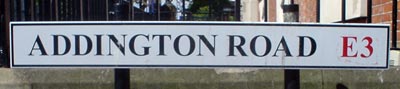
Last month, you may remember, I went out and explored the street signs down my localstreet. I took lots of photos [album here] and I wrote about them in some depth [post here]. I was particularly impressed by the historical diversity of signage on display, with old metal etchings surviving alongside more modern enamel plates. There can't be many roads in London where you can still see as many as 12 different designs of street sign. Well, make that 13! My local council have been busy over the last couple of weeks erecting several new signs of yet another design, and for no particularly obvious reason. In fact I'm starting to suspect that Tower Hamlets has a Pointless Streetsign Erection Committee with more money than sense. Let me show you why, using the police station on the corner of Bow Road and Addington Road as an example.
Until last year there was only one street sign on the wall here, this blue and gold sign dating back to the late 20th century. It's a proper heritage sign with a bit of character, proudly announcing to anyone willing to squint up close that they are standing in "Bow neighbourhood". But the sign had also seen better days. Years of marker pen abuse had taken their toll, and there were also the remains of a particularly stubborn sticker in the centre. Nothing a good scrub by some council operative couldn't shift, but oh no, that doesn't appear to have been an option. The Tower Hamlets Pointless Streetsign Erection Committee must have had a meeting and decided to introduce a completely different design concept, because last year this new sign appeared in front of the police station railings...
The 2005 sign is very white, very basic and rather nondescript. There's just a road name and a postcode, in two dead ordinary colours, with no additional embellishment whatsoever. Something this ordinary can only have been designed to comply with some all-encompassing legislation on accessibility for partially sighted citizens, allowing the Tower Hamlets Pointless Streetsign Erection Committee to fill in their Fully Diversity Compliant tickbox. But what the council forgot to do was take down the old sign on the same wall. There were suddenly two completely different street signs signs here... and exactly the same on the the opposite side of the road... and exactly the same at several other road junctions around the Bow area. Everywhere one new-style sign on posts, and one old-style sign on the wall. There's true diversity for you. Until very recently, when this new sign appeared as well...
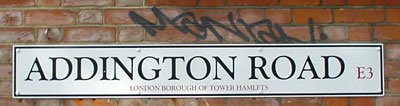
This is an example of the Tower Hamlets Pointless Streetsign Erection Committee's 2006 design. Again it has black writing on a white background with a red postcode, although the black font is lighter and fussier, and the red font is smaller and less distinct. This is so that an extra, crucial piece of information can be squeezed onto each new sign. It's now essential that we be told that this road is in the borough of Tower Hamlets... and not just any old borough of Tower Hamlets but the London Borough of Tower Hamlets. How very useful. And did the council remove both of the old signs before they put this new one up? Did they hell, they only removed the old one with a bit of character and left the bland year-old sign standing. So now we have two virtually-identical street signs on the same wall... and exactly the same on the opposite side of the road... and exactly the same at several other road junctions around the Bow area. Everywhere one new-style sign on posts, and one near-duplicate even-newer sign on the wall. Unless the old street sign was too high up on the wall, that is, in which case the council have left it in place because nobody could be arsed to remove it. In some places, for example at the end of Tomlins Grove, there are now as many as four different street signs visible on the same wall. This isn't coherent heritage retention, it's a total mess.
My local street is now wholly over-signed, and for no particularly obvious reason. I hate to think how much this pointless double replacement exercise has cost me and my neighbours, the local taxpayers. Perhaps if any members of the Tower Hamlets Pointless Streetsign Erection Committee are reading this, they could leave me a reply.
Monday, August 28, 2006
Metro-land revisited
August 2006
Calling at...
BAKER STREET
MOOR PARK
MARLBOROUGH ROAD
CROXLEY
NEASDEN
CHORLEYWOOD
WEMBLEY PARK
AMERSHAM
HARROW-ON-THE-HILL
QUAINTON ROAD
PINNER
VERNEY JUNCTION
"Child of the first war, forgotten by the second, we called you Metro-land. We laid our schemes, lured by the lush brochure, Down byways beckoned, to build at last the cottage of our dreams, A city clerk turned countryman again, and linked to the Metropolis by train." "Metro-land", John Betjeman (BBC, 1973)
In the summer of 1972 the newly-appointed Poet Laureate, John Betjeman, took a train ride out into the London suburbs. He followed the tracks of the Metropolitan railway from Baker Street out into the northwestern suburbs, through Middlesex, Herts and Bucks, and he took a BBC camera crew with him. The resulting documentary, Metro-land, is a television classic, lovingly reflecting the quirkier side of everyday Englishness. Sir John explored the extraordinary architecture to be found in London's commuter belt and met the ordinary people who lived therein. From mock-Tudor semis to the Harrow Women's Institute, his lilting prose exalted the eccentric and the commonplace.
There was much to see. In the early 20th century Metro-land had sprawled outwards from the extending railway line, covering the countryside with faux-rural housing stock. Pavements replaced hedgerows, lawns replaced fields and half-timbered gables replaced woodland. Those who had lived in the city rushed to resettle in outskirts Arcadia. They came in search of peace, and space, and a vegetable garden of their very own - all within easy commuting distance of the urban workplace. Here and there an existing village was swallowed up, its history and customs absorbed to create a new artificial heritage. Middle England had reinvented itself, and Betjeman was on hand to celebrate the end result.
Best of all, Sir John came to my village on the day of our annual village fete. He stood on a street corner close to my house to watch the carnival floats pass by. He watched my six foot something music teacher waiting proudly on the village green with the school orchestra stacked up behind. And he smiled benignly as the Queen of the Revels tried hard not to burst in fits of giggles during her coronation ceremony. I was only seven years old at the time and I don't appear on screen, but I was there, somewhere in the background, buying ice lollies and trying to win bottles of Cresta in the tombola. In his documentary Sir John lovingly chronicled my world, my childhood and my semi-detached roots.
To commemorate the centenary of Betjeman's birth, I'm attempting to revisit the locations that he visited in his seminal documentary all those decades ago. From the bustle of Baker Street to the forgotten fields of Quainton Road, and around ten stations inbetween. Will I rediscover early 20th century suburbia, or has life moved on? I shall be trying to follow the Neasden Nature Trail, searching for the pond in Harrow where half of Gilbert and Sullivan drowned, hunting for a giant organ in Chorleywood and, yes, returning 'home'. To Metro-land.
"Gaily into Ruislip Gardens runs the red electric train, With a thousand Ta's and Pardon's daintily alights Elaine; Hurries down the concrete station with a frown of concentration, Out into the outskirt's edges, where a few surviving hedges Keep alive our lost Elysium - rural Middlesex again." "Middlesex", John Betjeman (1954)
"The Company also has an important Extension line... The district through which it passes has been happily named Metro-land, and it is the purpose of this Guide briefly to describe the more important of the small townships which the Metropolitan serves, and in the steady development of which the line has been the principal agent." Foreword to "Metro-land" brochure (1924)
The MetropolitanRailway was the first steam underground in the world. It chugged beneath the Marylebone Road from Paddington to Farringdon, before spreading its tentacles out further around central London. So successful was the fledgling railway that its bosses started to look further afield, with dreams of connecting their network to Oxford, Birmingham and even Manchester. They took an existing stumpy branch line terminating at Swiss Cottage and extended it outwards - first to Willesden, then to Harrow, Rickmansworth, Aylesbury and beyond. Further branch lines followed, to Uxbridge, Watford and Stanmore, until the Metropolitan railway was the driving force across the northwestern Home Counties.
Long-distance traffic proved elusive, however, not least because the hoped-for connections to the Midlands failed to materialise, so the Met turned their attention instead to the land alongside their tracks. They'd had the sense to buy up acres and acres of fields while the railway was still under construction, because they realised the potential of future property development. Not only could they sell off executive villas for a tidy profit (detached houses in Ickenham sold for £650 each, for example) but they could also fill their trains with regular season-ticketed commuters (£2 first class for a month's travel from Ickenham to Baker Street). It was a surefire recipe for success.
The first published guide to Metro-land was launched in 1915. This annual glossy brochure attempted to lure the well-to-do away from built-up crammed-together London by painting a picture of a well-connected rustic paradise. All that a flat-renting smoke-dwelling clerk had to do was flick through the Metro-land brochure and select the station of his dreams. Everywhere was "traditional" but "modern", "delightful" but "convenient", "unspoilt" but "accessible". Estates were often "garden villages", country rambles were always "charming" and the golf clubs were nothing less than "luxurious". Estate agent superlatives haven't changed much over the years. The 1924 edition of the guide, the "British Empire Exhibition Number", is now available in bookshops should you want to take a look for yourself.
During the 1920s and 1930s the population of Metro-land increased dramatically. But as commuters moved in, so the countryside they had come to enjoy disappeared beneath acres of sprawling semis. Railway bosses had destroyed much of the rural idyll they were trying to sell, and these phenomenal growth rates stalled. When London Transport nationalised the line in 1933 their priorities were transport, not housing, and so the Metro-Land brand was dropped. It was left to private property investors to continue the area's transformation, at least until the Second World War and the emergence of the Green Belt put a stop to it.
Large swathes of northwest London are still mothballed in the 1930s, architecturally at least, thanks to the Metropolitan Railway. Hundreds of thousands of Londoners would live nowhere else, because they don't build homes like this any more. Indeed, it would be environmentally irresponsible to build on such a scale ever again. You don't get a tennis-court-sized garden in a modern housing development, you get a concrete patio and a windowbox. You don't get detached isolation in an inner city apartment, you get paper-thin party walls and ghetto-blasting neighbours. And you don't get a home of character with chimneypots in Prescott's Britain, you get a box surrounded by identical boxes, if you're lucky. Metro-land may be a fake Arcadia, but it's still a very desirable place to live.
The expansion of Metro-Land from Baker Street to... Swiss Cottage (1868), Willesden Green (1879), Harrow (1890), Pinner (1885), Rickmansworth (1887), Chesham (1889), Aylesbury & on to Verney Junction (1892), Uxbridge (1904), Watford (1925), Stanmore (1932)
Betjeman began his Home Counties Odyssey at Baker Street station... or, to be more accurate, in the elegant restaurant above the station. He sat beneath the gilded ceiling at a lined-topped table surrounded by folded napkins and gleaming china, as had so many diners before him. Sir John was clearly very much at home in such surroundings.
"Here the wives from Pinner and Ruislip, after a day's shopping at Liberty's or Whiteleys, would sit waiting for their husbands to come up from Cheapside and Mincing Lane, and while they waited they could listen to the strains of the band playing for the tea dances, before they took the train for home." John Betjeman in the Chiltern Court Restaurant ("Metro-land", BBC, 1973)
This is Chiltern Court [photo], the former headquarters of the Metropolitan Railway, looming large above the Marylebone Road. It's a vast building, as you'll know if you've ever looked across while standing in the queue outside Madame Tussauds nextdoor. There is no finer symbol of the financial success of Metro-land. This state-of-the-arts eleven-storey apartment block was the most luxurious in London when it opened in 1929. According to publicity at the time, the building contained "40 passenger and service lifts, postal chutes on each floor, hot-water radiator heating and automatic telephones." Residents were "able to proceed direct, not only to the Stores or the Restaurant, but also to the station platforms" [photos]. No wonder HG Wells found the place irresistable - he spent several years living in flat number 47. A mere half a million quid will get you a two-bedroom flat in Chiltern Court today - "conveniently located for Baker Street station". [entrance]
The Chiltern Court restaurant doesn't serve Brown Windsor soup to prim ladies and their stockbroker husbands any more. It's been bought up by the Wetherspoons chain and now lives out its days as the rather less exclusive MetropolitanBar[photo]. A meal costs much the same as when Sir John sat here, but he didn't have to face 2-for-1 price deals, ketchup sachets and disposable serviettes. Any old pleb can get past the doorman these days, and believe me they do. The tables and chairs are rather less grand than before, and are filled with students, cheery tourist types and bloated lagerboys. The walls have been repainted navy blue instead of ruby red, and one is nearly completely obscured behind the well-stocked bar. But look up above the chunky square pillars and lo, the sky-blue ceiling is still liberally covered with the stucco crests of the Metropolitan Railway. If you're able to block out the occasional ringtone and the whirr of a nearby slot machine, you could almost be sat here back in the restaurant's heyday. Just don't look down.
"Here the beery blokes from Watford and Uxbridge, after a day's boozing in Camden or Soho, would sit waiting for their girlfriends to come up from Lakeside and Bluewater, and while they waited they could watch the football on Sky playing on the plasma flat screen, before they threw up on the train home." diamond geezer in the Chiltern Court RestaurantMetropolitan Bar, 2006)
From Baker Street the Met line burrows north, more than two miles out to Finchley Road without stopping. But the journey wasn't always this fast. There used to be three stations inbetween, one at Lord's, one at Marlborough Road and one at Swiss Cottage. The former was well used during the cricket season, but otherwise all three stations barely justified their existence. Then in 1939 the new parallel Bakerloo line tunnels were opened, along with new stops at St John's Wood and Swiss Cottage, and the old three stations were closed for good. Only Marlborough Road is still clearly visble, both above ground and below, although you have to know where to look. You probably wouldn't give this Chinese restaurant a second glance, for example, not unless you were a St John's Wood resident with disposable income to expend. But this is the old station building, now scrubbed and whitewashed and serving up "Dim Sum daily" [photos]. It's a bit of a comedown, but still a culinary improvement on 1972 when Betjeman found an Angus Steak House here instead.
Sir John was also able to stand on the disused platform - one of the many advantages of being a documentary-making Poet Laureate. Here he waited, at the bottom of a deep brick canyon, looking appropriately wistful as the shiny white trains sped past. All that passing passengers get to see today, during a brief few seconds of daylight, is a rather more overgrown and rubble-strewn platform [photos]. The walls are arched, echoing the design of the station building above, and still painted a very faint shade of Metropolitan purple. And there's a wire-framed door in the east wall with a green sign labelled "Emergency exit", just in case any train should ever need to be evacuated here in a hurry. You never know your luck, you might end up here one day and be able to pop upstairs for a Chinese takeaway.
"Early electric, punctual and prompt, off to those cuttings in the Hampstead hills, St John's Wood, Marlborough Road, no longer stations, and the trains rush through." John Betjeman at Marlborough Road station ("Metro-land", BBC, 1973)
"Over the points by electrical traction Out of the chimneypots into the openness Til we come to the suburb that's thought to be commonplace Home of the gnome and the average citizen Sketchley and Unigate, Dolcis and Walpamur" John Betjeman on Neasden ("Metro-land", BBC, 1973)
If you were making a documentary about Neasden today, you wouldn't go the local park. More likely you'd go to the ShriSwaminarayan Mandir[photo], the impressive pinnacled Hindu temple on Brentfield Road, to be compared and contrasted with that other great modern temple, the blue and yellow IKEA on the North Circular. But neither of these had been built when Betjeman came in 1972, and I suspect he wouldn't have visited either. Instead he headed northeast from the station, up the slopes of Dollis Hill, to Gladstone Park.
This is one of the larger parks in north London, safeguarded against creeping urbanisation by Victorian philanthropists. There are 97 acres to slouch in, jog through and kickabout on, as well as large ares of woodland and hay meadow. Take a seat on one of the benches at the crest of the hill and the park spreads out in front of you, down a steep grassy slope to a sea of identikit semis in the valley below [photo]. You can see for miles, round from the old Post Office Tower to the new Wembley Stadium, across swathes of undulating suburbia. Look carefully and you can spot the Trellick Tower, and Harrow on its hill, and a steady procession of jets desecnding to land at Heathrow. It's perhaps not surprising that a grand home, Dollis Hill House, was built on the hilltop, nor that one of its most famous residents was William Gladstone the Liberal Prime Minister. Another regular house guest was author Mark Twain, who later penned perhaps the kindest words ever written about Neasden.
"I have never seen any place that was so satisfactorily situated, with its noble trees and stretch of country, and everything that went to make life delightful, and all within a biscuit's throw of the metropolis of the world." Mark Twain (Innocents Abroad, 1869)
Dollis Hill House today is a pitiful shell of its former self [photo]. Following a couple of arson attempts coupled with insufficient funds for renovation, one suspects it's only the scaffolding keeping the place upright. The stable block is in better shape, doubling up as an art gallery and cafe, with an immaculate walled rose garden nestling behind [photo]. An ornamental pond also survives, though the nude statue standing ankle deep in the murky green waters is a much later addition [photo]. This is a favourite spot for parked-up baby buggies and wheelchairs, or just for plonking down with a picnic beneath the rustling leaves and throwing crusts at the ducks.
Betjeman preferred civic pride to hilltop history and met up instead with local birdwatcher Mr Eric Sims, creator of the Neasden Nature Trail. Mr Sims effused on film about the variety of birdlife to be seen in Gladstone Park, and the bracing stroll he had devised to allow local residents to experience the same. Look, a hen blackbird, and here a house sparrow, and there's a pigeon. His enthusiasm appears out of all proportion, as these are birds which might be seen in any park across the nation. In suburbia, when you have no real countryside to hand, you have to make do with what you have. A check on Gladstone Park's website today reveals that others still share his in-depth fascination with the mostly-ordinary. Blue tits, chaffinches and crows are still lovingly catalogued, along with rarer visitors such as the green woodpecker (spotted by Colin George on June 29th last year) and a flock of redwings (spotted by Martin Thompson the previous April). Another scarily obsessive part of the site measures out each of the park's pathways so that those out power-walking can tell, to the nearest hundredth of a mile, precisely how far they've travelled. Alas of the Neasden Nature Trail itself, a product of the pre-internet era, there is no sign.
Eric and Sir John also narrowly missed the area's most fascinating secret location. While they were peering through binoculars in the Brook Road allotments, a small doorway across the street shielded something far more extraordinary. This is the entrance to 'Paddock' [photo], the government's bombproof WW2 bunker, to which Winston Churchill and his cabinet would have retreated had Whitehall ever been bombed. Paddock contained scores of rooms across two floors, protected beneath five feet of reinforced concrete, with enough room for 200 support staff within. But Churchill only ever visited once, for a dry run, and after the war the site was mothballed and forgotten. It was still top secret in 1972, and only came to light when a local housing association was given permission to build on top of it.
I'm not convinced that the family currently living in the house nextdoor to Paddock are aware of their secret neighbour. They gave me the funniest look as I stopped to take a photograph of the locked entrance door, maybe because they thought I was snapping their wheelie bin instead. And then they drove off in their car, hesitantly, hanging around in a nearby road until they were absolutely certain that me (and my camera) were no longer hanging around [photo]. They must surely notice next month when the bunker is opened up for London Open House weekend and scores of vistors in yellow hard hats start gathering in front of their driveway. I was lucky enough to get a ticket two years ago and ventured down in the wartime depths, along the long damp corridors and into the rusting cabinet room. It was a fascinating visit, and such an unexpected find beneath the streets of Neasden. But I think one visit was quite enough. Churchill and me, we have that in common.
"When melancholy Autumn comes to Wembley
And electric trains are lighted after tea,
The poplars near the stadium are trembly
With their tap and tap and whispering to me." John Betjeman (Harrow-on-the-Hill)
No other location on Betjeman's Metro-land journey has changed so utterly since 1972 as "trembly" Wembley. Sir John came to see the now-demolished Twin Towers stadium, and even to stand in the centre of the pitch. But he wasn't here for the football, he was here to remember the tower erected on the site several years before... and most especially the unique buildings that used to stand just across the road.
Wembley owes its world-wide fame to Sir Edward Watkin, Managing Director of the Metropolitan Railway, but not for the reason he hoped. Watkin's 1890 plan was to build a rival to the Eiffel Tower, here in the undeveloped Middlesex fields. He mounted an international competition and soon began to build the winning design, one level at a time, close to a new halt on his railway named 'Wembley Park' [photos]. But the crowds never came, the money ran out and the unstable tower was demolished after only its first storey had been completed. It was probably for the best - the view over Brent and Harrow is nothing special compared to looking down across Paris and the Bois de Boulogne.
In place of Watkin's Folly, indeed on the exact same spot, was built the Empire Stadium. Centrepiece of the British Empire Exhibition, this steel and concrete coliseum was knocked up on schedule in 300 days flat. Bolton won the first match in 1923, fending off pitch invasions long enough to beat West Ham in the legendary "White Horse" FA Cup Final. The stadium saw 72 FA Cup Finals in all, as well as one fairly memorable World Cup Final and 262 international matches. But Twenties design wasn't up to the demands of 21st century sport, and the Twin Towers were razed to the ground in 2003. It's taken rather longer than 300 days to finish erecting the replacement, although from the outside everything looks complete already. The Wembley Arch is visible for miles around, looming over the stadium like the handle on a very large metal shopping basket. It's four times higher than the original towers and really most impressive [photos], but I suspect that a slightly simpler design might not have delayed the incompetent construction company for quite so long.
"The British Empire Exhibition exhibition will be the chief event of 1924. It is costing over £10 million to produce, and an entirely new concrete city has been erected to house it... The grounds at Wembley will reproduce in miniature the entire resources of the British Empire. There you will be able to inspect the Empire from end to end... Every aspect of life, civilised and uncivilised, will be shown in an exhibition which is the last word in comfort and convenience." Feature in "Metro-land" brochure (1924)
As an impressionable 17 year old, Betjeman was enthralled by the BritishEmpireExhibition. He came especially to see the ecclesiastical basilica inside the Palace of the Arts, drifting disinterestedly past the more down-to-earth exhibits in the Palaces of Industry and Engineering (textile production and shipbuilding weren't really his style). The exhibition was the British Empire's last gasp - at the very peak of its extent but already ominously declining in power. 56 national pavilions were constructed to showcase local agriculture, crafts and exports, with Canada's one of the largest and Bermuda's one of the smallest. And there was an Amusement Park, also on a grand scale, featuring switchback coasters, a scenic railway, a giant Dancing Hall and even a walk-through reconstruction of a coal mine. The whole exhibition must have been breathtaking to the average Briton, previously unexposed to such global visions, and 27 million visitors eagerly flocked through the gates.
After the exhibition closed in 1925 many of the pavilions fell into disrepair, and most have now been demolished. The British Government Pavilion was razed the year after Betjeman visited, with two of the lions guarding its entrance given sanctuary at Woburn Safari Park. In place of these temples to Empire have sprung up warehouses, light industry and cavernous megastores. Londoners flock here now to experience Allied Carpets, JD Sports and Lidl. Last year only the Palaces of Industry and the Arts remained. The corner of the former still stands humbly alongside Wembley Way, its pillared facade now faded and grimy, enduring new life as a White Arrow courier depot [photo]. But broad acres of the remainder have oh-so-recently been delisted, destroyed, erased, to leave a broad open scar where once was magnificence [photo].
"Oh bygone Wembley, where's the pleasure now?
The temples stare, the empire passes by." John Betjeman on Wembley ("Metro-land", BBC, 1973)
The rebuilding of Wembley stretches far beyond the stadium. The Arena is blazing the way forward, its scrubbed-up interior now augmented by an imposing interactive fountain feature in the new plaza outside [photos]. I'm far less enamoured by imminent plans to construct "boutiques, offices, crèche, apartments, hotels, greenspaces..." all around, blocking off views of the stadium and blocking out all memory of the past. Developers Quintain describe the NewWembley as a "modern, urban and exciting place" with "high quality, state of the art, leisure, business and retail facilities"[photo]. Sounds grim, doesn't it? But Wembley's fields have seen enormous changes since the Metropolitan Railway first passed by, as each generation seeks to lure in the crowds where once there were none. Let's hope that the new stadium, whenever it's ready, becomes a beacon for positive regeneration and not a new Palace of Greed.
 ND
NDThere's a new sight on the ever-fascinating streets of Tower Hamlets. Not litter bins, because we've had those for ages, but the big yellow stars recently slapped upon them. Tower Hamlets' bins are squat, black and boring, and are therefore very easily overlooked by passers by. Heaven knows how many local pedestrians have carelessly discarded an empty can or burger wrapper onto the pavement simply because they weren't able to spot a nearby bin quickly enough. They don't have this problem nextdoor in Hackney where the bins are bright green [photo], nor in Newham where all the bins are an intrusive shade of scary pink [photo]. But that won't work here. It would cost Tower Hamlets council far too much to replace all of their bins using a vibrant shade of rainbow plastic. Never mind, because a big luminous star-shaped sticker does the job just as effectively. This new campaign has provided maximum impact for minimum outlay. The stellar shape is smart without being tacky, and eye-catching without being over-intrusive. It's now easy to spot a star-stickered bin even from a long way off, as you can see here [photo]. No East End pavement need ever again be scattered with crisp packets, London Lites and chicken wings. It may have taken a month of Saturdays, but the Tower Hamlets Street Management Committee have finally got something right.
This street sign at the end of Mornington Grove [photo] is their latest target... and about time too. It's stuck to an old wall opposite the local Magistrates Court, a few metres down from Bow Road tube station. The sign looks like an MDF offcut wedged inexpertly into a grimy brick frame, with a wafer-thin layer of white plastic slapped on top. The lettering wasn't so much designed as stencilled, with several of the characters rather too close together and others not quite properly aligned. The faded Tower Hamlets logo in the top left corner is now barely visible, and the surface is peeling in ugly random patches. The whole thing has the look of a temporary street sign which has somehow outlasted its expected shelf life. But no longer. The Tower Hamlets Pointless Streetsign Erection Committee has inspected this wall and found it wanting. The old sign didn't meet stringent inclusivity guidelines and has therefore been removed, to be replaced by one of the council's ultra-new 21st century designs. The new lettering's a bit spindly, and the gleaming white background probably won't survive a winter of lager abuse without creaming up a bit, but it's a big improvement on the old 70s atrocity.
And this signage upgrade has had a rather wonderful side-effect. An original mid 19th century street sign has been magically revealed from its hiding place, and it's a bit of a masterpiece [photo]. Look at that expert chisel work - every character chipped to perfection and not a letter out of place. The surrounding brickwork may now be cracking up, but there's still more craftsmanship on display here than on all the other street signs down Bow Road put together. A shame then that the 150-year-old sign has had to be painted black in an attempt to obscure its heritage features from the eyes of passers-by, because time has moved on since this wall was first erected. Mornington Road has somehow become Mornington Grove, a name change probably enforced by the Tower Hamlets Post-war Street Renaming Committee. The new name hints at a rural lane between orchards and smallholdings, which is what the road used to be, and not a poky backwater street where locals now dump unwanted sofas. The old carved sign may be lovely, but post-war street renaming means it's also outdated, misleading and extinct. I bet it won't be too long before some officious workman comes along and boards over it again, blocking it from view, because councils have "an obligation" not to mislead the travelling public. Which would be a great shame, because this is a rare streetscape jewel in an age of increasingly bland conformity.
100 things I love about London
As part of the Open Site programme, members of the public were yesterday permitted rare access behind the scenes at the capital's largest white elephant. This was a unique opportunity to glimpse beneath the Teflon-coated roof before the site reopens next year as an entertainment arena, and was therefore a must-visit for devotees of failed government projects. It was strange to see queues again outside the Dome... almost as strange as it would have been to see them when the place was open.
Severndroog Castle [photos]: Hidden amidst the trees on Shooters Hill is a three-cornered brick tower, erected in 1784 in honour of a reformed pirate. William James lived a daring and successful life on the high seas off India, returning home a successful and wealthy man, only to drop dead on the evening of his daughter's wedding. His wife Lady James was understandably distraught, and had this quirky belvedere built to honour his greatest naval success. The volunteers at Severndroog can tell you this story in much greater detail, probably whilst wielding a jangly bucket. By the time you've been round the tower to see what all the fuss is about, you'll probably want to throw a few coins in it yourself.
Donnybrook Quarter: One of the newest housing developments in Bow has brought an unexpected splash of Mediterranean white to the streets of the East End. This isn't your usual social housing - it's a high density mini-estate where every residence is afforded its own front door onto the street. The idea is to foster a sense of community - isn't it always - but here in these two streets it might just work. By removing hallways, lobbies and stairwells the amount of indoor living space is maximised, and there's even room for each building to have its own small outdoor courtyard. Yesterday afternoon the development gleamed in bright sunlight, as residents scuttled in and out wondering what all the fuss was about. The architect was on hand to enthuse about his award-winning project, but always with a sense of reality. Every cutting edge architectural project is a real-time experiment, and it'll take longer than six months for the new occupants to decide how this new living space will evolve. [photo] [photo] [photo]
Balfron Tower: West London's Trellick Tower has a less famous older brother on the other side of the capital, just north of the Blackwall Tunnel. Both have a similar silhouette, both were designed by Erno Goldfinger, and both are admired from the outside by people who'd never dream of living on the inside. The architect himself was an exception. Goldfinger and his wife moved into the Balfron Tower soon after it was built, and spent a couple of months living in flat 130 on the top floor to find out what living here was like. This weekend, as part of Open House, Londoners have the chance to take a look inside a flat just along the corridor.
Residents of the Balfron Tower were eyeing up the growing queue outside their front door this morning with a certain degree of bafflement. What were these middle-class arty types doing here on a council estate in Poplar, and why were they willing to wait for hours to get inside. But this building is something special, a brutalist architectural masterwork with a highly original construction. I was lucky enough to be in the first small group of the day to gain entrance. The lifts to the top floor were malfunctioning so we could only ride up as far as the 18th floor before having to climb the remaining six storeys via the staircase. All the stairs and liftshafts are housed in a separate tower, joined to the main apartment block by a series of concrete bridges. We crossed the toppermost connecting walkway, our precarious mid-air state mostly shielded from view, and proceeded along to our target flat.
Bromley Hall: One of the joys of Open House weekend is discovering unexpected architectural treats on your doorstep. Bromley Hall looks like a very ordinary building beside the Blackwall Tunnel Approach Road, and I must have been past it scores of times without giving it a second look, but at its heart is the oldest brick house in London. In 1485 this was a hunting lodge with royal connections, located at the tidal limit of the River Lea. Later it became home to a series of successful merchants, each of whom made their mark on the structure and design of the building. The architect responsible for the hall's restoration, Paul Latham, was only too pleased to be able to show eager members of the public around inside his pet project. He knows every inch of the property inside out, from the old woodstained floorboards to the scrap of painted 17th century dado rail in the hallway. Particularly impressive are the patchy remains of a Tudor wall painting of a soldier wielding a crossbow, and a preserved wooden doorway carved with hunting scenes. With so many historical periods represented side-by-side, you get a real sense of domestic architectural evolution. I'm particularly astonished that Bromley Hall survived the 20th century, during which time it was damaged by wartime bombs, a passing motorway and bolted-on advertising hoardings, as well as (most recently) its use as a garage store and a carpet warehouse. All praise then to Leaside Regeneration for the sensitive way they've converted the building back to office space... although it would be tough to choose between working here or inside the pile of red containers stacked up nextdoor.
Royal Courts of Justice: If you're particularly naughty you might one day end up here, inside the big gothic building at the top of Fleet Street. The RCJ is the top civil court in the land (with the exception of the House of Lords) and also the criminal Court of Appeal. And until today I'd never quite appreciated from the outside how vast it is inside - a labyrinth of corridors, chambers and court rooms arranged around a long high vaulted hall. The building's open to the public every weekday, but yesterday there were special tours allowing us to tour behind the scenes. It was fascinating to prowl the back corridors and to hear more about the courts and their 8000 staff from some of those who work here. There was even the opportunity to go down into the cells of the Court of Appeal and follow in the footsteps of the country's more famous miscreants. I can now claim to have stood in the VIP holding cell, sat in the back of a 12-seater prison van, and even been taken up to the accused's bench in a dark and dusty courtroom via the back stairs. And next time the Lord Chief Justice gets a mention in the news I'll be able to picture his airy book-lined court room without having to rely on one of those awful artist's impressions.

Metro-land revisited
In the summer of 1972 the newly-appointed Poet Laureate, John Betjeman, took a train ride out into the London suburbs. He followed the tracks of the Metropolitan railway from Baker Street out into the northwestern suburbs, through Middlesex, Herts and Bucks, and he took a BBC camera crew with him. The resulting documentary, Metro-land, is a television classic, lovingly reflecting the quirkier side of everyday Englishness. Sir John explored the extraordinary architecture to be found in London's commuter belt and met the ordinary people who lived therein. From mock-Tudor semis to the Harrow Women's Institute, his lilting prose exalted the eccentric and the commonplace.
Best of all, Sir John came to my village on the day of our annual village fete. He stood on a street corner close to my house to watch the carnival floats pass by. He watched my six foot something music teacher waiting proudly on the village green with the school orchestra stacked up behind. And he smiled benignly as the Queen of the Revels tried hard not to burst in fits of giggles during her coronation ceremony. I was only seven years old at the time and I don't appear on screen, but I was there, somewhere in the background, buying ice lollies and trying to win bottles of Cresta in the tombola. In his documentary Sir John lovingly chronicled my world, my childhood and my semi-detached roots.
The Metropolitan Railway was the first steam underground in the world. It chugged beneath the Marylebone Road from Paddington to Farringdon, before spreading its tentacles out further around central London. So successful was the fledgling railway that its bosses started to look further afield, with dreams of connecting their network to Oxford, Birmingham and even Manchester. They took an existing stumpy branch line terminating at Swiss Cottage and extended it outwards - first to Willesden, then to Harrow, Rickmansworth, Aylesbury and beyond. Further branch lines followed, to Uxbridge, Watford and Stanmore, until the Metropolitan railway was the driving force across the northwestern Home Counties.
The first published guide to Metro-land was launched in 1915. This annual glossy brochure attempted to lure the well-to-do away from built-up crammed-together London by painting a picture of a well-connected rustic paradise. All that a flat-renting smoke-dwelling clerk had to do was flick through the Metro-land brochure and select the station of his dreams. Everywhere was "traditional" but "modern", "delightful" but "convenient", "unspoilt" but "accessible". Estates were often "garden villages", country rambles were always "charming" and the golf clubs were nothing less than "luxurious". Estate agent superlatives haven't changed much over the years. The 1924 edition of the guide, the "British Empire Exhibition Number", is now available in bookshops should you want to take a look for yourself.
Large swathes of northwest London are still mothballed in the 1930s, architecturally at least, thanks to the Metropolitan Railway. Hundreds of thousands of Londoners would live nowhere else, because they don't build homes like this any more. Indeed, it would be environmentally irresponsible to build on such a scale ever again. You don't get a tennis-court-sized garden in a modern housing development, you get a concrete patio and a windowbox. You don't get detached isolation in an inner city apartment, you get paper-thin party walls and ghetto-blasting neighbours. And you don't get a home of character with chimneypots in Prescott's Britain, you get a box surrounded by identical boxes, if you're lucky. Metro-land may be a fake Arcadia, but it's still a very desirable place to live.
This is Chiltern Court [photo], the former headquarters of the Metropolitan Railway, looming large above the Marylebone Road. It's a vast building, as you'll know if you've ever looked across while standing in the queue outside Madame Tussauds nextdoor. There is no finer symbol of the financial success of Metro-land. This state-of-the-arts eleven-storey apartment block was the most luxurious in London when it opened in 1929. According to publicity at the time, the building contained "40 passenger and service lifts, postal chutes on each floor, hot-water radiator heating and automatic telephones." Residents were "able to proceed direct, not only to the Stores or the Restaurant, but also to the station platforms" [photos]. No wonder HG Wells found the place irresistable - he spent several years living in flat number 47. A mere half a million quid will get you a two-bedroom flat in Chiltern Court today - "conveniently located for Baker Street station". [entrance]
From Baker Street the Met line burrows north, more than two miles out to Finchley Road without stopping. But the journey wasn't always this fast. There used to be three stations inbetween, one at Lord's, one at Marlborough Road and one at Swiss Cottage. The former was well used during the cricket season, but otherwise all three stations barely justified their existence. Then in 1939 the new parallel Bakerloo line tunnels were opened, along with new stops at St John's Wood and Swiss Cottage, and the old three stations were closed for good. Only Marlborough Road is still clearly visble, both above ground and below, although you have to know where to look. You probably wouldn't give this Chinese restaurant a second glance, for example, not unless you were a St John's Wood resident with disposable income to expend. But this is the old station building, now scrubbed and whitewashed and serving up "Dim Sum daily" [photos]. It's a bit of a comedown, but still a culinary improvement on 1972 when Betjeman found an Angus Steak House here instead.
Sir John was also able to stand on the disused platform - one of the many advantages of being a documentary-making Poet Laureate. Here he waited, at the bottom of a deep brick canyon, looking appropriately wistful as the shiny white trains sped past. All that passing passengers get to see today, during a brief few seconds of daylight, is a rather more overgrown and rubble-strewn platform [photos]. The walls are arched, echoing the design of the station building above, and still painted a very faint shade of Metropolitan purple. And there's a wire-framed door in the east wall with a green sign labelled "Emergency exit", just in case any train should ever need to be evacuated here in a hurry. You never know your luck, you might end up here one day and be able to pop upstairs for a Chinese takeaway.
Dollis Hill House today is a pitiful shell of its former self [photo]. Following a couple of arson attempts coupled with insufficient funds for renovation, one suspects it's only the scaffolding keeping the place upright. The stable block is in better shape, doubling up as an art gallery and cafe, with an immaculate walled rose garden nestling behind [photo]. An ornamental pond also survives, though the nude statue standing ankle deep in the murky green waters is a much later addition [photo]. This is a favourite spot for parked-up baby buggies and wheelchairs, or just for plonking down with a picnic beneath the rustling leaves and throwing crusts at the ducks.
Eric and Sir John also narrowly missed the area's most fascinating secret location. While they were peering through binoculars in the Brook Road allotments, a small doorway across the street shielded something far more extraordinary. This is the entrance to 'Paddock' [photo], the government's bombproof WW2 bunker, to which Winston Churchill and his cabinet would have retreated had Whitehall ever been bombed. Paddock contained scores of rooms across two floors, protected beneath five feet of reinforced concrete, with enough room for 200 support staff within. But Churchill only ever visited once, for a dry run, and after the war the site was mothballed and forgotten. It was still top secret in 1972, and only came to light when a local housing association was given permission to build on top of it.

No other location on Betjeman's Metro-land journey has changed so utterly since 1972 as "trembly" Wembley. Sir John came to see the now-demolished Twin Towers stadium, and even to stand in the centre of the pitch. But he wasn't here for the football, he was here to remember the tower erected on the site several years before... and most especially the unique buildings that used to stand just across the road.
In place of Watkin's Folly, indeed on the exact same spot, was built the Empire Stadium. Centrepiece of the British Empire Exhibition, this steel and concrete coliseum was knocked up on schedule in 300 days flat. Bolton won the first match in 1923, fending off pitch invasions long enough to beat West Ham in the legendary "White Horse" FA Cup Final. The stadium saw 72 FA Cup Finals in all, as well as one fairly memorable World Cup Final and 262 international matches. But Twenties design wasn't up to the demands of 21st century sport, and the Twin Towers were razed to the ground in 2003. It's taken rather longer than 300 days to finish erecting the replacement, although from the outside everything looks complete already. The Wembley Arch is visible for miles around, looming over the stadium like the handle on a very large metal shopping basket. It's four times higher than the original towers and really most impressive [photos], but I suspect that a slightly simpler design might not have delayed the incompetent construction company for quite so long.
As an impressionable 17 year old, Betjeman was enthralled by the British Empire Exhibition. He came especially to see the ecclesiastical basilica inside the Palace of the Arts, drifting disinterestedly past the more down-to-earth exhibits in the Palaces of Industry and Engineering (textile production and shipbuilding weren't really his style). The exhibition was the British Empire's last gasp - at the very peak of its extent but already ominously declining in power. 56 national pavilions were constructed to showcase local agriculture, crafts and exports, with Canada's one of the largest and Bermuda's one of the smallest. And there was an Amusement Park, also on a grand scale, featuring switchback coasters, a scenic railway, a giant Dancing Hall and even a walk-through reconstruction of a coal mine. The whole exhibition must have been breathtaking to the average Briton, previously unexposed to such global visions, and 27 million visitors eagerly flocked through the gates.
The rebuilding of Wembley stretches far beyond the stadium. The Arena is blazing the way forward, its scrubbed-up interior now augmented by an imposing interactive fountain feature in the new plaza outside [photos]. I'm far less enamoured by imminent plans to construct "boutiques, offices, crèche, apartments, hotels, greenspaces..." all around, blocking off views of the stadium and blocking out all memory of the past. Developers Quintain describe the New Wembley as a "modern, urban and exciting place" with "high quality, state of the art, leisure, business and retail facilities" [photo]. Sounds grim, doesn't it? But Wembley's fields have seen enormous changes since the Metropolitan Railway first passed by, as each generation seeks to lure in the crowds where once there were none. Let's hope that the new stadium, whenever it's ready, becomes a beacon for positive regeneration and not a new Palace of Greed.