ND
NDSunday, December 27, 2020
20 things that happened w/b 27th December #coronavirus
• EU launches mass vaccination programme
• Boxing Day footfall two-thirds lower than normal
• 999 calls in London exceeding spring peak
• South Africa passes 1 million cases
• British skiers flee Swiss quarantine
• more hospital beds occupied than in April
• first NHS patient has second jab
• NHS faces unprecedented pressure
• Essex declares major health incident
• Oxford vaccine approved & set for mass roll-out
• many more areas raised to tier 3 or tier 4
• only the Scilly Isles in tier 1 (nobody in tier 2)
• secondary school term to start two weeks late
• second doses to be delayed (from 2 to 12 weeks)
• "Covid loves a crowd" - stay home on NYE
• new variant raises R by 0.4-0.7
• police break up New Year parties
• 'nail-biting' weeks ahead for NHS
• all London schools to remain closed
• India approves Oxford vaccine
Worldwide deaths: 1,750,000 → 1,830,000
Worldwide cases: 80,000,000 → 84,000,000
UK deaths: 70,405 → 74,570
UK cases: 2,256,005 → 2,599,789
Vaccinations: 963,208 → 1,296,432
FTSE: down 1% (6502 → 6460)
20 things that happened w/b 20th December #coronavirus
• 17 million Britons enter tier 4 lockdown
• daily cases at record high
• Dover/Eurotunnel closed to accompanied freight
• 40 countries ban travel from the UK
• supermarkets say no short term shortages
• Joe Biden vaccinated on live TV
• new variant is 'everywhere' in UK
• 3000 lorries now stuck in Kent
• first cases in Antarctica
• France reopens border for those who test -ve
• calls to use single vaccine dose, not two
• tough restrictions on arrivals from SA
• 2% of Londoners have the virus
• schools may need to close in January
• Trump blocks coronavirus stimulus package
• no Christmas gatherings for 43% of England
• Queen's broadcast - "you are not alone"
• SE England & East Anglia → tier 4
• mainland Scotland & NI back into lockdown
• new variant detected across Europe
Worldwide deaths: 1,680,000 → 1,750,000
Worldwide cases: 76,000,000 → 80,000,000
UK deaths: 67,075 → 70,405
UK cases: 2,004,219 → 2,256,005
Vaccinations: 650,714 → 963,208
FTSE: down ½% (6529 → 6502)
20 things that happened w/b 13th December #coronavirus
• think carefully about Christmas risk (NHS)
• legal battle over closure of Greenwich schools
• London, most of Essex & some of Herts → tier 3
• new virus variant may be causing faster spread
• month-long lockdowns in Germany/Netherlands
• pressure to review 5-day Christmas bubbles
• redundancies hit a record high
• 130,000 vaccinated in first week
• Wales advises smaller Xmas bubbles
• Scotland advises shorter Xmas bubbles
• PM advises a merry little Christmas
• 11,000 missing +ve tests in Wales
• furlough scheme extended by a month
• French president tests positive
• tier 3 spreads across SE England
• schools overwhelmed by new testing plans
• 90% of hospital beds are full
• new virus variant 70% more transmissible
• tier 4 lockdown in London & SE England
• elsewhere Christmas restricted to one day
Worldwide deaths: 1,600,000 → 1,680,000
Worldwide cases: 71,300,000 → 76,000,000
UK deaths: 64,026 → 67,075
UK cases: 1,830,956 → 2,004,219
Vaccinations: 650,714
FTSE: down ¼% (6546 → 6529)
20 things that happened w/b 6th December #coronavirus
• overcrowded Nottingham Xmas market closes
• vaccine rollout 'a marathon not a sprint'
• Trump's chief lawyer admitted to hospital
• stay-at-home order in California
• cases rising in Wales (not rest of UK)
• record grocery sales in November
• first NHS patient receives vaccine
• world watches Margaret Keenan, 90, get her jab
• Oxford vaccine is safe and effective
• calls for London to enter tier 3
• a few patients allergic to Pfizer vaccine
• record daily death toll in US
• economic rebound slows further
• NHS waiting lists 100× longer than normal
• Canary Isles back on quarantine list
• France introduces curfew after 8pm
• self-isolation reduced from 14 to 10 days
• vaccine not a short-term solution (WHO)
• 5-day Xmas break a mistake, experts say
• highest restrictions eased in Scotland
Worldwide deaths: 1,520,000 → 1,600,000
Worldwide cases: 66,100,000 → 71,300,000
UK deaths: 61,014 → 64,026
UK cases: 1,705,971 → 1,830,956
FTSE: down 0.06% (6550 → 6546)
Sunday, November 29, 2020
20 things that happened w/b 29th November #coronavirus
• new tier system will end on 2nd February (PM)
• "risk of a third wave in the new year"
• Santa's grottos can open if Covid-secure
• 4 weeks of lockdown has cut cases by a third
• shops can open 24h a day (except Sundays)
• Lewis Hamilton tests positive
• Arcadia in administration; Debenhams to close
• no plans for 'vaccine passport'
• 55 Tory MPs vote against tiered system
• Lockdown 2 ends, tiers return
• Pfizer vaccine authorised in UK
• PM "sure and certain" of normal life by spring
• students testing negative start travelling home
• first vaccine doses arrive in UK
• quarantine lifted for 'high value' travellers
• pubs in Wales barred from selling alcohol
• small crowds return to football matches
• tests for care home visitors ineffective
• Russia begins vaccinations
• Sir Keir self-isolates again
Worldwide deaths: 1,450,000 → 1,520,000
Worldwide cases: 61,800,000 → 66,100,000
UK deaths: 58,030 → 61,014
UK cases: 1,605,172 → 1,705,971
FTSE: up 3% (6387 → 6550)
20 things that happened w/b 22nd November #coronavirus
• strengthened tiers will follow Lockdown 2
• borrowing 'cannot go on indefinitely'
• Oxford vaccine 70% effective
• daily tests offered in lieu of self-isolation
• 'Covid Winter Plan' published
• gyms and all retail to reopen next week
• fans to be allowed at outdoor sport
• UK Christmas: 3 households can mix for 5 days
• ...but be careful, say national leaders
• Russian vaccine "up to 95% effective"
• economy to shrink 11% this year
• economic emergency "only just begun"
• 99% of England placed in top two tiers
• only Cornwall, Scillies and IoW in tier 1
• MPs angered by blanket restrictions
• R dips below 1
• Northern Ireland goes back into lockdown
• Black Friday sales significantly down
• vaccine rollout minister appointed
• free vitamin D for 2½m
Worldwide deaths: 1,380,000 → 1,450,000
Worldwide cases: 57,800,000 → 61,800,000
UK deaths: 54,626 → 58,030
UK cases: 1,493,383 → 1,605,172
FTSE: up ¼% (6351 → 6367)
20 things that happened w/b 15th November #coronavirus
• 'normal life back next winter' thanks to vaccine
• Test & Trace tell PM to self-isolate
• testing capacity will double in 2021
• US vaccine 95% effective (UK hasn't bought any)
• PM working from home, 'feeling great'
• tier system may need strengthening
• political will to 'save Christmas'
• 11 areas in Scotland raised to tier 4
• PPE contracts: £10bn awarded without tendering
• Hull has UK's highest rate of infection
• head of Test & Trace now self-isolating
• Oxford vaccine showing good results
• New York closes schools
• rescue package for UK sport
• Brexit talks suspended after +ve test
• NI relaxes lockdown... for one week
• infection rates levelling off
• UK setting up vaccine hubs
• R still (just) above 1
• curfew introduced in California
Worldwide deaths: 1,310,000 → 1,380,000
Worldwide cases: 53,700,000 → 57,800,000
UK deaths: 51,766 → 54,626
UK cases: 1,344,356 → 1,493,383
FTSE: up ½% (6316 → 6351)
20 things that happened w/b 8th November #coronavirus
• scaled-back & distanced Remembrance Sunday
• Manchester hospitals suspend non-urgent care
• Wales ends its 17-day firebreak
• Biden's team planning ahead for the pandemic
• Pfizer vaccine 90% successful in trials
• "life could return to normal by Spring"
• "several more hurdles for vaccine" (PM)
• record number of redundancies this summer
• Wales cancels next summer's exams
• 'lockdown' is the word of the year
• testing operation to get students home for Xmas
• UK death toll passes 50,000
• economy out of recession (still down on March)
• surge in infections in Sweden
• long waits for hospital operations
• Yorkshire Ripper dies in prison from virus
• Dominic Cummings departs Number 10
• R decreasing but still above 1
• Divali goes digital
• Britons warned not to become complacent
Worldwide deaths: 1,250,000 → 1,310,000
Worldwide cases: 49,600,000 → 53,700,000
UK deaths: 48,888 → 51,766
UK cases: 1,171,441 → 1,344,356
FTSE: up 7% (5910 → 6316)
20 things that happened w/b 1st November #coronavirus
• Test and Trace app set threshold too high
• England lockdown 'may last more than 4 weeks'
• Prince William contracted virus in April
• increased help for the self-employed
• lockdown a 'medical and moral' responsibility (PM)
• everyone in Liverpool to be tested
• UK death rate 10% higher than usual
• shops extend hours/pubs offload beer
• US election - outcome unclear
• M&S suffers first annual loss
• 38 MPs vote against lockdown 2
• Lockdown for four weeks across England
• furlough scheme extended until March
• new rapid test misses half of cases
• Danish mink hosted virus mutation
• Denmark/Sweden/Germany → quarantine list
• infection rate may be stabilising
• UK bans visitors from Denmark
• St Paul's Cathedral gets £2m culture grant
• Joe Biden announced as US president
Worldwide deaths: 1,180,000 → 1,250,000
Worldwide cases: 45,800,000 → 49,600,000
UK deaths: 46,555 → 48,888
UK cases: 1,011,660 → 1,171,441
FTSE: up 6% (5577 → 5910)
Sunday, October 25, 2020
20 things that happened w/b 25th October #coronavirus
• Spain introduces night-time curfew
• Wales anticipates another firebreak in January
• row about free school meal vouchers, again
• Nottinghamshire → tier 3
• Tory MPs call for roadmap out of lockdown
• study says antibodies decline rapidly
• sharp rise in deaths across Europe
• Staffordshire → tier 2
• 'too early to say what Christmas rules will be'
• Heathrow no longer Europe's busiest airport
• 2/3 of businesses at risk of insolvency
• second national lockdown in France
• 100,000 catching virus every day
• E Yorks → tier 2, W Yorks → tier 3
• Melbourne emerges from four month lockdown
• ½ million in England had virus last week
• Govt trying to avoid blanket measures
• cases now well above worst-case scenario
• 4 week lockdown across England from next week
• furlough scheme extended by a month
Worldwide deaths: 1,150,000 → 1,190,000
Worldwide cases: 42,400,000 → 45,800,000
UK deaths: 44,745 → 46,555
UK cases: 854,010 → 1,011,660
FTSE: down 5% (5860 → 5577)
20 things that happened w/b 18th October #coronavirus
• police allowed access to test and trace data
• Manchester still refusing to join tier 3
• Italy tightens the rules
• 2½ week "firebreak" lockdown in Wales
• high level restrictions for 6 weeks in Ireland
• 'tsunami' of new infections in Belgium
• Heathrow - tests for those flying to Hong Kong
• tier 3 imposed on Greater Manchester
• ..."a game of poker with people's lives”
• Melania Trump still has lingering cough
• South Yorkshire is next into tier 3
• Chancellor offers extra aid for tier 2
• Scots told to prepare for 'digital Christmas'
• Stoke, Coventry and Slough → tier 2
• Test and Trace needs to improve (PM)
• Scotland to introduce 5-tier system
• PM hopes families can celebrate Xmas together
• Warrington → tier 3
• Polish president tests positive
• yet another (small) anti-lockdown protest
Worldwide deaths: 1,110,000 → 1,150,000
Worldwide cases: 39,500,000 → 42,400,000
UK deaths: 43,579 → 44,745
UK cases: 705,428 → 854,010
FTSE: down 1% (5919 → 5860)
20 things that happened w/b 11th October #coronavirus
• second national lockdown possible
• Trump claims he's now immune
• three Nightingale hospitals on standby
• 3-tier lockdown restrictions introduced
• Liverpool placed in 'Very High' tier - pubs closed
• scientists warn measures are insufficient
• unemployment at 3 year high
• confirmed case of reinfection in Nevada
• Sir Keir proposes 3 week circuit breaker
• PM defends regional restrictions
• NI closes schools for 2 weeks (& pubs for 4)
• Wales bans visitors from tiers 2 & 3
• London, Essex and York move to tier 2
• Italy joins the quarantine list
• masks required in Scottish workplaces
• Manchester holds out against joining tier 3
• R is between 1.3 and 1.5
• fast turnaround tests due in a few weeks (PM)
• month-long curfew in nine French cities
• Israel eases second lockdown
Worldwide deaths: 1,070,000 → 1,110,000
Worldwide cases: 37,000,000 → 39,500,000
UK deaths: 42,760 → 43,579
UK cases: 590,844 → 705,428
FTSE: down 2% (6016 → 5919)
20 things that happened w/b 4th October #coronavirus
• London Marathon for elite runners only
• Cineworld to close all cinemas
• "bumpy through to Christmas" (PM)
• numerous other White House staff test positive
• Trump briefly leaves hospital for a motorcade
• 15841 cases uncounted (& not followed up)
• Trump 'feeling really good' - leaves hospital
• PM looks ahead to a post-Covid UK
• hospital admissions jump by 25%
• shortage of tests across the NHS
• intensive care filling up in Paris
• pubs to close for 2 weeks in central Scotland
• new 3-tier restrictions expected on Monday
• getting Covid "a blessing from God" (Trump)
• cafes/bars in Brussels closed for a month
• economy still 9% below pre-pandemic levels
• cases have 'increased rapidly' (ONS)
• new Job Support Scheme will pay 2/3 of wages
• delayed honours list recognises care workers
• Northern mayors say govt support insufficient
Worldwide deaths: 1,030,000 → 1,070,000
Worldwide cases: 34,700,000 → 37,000,000
UK deaths: 42,317 → 42,760
UK cases: 480,017 → 590,844
FTSE: up 2% (5902 → 6016)
Sunday, September 27, 2020
20 things that happened w/b 27th September #coronavirus
• three more Welsh counties face lockdown
• cases at 40 UK universities
• ban on socialising in pubs in the NE
• WHO develops quick low-cost test
• calls to end 10pm pub curfew
• global deaths pass 1 million
• PM misquotes new NE restrictions
• four more Welsh counties face lockdown
• students won't face Christmas quarantine
• Speaker demands greater Parliamentary say
• PM calls for "collective forbearance"
• growth in cases could be slowing
• new restrictions in Merseyside
• Poland and Turkey added to quarantine list
• SNP MP broke self-isolation rules
• President Trump tests positive
• "everyone got a bit, kind of complacent" (PM)
• President Trump taken to hospital
• latest Bond film postponed again, to April
• conflicting reports on Trump's health
Worldwide deaths: 990,000 → 1,030,000
Worldwide cases: 32,700,000 → 34,700,000
UK deaths: 41,971 → 42,317
UK cases: 429,277 → 480,017
FTSE: up 1% (5842 → 5902)
20 things that happened w/b 20th September #coronavirus
• Singapore issues Bluetooth tracking devices
• 20% of UK population under local restrictions
• 'last chance saloon' before a 2nd lockdown
• if no action, 50000 daily cases by mid-October
• four more Welsh counties locked down
• UK virus alert level rises from 3 to 4
• pubs & restaurants must close by 10pm
• "if you can work from home you should do so"
• "we've reached a perilous turning point" (PM)
• new rules are "for perhaps six months"
• household visits banned in Scotland
• daily cases continue to rise rapidly
• NHS COVID-19 app (finally) launches
• Chancellor announces new Job Support Scheme
• only 28% of tests turned round in 24 hours
• virus spreading in university accommodation
• tighter lockdowns in Cardiff, Swansea & Leeds
• Tesco limits sales of toilet roll & pasta
• R number rises to 1.2-1.5
• 2m deaths worldwide 'not impossible' (WHO)
Worldwide deaths: 950,000 → 990,000
Worldwide cases: 30,600,000 → 32,700,000
UK deaths: 41,759 → 41,971
UK cases: 390,358 → 429,277
FTSE: down 3% (6007 → 5842)
20 things that happened w/b 13th September #coronavirus
• care homes warned of rise in infections
• 2nd lockdown in Israel leads to resignations
• UK tests being sent abroad for analysis
• Rule of Six comes into effect
• Labour leader self-isolating
• no tests available in top 10 hotspot areas
• unemployment up, redundancies accelerating
• Home Secretary attempts to define 'mingling'
• entire Irish cabinet self-isolates
• inflation tumbles to 0.2%
• Rhondda goes into isolation/lockdown
• 'very serious situation in Europe' (WHO)
• new restrictions across NE England
• test demand 'significantly outstripping' capacity
• national 'circuit break' restrictions discussed
• London's New Year fireworks cancelled
• new restrictions across NW England
• UK now seeing "inevitable" second wave (PM)
• everyday interactions need to be "dialled back"
• PM plans hefty fines for breaking self-isolation
Worldwide deaths: 920,000 → 950,000
Worldwide cases: 28,600,000 → 30,600,000
UK deaths: 41,623 → 41,759
UK cases: 365,174 → 390,358
FTSE: down ½% (6032 → 6007)
20 things that happened w/b 6th September #coronavirus
• "the economy needs to have people back at work"
• sudden spike in UK cases (2988 is highest since May)
• India overtakes Brazil to be 2nd-worst hit
• Health Secretary wags finger at young people
• seven Greek islands added to quarantine list
• tests unavailable (or ridiculously far away)
• sudden rise in cases "a great concern"
• lockdown cuts off Caerphilly
• the arts are at a "point of no return"
• many people requesting tests "inappropriately'
• social gatherings over 6 to be banned
• new rules "for no longer than we have to"
• PM suggests mass daily testing by the spring
• Portugal back on quarantine list
• masks mandatory in shops in Wales
• test and trace app coming on 24th September
• R now between 1 and 1.2 (or higher)
• restrictions on socialising in Birmingham
• daily cases have doubled since this time last week
• looks very much like a second wave...
Worldwide deaths: 875,000 → 920,000
Worldwide cases: 26,700,000 → 28,600,000
UK deaths: 41,549 → 41,623
UK cases: 344,164 → 365,174
FTSE: up 4% (5799 → 6032)
Sunday, August 30, 2020
20 things that happened w/b 30th August #coronavirus
• concerns over students returning to universities
• Notting Hill Carnival goes digital
• several cases on flight from Greek island
• Eat Out To Help Out scheme ends
• calls to delay next year's exams
• concern over increase in cases in Scotland
• back to school... back to work?
• visiting restrictions imposed in Glasgow
• Hong Kong starts mass testing
• 40% of UK deaths were in care homes
• retreat on easing Manchester lockdown
• shortage of Track & Trace tests
• US expects vaccine at start of November
• Eng/Wales/Scot/NI quarantine lists diverge
• Batman (actor) tests +ve during filming
• Eat Out To Help Out used 100m times
• testing at airports wouldn't help (PM)
• civil servants should return to the office
• anti-lockdown protests in Melbourne
• tougher lockdown measures in Bolton
Worldwide deaths: 840,000 → 875,000
Worldwide cases: 24,800,000 → 26,700,000
UK deaths: 41,498 → 41,549
UK cases: 332,752 → 344,164
FTSE: down 3% (5963 → 5799)
20 things that happened w/b 23rd August #coronavirus
• campaign to persuade parents that school is 'safe'
• increased fines for organisers of mass gatherings
• Tesco add 16000 home delivery jobs
• Scottish high schools to require face coverings
• 1st confirmed case of patient being re-infected
• 1st known UK case was on 21st February
• England follows Scotland on masks in schools
• millions of workers may not return to the office
• Usain Bolt tests positive
• 1 in 4 jobs to go at Gatwick Airport
• low paid to get £13 a day to self-isolate
• Jamaica and Switzerland join quarantine list
• outbreak at Norfolk poultry factory
• Paris makes masks mandatory
• highest number of new cases for 2 months
• Pret to cut quarter of its workforce
• restrictions eased in parts of NW England
• risk to children is 'vanishingly small'
• up to 85,000 deaths in worst case winter scenario
• virus badly affecting several Pacific islands
Worldwide deaths: 800,000 → 840,000
Worldwide cases: 23,000,000 → 24,800,000
UK deaths: 41,423 → 41,498
UK cases: 324,601 → 332,752
FTSE: down 1% (6001 → 5963)
20 things that happened w/b 16th August #coronavirus
• shielding ends in Wales
• Public Health England to be replaced
• New Zealand delays election
• Ryanair cuts flights
• A levels, belatedly, to match teacher assessment
• MP's wife to head PHE replacement
• M&S to lose 7000 jobs
• masks compulsory in French workplaces
• NI at risk of 'a slippery and treacherous slope'
• Florida death toll passes 10,000
• ONS to test 150,000 people a fortnight
• GCSEs match teacher assessment
• fewer test results ready in 24 hours
• Portugal off the quarantine list, Croatia on
• government debt exceeds 100% of GDP
• ban on socialising in Blackburn/Oldham/Pendle
• R value may have risen above 1
• eviction ban extended for another month
• pandemic "could be over in two years" (WHO)
• virus "will be with us forever" (SAGE)
Worldwide deaths: 770,000 → 800,000
Worldwide cases: 21,300,000 → 23,000,000
UK deaths: 41,361 → 41,423
UK cases: 317,379 → 324,601
FTSE: down 1% (6090 → 6001)
20 things that happened w/b 9th August #coronavirus
• "moral duty" to reopen schools (PM)
• Brazil passes 100,000 deaths
• soft play reopens in Wales
• 'suppress, suppress, suppress' (WHO)
• contact tracing team to be reduced by 6000
• retail sales rise, employment falls
• Russia registers first vaccine
• 10m Ate Out To Help Out last week
• 4 cases in NZ (after 100 days with none)
• France "going the wrong way"
• UK in recession after 20% quarterly fall
• Govt reduces deaths total by 5400*
• 13% of Londoners have antibodies (6% nationally)
• examless A-level awards prove unsatisfactory
• outbreak at Northampton sandwich factory
• France added to UK's quarantine list
• tourists in France scramble home
• UK cases levelling off (ONS)
• bowling alleys, casinos and theatres re-open
• South Africa eases lockdown
Worldwide deaths: 720,000 → 770,000
Worldwide cases: 19,500,000 → 21,300,000
UK deaths: 46,566 → 41,361*
UK cases: 309,763 → 317,379
FTSE: up 1% (6032 → 6090)
20 things that happened w/b 2nd August #coronavirus
• Melbourne under curfew
• employers now contributing to furlough
• PM considers response to second-wave scenarios
• opening schools in September "a priority"
• virus now 'extraordinarily widespread' in US
• 90 minute tests for hospitals and care homes
• Eat Out to Help Out scheme begins
• test and trace not yet good enough for autumn
• exam-less grades for Scottish pupils
• localised lockdown in Aberdeen
• UK 'underestimated virus threat from Europe'
• cases rising in France, Spain and Greece
• Govt has bought 50m unusable NHS masks
• downturn less bad than feared (Bank of England)
• Belgium added to UK quarantine list
• India is the third country to pass 2m cases
• stricter lockdown measures in Preston
• masks required in museums, churches, etc
• ¾m care home test kits recalled
• redundancies up fivefold
Worldwide deaths: 680,000 → 720,000
Worldwide cases: 17,700,000 → 19,500,000
UK deaths: 46,193 → 46,566
UK cases: 303,952 → 309,763
FTSE: up 2% (5897 → 6032)
Sunday, July 26, 2020
20 things that happened w/b 26th July #coronavirus
• tourist industry hit by Spain→UK quarantine
• Westminster Abbey announces redundancies
• masks mandatory on public transport in Wales
• health strategy to tackle obesity
• pet cat tests positive
• UK economy might not recover until 2024
• "signs of a second wave in Europe" (PM)
• Belgium re-tightens social restrictions
• Govt refuses to loosen Spanish quarantine
• "Young people must do more" (WHO)
• Barclays want their staff back in the office
• self-isolation increased from 7 to 10 days
• lockdown solidarity 'starting to fray'
• England has Europe's highest % of excess deaths
• Trump suggests delaying Presidential election
• home visits suddenly banned in NW England
• PM postpones further easing of lockdown
• "we need to pull back a bit" (CMO)
• to reopen schools, pubs may have to close
• shielding ends
Worldwide deaths: 640,000 → 680,000
Worldwide cases: 15,800,000 → 17,700,000
UK deaths: 45,738 → 46,193
UK cases: 298,681 → 303,952
FTSE: down 4% (6123 → 5897)
20 things that happened w/b 19th July #coronavirus
• "we will not need another national lockdown" (PM)
• outbreak at Test and Trace centre in Lanark
• Govt signs deal for 90m vaccine doses
• France: masks compulsory in confined public spaces
• Oxford Uni vaccine trial results promising
• EU signs off on €750bn recovery plan
• it won't be over by Christmas, experts warn
• 25% of Delhi's population have had the virus
• Trump predicts pandemic will get worse
• masks compulsory in public in Melbourne
• handshakes are “probably out forever”
• visits to care homes allowed again
• shielding ends in Scotland
• first coronavirus death in Uganda
• 30m will be offered a flu vaccine this winter
• face coverings now compulsory in shops
• retail sales bounced back in June
• "We could have done things differently" (PM)
• indoor gyms, pools and leisure centres reopen
• Spain suddenly added to UK quarantine list
Worldwide deaths: 600,000 → 640,000
Worldwide cases: 14,100,000 → 15,800,000
UK deaths: 45,233 → 45,738
UK cases: 294,066 → 298,681
FTSE: down 3% (6290 → 6123)
20 things that happened w/b 12th July #coronavirus
• Trump finally seen wearing mask in public
• outbreak on Herefordshire farm - 200 in isolation
• mixed messaging on masks
• seven National Trust houses reopen
• immunity from virus may be short-lived
• "countries headed in the wrong direction" (WHO)
• face coverings to be compulsory in shops
• California reimposes indoor restrictions
• winter wave "could be much worse"
• Blackburn could be another Leicester
• PM promises an independent enquiry, later
• Oxford vaccine trial progressing well
• 650,000 jobs lost during lockdown, so far
• Leicester lockdown to be eased
• "anyone may use public transport" (PM)
• "hoping for the best but planning for the worst"
• in future, local not national restrictions
• "significant normality" by Christmas, maybe
• daily deaths data halted for statistical reasons
• 150 new virus clusters in Spain
Worldwide deaths: 560,000 → 600,000
Worldwide cases: 12,600,000 → 14,100,000
UK deaths: 44,798 → 45,273
UK cases: 288,953 → 294,066
FTSE: up 3% (6095 → 6290)
20 things that happened w/b 5th July #coronavirus
• job centre staff will be doubled
• clap to celebrate the NHS's 72nd birthday
• £1.5bn emergency funding for the arts
• Wales ends 5 mile travel limit
• Northern Ireland reopens beauty salons
• Scotland opens beer gardens and pavement cafes
• 80% of those testing positive have no symptoms (ONS)
• Trump pushes US schools to reopen
• Brazil's President Bolsonaro tests positive
• £30bn budget stimulus for jobs and the economy
• 'Eat Out To Help Out' (50% off in August)
• stamp duty cut with immediate effect
• Chancellor's plans 'not value for money'
• virus may spread by airborne transmission (WHO)
• reopening date set for pools, gyms and nail bars
• UK relaxes quarantine from 75 countries
• ONS estimate - one in 3,900 have the virus
• PM considering mandatory face masks in shops
• Belgium places Leicester on its red zone list
• cases accelerating in several US states
Worldwide deaths: 530,000 → 560,000
Worldwide cases: 11,100,000 → 12,600,000
UK deaths: 44,198 → 44,798
UK cases: 284,900 → 288,953
FTSE: down 1% (6157 → 6095)
Sunday, June 28, 2020
20 things that happened w/b 28th June #coronavirus
• global cases pass 10m, global deaths pass ½m
• non-essential shops open in Scotland
• "the worst is yet to come" (WHO)
• virus spike sees Leicester locked down
• Broadway to stay dark until January 2021
• infrastructure programme to boost the economy
• planning laws loosened
• UK death rate returns to normal
• 'expect more Leicesters'
• thousands of job losses announced
• EU borders reopened to 15 'safe' countries
• two Southampton theatres to close permanently
• face coverings must be worn in Scottish shops
• number of UK cases falls 10% after reclassification*
• England lifts quarantine from 'low risk' countries
• "grab a drink and raise a glass" (HM Treasury)
• "let's not blow it" (PM)
• hairdressers and pubs reopen
• many rush to drink and/or eat out
• nine Melbourne tower blocks totally locked down
Worldwide deaths: 495,000 → 530,000
Worldwide cases: 9,900,000 → 11,100,000
UK deaths: 43,514 → 44,198
UK cases: 310,250 → 284,900*
FTSE: down 0.03% (6159 → 6157)
20 things that happened w/b 21st June #coronavirus
• outbreak at Anglesey chicken plant
• pandemic is far from over (WHO)
• face coverings mandatory on transport in Scotland
• non-essential shops reopen in Wales
• shielding to end in July
• major easing of lockdown from 4th July
• social distancing reduced to "one metre plus"
• pubs, restaurants, hotels and hairdressers to open
• social distancing legislation becomes 'guidance'
• daily news conferences end
• number of cases accelerating in the US
• many UK councils fear bankruptcy
• "too much mingling could set the UK back" (PM)
• 1 in 14 care home residents have died
• WHO warns of resurgence in (Eastern) Europe
• heatwave crowds - major incident at Bournemouth
• Texas and Florida roll back reopenings
• 'air corridors' to boost European travel
• "most SAGE evidence is ignored or politicised"
• cases soaring in Delhi
Worldwide deaths: 460,000 → 495,000
Worldwide cases: 8,700,000 → 9,900,000
UK deaths: 42,589 → 43,514
UK cases: 303,110 → 310,250
FTSE: down 2% (6292 → 6159)
20 things that happened w/b 14th June #coronavirus
• Govt to review 2m distancing rule
• German holidaymakers return to the Canaries
• face coverings mandatory on public transport
• shoppers rush back to the high street
• Isle of Man scraps social distancing
• school meal vouchers extended through summer
• Dexamethasone cuts death risk for seriously ill
• Royal Ascot goes ahead behind closed doors
• hospitals in Delhi overwhelmed
• NHS tracing app will be ready “for the winter”
• Premier League returns (with a nil nil draw)
• Bank of England pumps £100bn into economy
• test & trace app switched to Google/Apple model
• contact tracers fail to reach 25% who test +ve
• UK alert level lowered from 4 to 3
• UK debt now exceeds size of economy
• £1bn of funding for educational catch-up
• Brazil second country to exceed a million cases
• road traffic back at 75% of normal
• enormous hints that 2m will become 1m
Worldwide deaths: 430,000 → 460,000
Worldwide cases: 7,700,000 → 8,700,000
UK deaths: 41,662 → 42,589
UK cases: 294,375 → 303,110
FTSE: up 3% (6105 → 6292)
20 things that happened w/b 7th June #coronavirus
• places of worship to reopen for private prayer
• mass gatherings at anti-racism protests
• daily death toll in Scotland hits zero
• quarantine begins for incoming travellers
• some dentists reopen
• New Zealand declares itself virus-free
• Govt drops plans to fully reopen primary schools
• 9m UK workers covered by furlough scheme
• Test and Trace system 'not fit for purpose'
• NHS waiting list growing fast
• virus could hit UK economy hardest
• 'support bubbles' for single adult households
• earlier lockdown would have halved death toll
• calls to cut 2m rule to 1m
• UK economy shrank by 20% in April
• approximately 1 in 1700 Britons infected (ONS)
• deprived areas hit twice as hard (ONS)
• Brazil's death toll now exceeds the UK
• Trooping the Colour cancelled
• fresh outbreak at Beijing food market
Worldwide deaths: 400,000 → 430,000
Worldwide cases: 6,800,000 → 7,700,000
UK deaths: 40,465 → 41,662
UK cases: 284,868 → 294,375
FTSE: down 6% (6484 → 6105)
Sunday, May 31, 2020
20 things that happened w/b 31st May #coronavirus
• 200,000 daily testing target exceeded, allegedly
• sunny weekend = lockdown breaking down early
• 2.2m 'shielding' can leave the house again
• lockdown eased despite alert level remaining high
• schools reopen, but turn-out mixed
• racing at Newcastle kickstarts sport's return
• Spain reports no virus deaths today (UK still 100+)
• Govt criticised over use of testing data
• Parliament votes to abandon remote voting
• Business Secretary develops symptoms (but tests -ve)
• 14 day quarantine a 'killer blow' for travel sector
• record profits for teleconferencing company Zoom
• UK hosts virtual vaccine summit
• face coverings to be mandatory on public transport
• 40% of global deaths are now in Latin America
• WHO now encourages use of face coverings
• IoW MP apologises for going to barbecue
• regional R may be greater than 1
• do not assemble to join a protest (Gov)
• weekend press conferences discontinued
Worldwide deaths: 370,000 → 400,000
Worldwide cases: 6,000,000 → 6,800,000
UK deaths: 38,376 → 40,465
UK cases: 272,826 → 284,868
FTSE: up 7% (6076 → 6484)
20 things that happened w/b 24th May #coronavirus
• Cummings "followed instincts of every parent" (PM)
• Step 2 begins 1st June - schools to reopen
• Even the Daily Mail attacks Dominic Cummings
• Dominic explains his motives, but without apology
• Step 2: outdoor markets/car showrooms can reopen
• non-essential shops can reopen on 15th June
• polls show government support in decline
• Remdesivir shortens recovery time 'by four days'
• South America showing rapid increase in cases
• New Zealand now has no hospital cases
• Track and Trace launches in England and Scotland
• ... but won't be fully operational until end of June
• Durham police say Dominic Cummings broke the law
• from Monday, groups of 6 allowed to meet outdoors
• ...but groups of 8 in Scotland, from Thursday
• 10th (and final?) Clap For Carers
• Premier League to restart in three weeks
• too early to ease lockdown, say scientists
• Trump plans to withdraw the US from the WHO
• sport can resume behind closed doors from Monday
Worldwide deaths: 340,000 → 370,000
Worldwide cases: 5,300,000 → 6,000,000
UK deaths: 36,675 → 38,376
UK cases: 257,154 → 272,826
FTSE: up 1% (5993 → 6076)
20 things that happened w/b 17th May #coronavirus
• reopening schools in doubt over safety concerns
• most of Europe past virus peak
• hospitals in São Paulo overwhelmed
• loss of taste/smell added to UK symptoms list
• food industry seeks 'pickers who are stickers'
• tests now available to anyone with symptoms
• death toll in Brazil overtakes UK
• Trump is taking hydroxychloroquine
• inflation tumbled to 0.8% in April
• contact tracing to begin in June
• track and trace app delayed until June
• 17% of Londoners may have had virus
• Scotland to start easing lockdown next week
• UK buys 10m antibody tests
• global death toll accelerating
• 14 day quarantine for those entering the UK
• UK borrowing at record high
• Dominic Cummings broke quarantine while infected
• ...this was abhorrent behaviour/perfectly OK
• (and may also have driven to Barnard Castle)
Worldwide deaths: 310,000 → 340,000
Worldwide cases: 4,600,000 → 5,300,000
UK deaths: 34,466 → 36,675
UK cases: 240,161 → 257,154
FTSE: up 3% (5799 → 5993)
20 things that happened w/b 10th May #coronavirus
• Stay Alert - Control The Virus - Save Lives
• PM announces conditional plan to ease lockdown
• nation tries to unravel what little has changed
• PM tries to clarify what he said yesterday
• rules now different in England to Wales/Scotland
• furlough scheme to continue for four more months
• death rate in care homes now falling
• after seven weeks, lockdown eases marginally
• England nudged back to work/golf courses reopen
• public urged to avoid public transport
• New Zealand back to (new) normal
• every country in Africa now affected
• UK economy shrank 2% in first quarter
• Govt approves Roche antibody test
• 0.27% of the population currently infected (ONS)
• coronavirus may never go away (UN)
• unions say June too early to be reopening schools
• plan to test all care home staff and residents
• anti-lockdown protesters gather in Hyde Park
• football restarts in the German Bundesliga
Worldwide deaths: 280,000 → 310,000
Worldwide cases: 4,000,000 → 4,600,000
UK deaths: 31,587 → 34,466
UK cases: 215,260 → 240,161
FTSE: down 2% (5935 → 5799)
20 things that happened w/b 3rd May #coronavirus
• focus turns to how and when to reopen what
• contact tracing app to be trialled on IoW
• Govt misses testing target again
• Italy starts to ease lockdown
• Govt paying almost a quarter of workers' wages
• privacy concerns about new contact tracing app
• UK now has Europe's highest death total
• lead epidemiologist resigns over lockdown affair
• Germany reopens shops (masks compulsory)
• "It's time to reopen business" (Trump)
• PM hints lockdown could be eased from Monday
• newspapers widely leak next week's announcement
• PM urges caution ahead of lockdown announcement
• PPE gowns from Turkey are unusable
• VE Day anniversary commemorations under lockdown
• Wales to allow exercise more than once a day
• US unemployment rate rises to 15%
• 14-day quarantine proposed for air passengers
• Govt announces £2bn for walking and cycling
• garden centres can reopen next week
Worldwide deaths: 240,000 → 280,000
Worldwide cases: 3,400,000 → 4,000,000
UK deaths: 28,131 → 31,587
UK cases: 182,260 → 215,260
FTSE: up 3% (5763 → 5935)
Sunday, April 26, 2020
20 things that happened w/b 26th April #coronavirus
• 3-10% of UK population may have been infected
• Birmingham's Nightingale hospital still empty
• NZ has successfully ended community transmission
• PM returns to work after 3 weeks
• "this is the moment of maximum risk" (PM)
• Small firms to get 100% govt-backed loans
• highest weekly death total since records began
• Germany may have eased lockdown too early
• testing to be extended to care homes
• PM's fiancee gives birth to son
• half global workforce in financial peril (UN)
• UK daily deaths figure now includes care homes
• record falls in CO2 emissions
• PM returns to daily press conference after 5 wks
• "we are now past the peak" (PM)
• Trump suggests virus originated in Chinese lab
• Govt unexpectedly hits 100000 daily tests target
• nobody's caught it twice, South Korea confirms
• death rates higher in poorer areas
• adults in Spain allowed outside again
Worldwide deaths: 200,000 → 240,000
Worldwide cases: 2,900,000 → 3,400,000
UK deaths: 20,319 → 28,131
UK cases: 148,377 → 182,260
FTSE: up 0.2% (5752 → 5763)
20 things that happened w/b 19th April #coronavirus
• "PM skipped five COBRA meetings" (Sunday Times)
• 6½m jobs at risk if lockdown continues
• delivery of PPE from Turkey delayed
• no plans to reopen schools any time soon
• Italy finally seeing fall in number of cases
• US oil prices turn negative
• weekly UK death total hits 20-year high
• Parliament returns, mostly virtually
• Germany eases lockdown; Spain extends it
• row over inadequate government preparations
• UK testing regime not up to speed
• Trump suspends immigration to the US
• "don't expect a return to normal life this year"
• over half of European deaths are in care homes
• Oxford University starts vaccine trial
• Trump muses on injecting disinfectant
• testing extended to all essential workers
• virus test website swiftly overwhelmed
• 'no evidence' recovery confers immunity
• road traffic levels rising again
Worldwide deaths: 155,000 → 200,000
Worldwide cases: 2,300,000 → 2,900,000
UK deaths: 15,464 → 20,319
UK cases: 114,217 → 148,377
FTSE: down ½% (5786 → 5752)
20 things that happened w//b 12th April #coronavirus
• Queen offers Easter message of hope
• PM discharged and recuperating at Chequers
• UK may have Europe's highest death toll
• Spain starts to loosen restrictions
• no plans to lessen UK lockdown this week
• concerns over high death tolls in care homes
• forecast: UK economy to slump 35% by June
• forecast: UK unemployment to rise by 2m
• Trump suspends US funding for the WHO
• 99 year-old army veteran raises £25m for NHS
• UK "probably" reaching the peak of its epidemic
• "only a vaccine will end social distancing"
• UK lockdown will last at least three more weeks
• so far, Nightingale hospitals barely used
• Trump plans to reopen the US "in three stages"
• London Mayor calls for compulsory masks
• Romanians fly in to help pick British fruit
• NHS staff running out of protective gowns
• WHO warns antibody tests still unreliable
• Japan hit by fresh wave of infections
Worldwide deaths: 110,000 → 155,000
Worldwide cases: 1,750,000 → 2,300,000
UK deaths: 9875 → 15464
UK cases: 78,991 → 114,217
FTSE: down 1% (5842 → 5786)
20 things that happened w/b 5th April #coronavirus
• sunny parks raise lockdown fears
• Queen broadcasts to the nation
• "We will succeed... we will meet again" (HM)
• PM admitted to hospital 'for tests'
• Several 5G masts vandalised
• PM taken into intensive care
• Dominic Raab takes control
• China records no new deaths
• Paris bans outdoor exercise
• first patients enter NHS Nightingale
• £750m support for UK charities
• PM 'improving and sitting up in bed'
• "the worst recession in almost a century" (IMF)
• too early to lift UK lockdown
• PM out of intensive care
• warm, sunny Easter weekend begins
• EU agrees €500bn rescue package
• lack of PPE putting NHS staff at risk
• PM "able to do short walks"
• USA death tally overtakes Italy
Worldwide deaths: 60,000 → 110,000
Worldwide cases: 1,150,000 → 1,750,000
UK deaths: 4313 → 9875
UK cases: 41903 → 78991
FTSE: up 8% (5415 → 5842)
Sunday, March 29, 2020
20 things that happened w/b 29th March #coronavirus
• strict measures could last 'a significant period'
• all parts of UK 'on emergency footing'
• Italy and Spain have most global deaths
• Dominic Cummings tests positive
• £75m fund to fly home Britons abroad
• Forces policing lockdown inconsistently
• UK testing regime criticised
• contactless payment limit rises to £45
• Glasgow climate summit postponed
• Wimbledon cancelled
• Government sets target of 100000 tests per day
• known cases worldwide top 1 million
• World Bank sets up $1.9bn emergency fund
• weekly round of applause for NHS
• New York tells citizens to wear masks
• NHS Nightingale Hospital opens
• Spain now has more cases than Italy
• PM remains in self-isolation
• 'Stay at home' campaign as temperatures rise
• "There will be a lot of death, unfortunately" (Trump)
Worldwide deaths: 30,000 → 60,000
Worldwide cases: 650,000 → 1,150,000
UK deaths: 1019 → 4313
UK cases: 17089 → 41903
FTSE: down 2% (5499 → 5415)
20 things that happened w/b 22nd March #coronavirus
• "don't visit your mother on Mothers Day" (PM)
• (nation goes to parks and the seaside instead)
• 1½m most vulnerable told to isolate for 12 weeks
• Global economy will suffer for years to come (OECD)
• UK goes into lockdown for at least 3 weeks
• public gatherings of more than two people banned
• "one form of exercise a day" permitted
• Summer Olympics postponed until 2021
• daily Govt press conference goes virtual
• launch of NHS Volunteers
• 4000 bed hospital established at ExCel
• situation worsening in Spain and New York
• Prince Charles tests positive
• unemployment skyrockets in USA
• government to pay 80% of self-employed income
• South Korea starting to ease restrictions
• nation applauds the NHS at 8pm
• PM and Health Secretary test positive
• testing to be rolled out to frontline NHS staff
• USA now has more cases than any other country
Worldwide deaths: 13,000 → 30,000
Worldwide cases: 300,000 → 650,000
UK deaths: 233 → 1019
UK cases: 5018 → 17089
FTSE: up 6% (5191 → 5499)
20 things that happened w/b 15th March #coronavirus
• many countries introduce lockdown measures
• now more cases outside China then within
• without action, 8m Britons could be hospitalised
• "stop non-essential contact with others" (PM)
• "stop all non-essential travel" (PM)
• "avoid pubs, clubs and other venues" (PM)
• stay home for 14 days if member of household is ill
• £330bn financial rescue package announced
• foreigners abroad scramble to get home
• Euro 2020 and Eurovision delayed until 2021
• schools close until further notice/exams cancelled
• London transport services slimmed down
• interest rates cut from 0.25% to 0.1%
• "we can turn the tide within 12 weeks" (PM)
• health service in Italy overwhelmed
• government to pay 80% of employees' wages
• pubs, cinemas and restaurants forced to close
• social distancing required "at least most of a year"
• "be responsible when you shop" (Gov)
• NHS buys up private hospital capacity
Worldwide deaths: 5500 → 13000
Worldwide cases: 150,000 → 300,000
UK deaths: 21 → 233
UK cases: 1140 → 5018
FTSE: down 3% (5366 → 5191)
20 things that happened w/b 8th March #coronavirus
• "highly likely" virus will spread in a “significant way”
• worldwide recession anticipated
• country-wide quarantine in Italy
• new cases start to decline in China
• WHO says COVID-19 outbreak now a pandemic
• UK Health Minister diagnosed with virus
• Budget: £12bn stimulus in response to virus
• interest rates cut from 0.75% to 0.25%
• Trump suspends Europe → USA travel for 30 days
• UK strategy moves from 'containment' to 'delay'
• "Many more families are going to lose loved ones" (PM)
• schools/universities closed in many countries (not UK)
• panic buying of toilet roll/pasta/tinned food/etc
• continuous cough + fever = self-isolate for 7 days
• UK strategy is to "build up herd immunity"
• local elections postponed for 1 year
• professional football suspended until April 3
• London Marathon postponed until October
• several European countries close borders to visitors
• Spain and US declare state of emergency
Worldwide deaths: 3500 → 5500
Worldwide cases: 103,000 → 150,000
UK deaths: 2 → 21
UK cases: 206 → 1140
FTSE: down 17% (6463 → 5366)
Friday, November 01, 2019
Miles west from central London
The centre of London is generally taken to be Charing Cross, specifically the statue of Charles I in the middle of the roundabout. I've visited the points one mile due west, then two miles, then three miles, all the way up to ten miles, to see how London changes the further west you go. [map]
ONE MILE WEST: Audley Square, Mayfair
(on South Audley Street, behind the Dorchester)
Mayfair is a different world. Its streets are old and narrow, and plied by a better class of vehicle. Five consecutive taxis drive towards me along South Audley Street, which I suspect isn't in any way abnormal. One drops off a headscarved woman outside The Embassy Of The State of Qatar, where the doorman checks she has appropriate business to be allowed inside. Across the road is a Merc with diplomatic plates, and another with the personalised registration QTR 1 (the first letter of which must've involved some high-level string-pulling). Yet another Merc is parked up round the corner with a chauffeur at its wheel, awaiting the call to action.
Most of the men who walk by are middle-aged, wearing suits in fractionally different shades of blue. One couple are carrying a property portfolio. The handsome sandstone building at number 2 Audley Square, with the cornucopia relief, has been owned by the University Women's Club since 1921. A Union Jack is wrapped several times around its flagpole. The sash-windowed townhouse nextdoor at number 3 is perfectly presented, and conceals a luxury 5-bed dwelling with knockthroughs and basement swimming pool behind its flawless facade. But number 4 is missing, as are the former 5, 6 and 7, because the remainder of Audley Square is a levelled demolition site behind a wall of blue hoardings.
What's been taken down is a public multi-storey car park inserted in 1962 and the disused petrol filling station behind, to make way for "the finest residential apartment building (and facilities) ever built in Mayfair and in the wider London area". The billionaire speculator making this massive boast is John Caudwell, former owner of Phones4U, whose snail's pace project was only given the go-ahead when he agreed to build some affordable housing three streets away in a former street-sweeping depot. He bought the site for £155m, but hopes to flog the three penthouses for £100m each, which should make the lower 27 apartments pure profit. One mile from the centre of London, a whole lot of shenanigans are going on.
TWO MILES WEST: Kensington Gardens
(on the banks of the Long Water)
Here's a lovely spot in Kensington Gardens you might just know, the first waterside vista to the south of the Peter Pan statue. Kensington Palace is to the west, on a sightline behind the Physical Energy statue, while Henry Moore's 37 ton Arch lies immediately across the lake. You may know it as the Serpentine, but officially this end is the Long Water. Pleasureboat-free, it's the sanctuary waterfowl prefer. One gull has perched on each of the wooden posts along the water's edge. Two swans glide by. A moorhen disappears with a ripple.
The footpath is busy, with tourists and hire bikes and over-bellied joggers. One well-prepared party pauses to scatter crumbs on the ground, which is the signal for avian scrutineers to hotfoot over. The air is briefly full of ducks. Several geese hop out of the water. All but three of the wooden posts are now empty. The crumb-sower whips out his phone to grab the photo he wanted, beaming to camera, than quickly walks on. The geese progress further onto the lawn, where an entwined couple are finishing off a treat from the Hummingbird Bakery, surrounding them on two flanks. I hope they looked carefully at the grass before they sat down.
A long bench runs down to the water, one of its wooden slats uncomfortably missing. I grab a seat at the far end after a retired couple have departed, and just as a single yellow leaf floats down and lands beside me. The green box which is supposed to contain a lifebelt appears to be empty. Two Peroni bottle caps lie on the tarmac. A rustic-looking sign urges "No bathing, fishing or dogs permitted in this lake". Most of the ducks and geese have had enough of waddling and have returned to the lake. The trees across the water look splendid. Nobody else is here because of the precise distance it is from Charing Cross, but sometimes following the numbers pays off.
THREE MILES WEST: Kensington Place, Notting Hill
(at the junction with Hillgate Street, W8)
Kensington Place runs a couple of streets back from Notting Hill Gate, sloping down towards Kensington Church Street, and is nowhere the hoi polloi would normally go. One side is perfect pastel terraces with sash windows, basement steps and prices approaching three million apiece - ideal for purchasers who want reconfigurable internal space with hardly any garden to fuss over. The other side is a school playground, colourfully marked, and a block of brown flats built on the site of a garage on the site of a disused reservoir. The street could have traffic both ways, but folks need to be able to park their Mini Coupés out front so it has to be one way only.
A kid from the flats speeds down the pavement on his silver scooter, and thanks me ever so politely for stepping to one side. Two floppy haired blonds with brogues and Barbours walk down the middle of the road, confident of not being run over. Some terribly nice vases are on show on parlour tables, unless the shutters are down because there's nothing, or too much, worth ogling. Someone in the unpainted stretch has got the scaffolders in. The primary school offers weekend classes in Family Yoga. A copper-spired church on Campden Hill dominates the top of the street. The display of autumn colours at number 30 is currently stunning. What a difference a mile makes.
FOUR MILES WEST: Westfield London
(i.e. Shepherd's Bush, not Stratford)
Four miles west of Trafalgar Square delivers us to Europe's largest shopping mall, within the confines of the retail maelstrom that is Westfield London. The specific spot is along the promenade linking the central atrium to the upmarket 'Village', where the shops that would never thrive in Stratford are clustered. It's lofty, it's spacious, and because I've turned up on a Sunday afternoon it's quite busy. Those in their 20s and 30s generally have carrier bags in their hands, those in their 40s more likely small children. Triangular skylights reveal the outside world shoppers aren't meant to notice. Private security personnel keep a careful eye on proceedings.
Up on Level 1 the mall passes between Zara and a boarded up unit, new retailer (hopefully) coming soon. In the centre of the aisle is an 'outdoor' overspill for Pret, plus a sushi vendor with fewer, shabbier banquettes. Oud Milano are offering 50% off their selection of oriental beauty products, this small kiosk their only outlet this side of the Alps. A lowly operative wheels over her trolley to empty the litter bin, which is mostly full of empty cups. Wave your phone at the QR code on Zara's shop window for exclusive details of sales promotions within. The music pumping out from somewhere overhead is so mainstreamly modern that I recognise none of it.
Downstairs, or rather down-escalator, the units are smaller and more fashionable. Armani, Versace and Calvin Klein are amongst the famous names bedded in, the latter exclusively for the sale of underwear. I worry that Tory Burch might be a political faction's HQ, but instead its gold shelves are sparsely dotted with not many handbags. One young couple pause to look over the watches and Ray-Bans slotted into a mid-aisle display. A very patient-looking dad pushes his offspring forwards inside a hired red miniature sports car. Another family have hunkered down on some benches and unleashed the kids' packed lunches, spilling crisps and Haribo onto the carpet. Westfield is their day out, Sunday is no day of rest, and once more round and then we'll go home.
FIVE MILES WEST: Ollgar Close, W12
(where Shepherds Bush meets Acton)
Here's dull. We're on the Uxbridge Road one mile west of Westfield, at the point just before Hammersmith & Fulham morphs into Ealing. Ollgar House is a 1980s-looking development of three redbrick blocks of flats, the shorter two poking out at right angles from the longest to create square landscaped gardens. It was designed to make better use of the open space behind the shops on the main road, now demolished, and is a resolutely private affair. Gates into the estate are padlocked, signs warn interlopers away, and the only access for non-residents is the access road round the back. Fortunately for this post, and unfortunately for the reader, that's where the exact five-mile marker falls.
Ollgar Close starts between a very modern school for autistic children and a tiny cottage offering French polishing expertise, then progresses past a row of lock-ups and a fence covered with obviously fake-foliage. Before long it reaches the ugly backside of the longest block of flats, where a handful of parking bays are labelled with signs telling visitors not to park here unless they want a £100 fine. I was trying to work out how on earth residents get up to their flats, there being no stairs, when a lift door opened and the caretaker emerged with a mop and bucket. He wandered off to the plant room, a rumbling chamber of grubby machinery, and I carried on walking towards the shrubbery at the far end like I had some reason to be here. The capital's fourth fatal stabbing of 2018 occurred here when an argument on Instagram escalated and a male model was fatally wounded, his killers subsequently jailed for life. Private places always look more appealing from the front.
SIX MILES WEST: Cromwell Close, W3
(Acton, off the High Street)
Acton's smart and dapper, at least in the slice between Churchfield Road and the High Street. Desirable Victorian terraces cut through, conveniently located for shops that sell craft beer, vintage clothes and farmhouse cheese. Turn off Grove Road halfway down to find Grove Place, and turn left off that to enter Cromwell Close. Its residents would rather you didn't because they've slapped Private Property signs everywhere in an attempt to deter unwanted parking, and in the vain hope that pedestrians won't discover it's a cut-through. These flats are rather newer, the central block resembling a converted mill whereas it's absolutely nothing of the sort. Before 1971 this was the site of Acton Technical College, in its later life a campus of the fledgling Brunel University, whose demolition left a hole ripe for redevelopment. No Cycling. No Ball Games. No Dumping. CCTV In Operation. And lots of space for parking.
Through a gate on the far side is Locarno Road, a brief cul-de-sac connecting to the High Street. As well as being packed with Pizza Hut delivery bikes it has two tiny shops, one a barbers and the other an entirely unbranded cafe with space for four chairs outside on a scrap of astroturf. The streetsign high on the wall behind a drooping cable is headed 'Borough of Acton'. Looming across the main road is the clocktower of redbrick Acton Town Hall, as was, deemed surplus to requirements by Ealing council and sold off as a valuable asset. The building's now emblazoned with signs advertising 58 luxury apartments, and its marketing suite and showhome are open seven days a week. Ealing's housing register contains over 12000 applicants, but priorities post-austerity are somewhat skewed.
SEVEN MILES WEST: Ealing Common, W5
(Gunnersbury Avenue, aka North Circular Road)
When you think of the North Circular you think of a drear dual carriageway, but here in Ealing it's a narrow tree-lined avenue. No planner ever dared encroach upon the common, or deprive the villas along Gunnersbury Avenue of their front gardens. These have highly decorated gables crafted with overlapping terracotta tiles, and intricate arched porches that plead with you to come inside. The two houses guarding the entrance to Crosslands Avenue even have turrets. They're built on the site of Ealing Common Farm, and the estate beyond used to be its orchard. Today's residents perch pots of pansies on their gateposts, and drape hosepipes across their front lawns to refresh their rosebushes, and park their Mini Countrymans beside their BMWs, and live out an idyllic Thirties suburban dream as if in a quiet corner of Chorleywood but in zone 3.
The corner of the common that abuts the North Circular is closed to all traffic but bicycles. One bright orange steed has been left propped up beneath a sycamore, this one of the Chinese-funded Mobike fleet that still attempts to eke out a dockless living across Ealing. The common bristles with rich vegetation, grassy stalks and scattered wildflowers. Follow the sandy track to a bench where you can watch the delivery lorries go by, or spy the tower of the local parish church, or flop back with a podcast and a wrap. Close scrutiny of the horse chestnuts reveals clusters of tiny spiked green cases preparing autumn's conker harvest. Beyond the treeline the Eid In The Park festival is getting underway. Best not rush ahead to eight miles too soon.
EIGHT MILES WEST: Waldemar Avenue, W13
(at the corner of Lyncroft Gardens)
And briefly to West Ealing, a stone's throw from Walpole Park, amid a web of bucolic Edwardian avenues. This is prime middle class territory, mixing palm-fronted properties, redbrick villas and 4-bed semis with the twiddliest of external features. An old garage has been left to fall apart behind a broken fence. Gnarled roots erupt repeatedly from the pavement. LED bulbs droop from original fluted lampposts. Number 10 has thrown several chunks of their back garden into a set of skips. The inaugural Ealing Art Trail takes place next weekend, please take a brochure. Sorry, there's little to say about life hereabouts, other than it looks like a lovely place to live.
NINE MILES WEST: Maunder Road, Hanwell, W7
(off Boston Road)
Hanwell's a lot older than it looks, and used to be important until Ealing overwhelmed it. At its heart is the Uxbridge Road, and off that a triangular one-way system, and off that the brief dogleg of Maunder Road. It's been here since Victorian times when it ran down to some fields, whereas now it merely dodges the back of Lidl. One of its corner shops is occupied by a beauty bar, which is smart by local standards, although looking around that isn't hard because the gentrification whirlwind has yet to hit. The other corner shop belongs to some solicitors, while across the road is a shuttered unit called LookingForBargain.com, a website which probably never existed (and probably never should).
Maunder Road is "Unsuitable For H.G.V.S." according to its street sign, partly because parked cars make it too narrow but mainly because of the sharp bend at the end. Twenty terraced houses have been squeezed in along its length, each with barely any garden front or back but still boasting a half-million price tag. Only proper hanging baskets grace their frontage, there'll be none of those cheap topiary globes here. Most of the houses have a single attic skylight in the centre of the roof, but number 7 has had the builders in to give their extra bedroom some decent width. Only one resident has a Garage In Constant Use, and only one a Driveway In Constant use, neither of which I saw being used. It's all delightfully ordinary, and ever so convenient for Crossrail.
TEN MILES WEST: Great Western Industrial Park, Southall UB2
(at the bend in Dean Way)
If you know the Uxbridge Road, or indeed the Great Western Railway, we're by the Iron Bridge. The quirky Three Bridges, where Isambard Kingdom Brunel slotted a road bridge above an aqueduct above a railway line, is close by. In 1927 this site was chosen by Associated Daimler Co Ltd for their new factory, and it's where A.D.C. (soon renamed A.E.C.) spent the next half century manufacturing commercial and passenger vehicles. They specialised in chassis for buses and lorries, plus the occasional artillery tractor, and are perhaps most famous for turning out classic Routemaster double deckers. In the 1960s A.E.C. was the largest employer in Southall, with a labour force exceeding 5000, but in 1979 British Leyland closed it down and the flattened site is now an industrial estate.
Great Western Industrial Park is a Screwfix, Topps Tiles and Carpet Town affair, plus a large Matalan to help draw the crowds. But drive fractionally further in and the large grey sheds are less public, mostly warehouses, freight depots and factories for the processing of food. Up Dean Way, where we're heading, two statuesque elephants guard the entrance to Noon Foods, the heart of a Southall entrepreneur's ready meal empire. If you pinged a chicken tikka masala in your microwave during the early years of convenience food it may well have come from here, and the Waitrose lorries parked out front suggest business is still hot. Across the road we find Delifrance, automated manufacturers of artisan bread, whose factory is flanked by tall metal silos and a row of red, white and blue flags. And at the end of the road trains to Cardiff can occasionally be seen rushing by, but that's One Hundred And Thirty Miles West and I am very much stopping at Ten.
MILES NORTH
MILES EAST
MILES SOUTH
MILES WEST


Tuesday, October 01, 2019
Miles south from central London
The centre of London is generally taken to be Charing Cross, specifically the statue of Charles I in the middle of the roundabout. I've visited the points one mile due south, then two miles, then three miles, all the way up to ten miles, to see how London changes the further south you go. [map]
ONE MILE SOUTH: John Islip Street, Millbank
(just north of Tate Britain, by the junction with Marsham Street)
One road back from Millbank, all is quiet. John Islip Street is a road of two halves divided, roughly at the point where I'm standing, into an unchanged older part and a sleeker modern quarter. The older part includes what looks very much like an atypical council estate, with four parallel blocks named after painters, the exterior perfectly maintained and the courtyard sparkling with potted flowers. Across the street is Tate Britain's administrative building, where the offices are, with a splendid redbrick frontage topped by a sugar-magnate crest. Lorries creep in up the side. Occasionally a lowly member of staff pushes the binbags out on a trolley.
Across the fault line is Millbank Court, a quintessentially 1970s concrete apartment block with pebbledash inserts, and a first floor lobby extending forwards between granite slabs. It looks the ideal place for a secret agent's liaison - MI5 are based just around the corner - or somewhere a provincial parliamentarian might have their pied à terre. The DoubleTree Hilton is a more recent intrusion, all glass and taxi bay, whose menu looks reasonably priced until you spot the small print saying "dishes are small and designed to share - we recommend three per person".
The pavement outside Abell House has been sprayed with red, white and blue marks, including the location of an Empty Duct. A helicopter flies across. Three workmen sit chatting on a gap in the topiary, then move to stand outside a garage door, then disappear. A stream of civil servants and Burberry employees drip down from the top of the street. It's not hard to deduce who's who.
TWO MILES SOUTH: Thorncroft Street, SW8
(off Wandsworth Road, not far from Nine Elms tube)
Thorncroft Street is an unremarkable residential road in South Lambeth, a few hundred metres in length, its former terraces erased after WW2. Their replacements are sturdy multi-storey blocks - Dean Court, Sheldon Court and Burden House - the latter proudly owned by the Church Commissioners. Given the choice, Burden House looks the nicest. You will not be getting into any of their railinged gardens.
We may be only two miles from the centre of London, but owning a car is really popular here. A red Corsa arrives, radio pulsing, and manages to find a gap in the parking bay. A young couple emerge, unlock the boot and take out a week's shopping and two cat carriers. Another couple have driven back from the gym, with hubby in beach shorts carrying a stuffed Lonsdale bag. The cabbie with the light blue taxi drives off so his mate can fill the vacant space with an estate. I smile when I see that the driver of the white van from Harvey & Brockless, "the fine food co", is stuffing his face with a saucy chicken takeaway.
Luke, the golden retriever, has stopped to be admired by the neighbours. His owner questions what might be stuck around his mouth, then walks very slowly in the direction of Sainsbury's. A pink suitcase with a butterfly design has been abandoned on the pavement beside most of an apple. Someone has dumped a broken chair next to the bins. Finches flock to the feeders on a balcony brightened by tubs of geraniums. An old man limps past the basketball court towards the pub on the corner, the sole building to survive postwar demolition. The Nott is an uncomplicated careworn boozer offering Chinese cuisine, rock'n'roll on Fridays and a night of misspelt Halloeen entertainment. For those in need of karaoke, a banner above the door lists Elvis's mobile number.
THREE MILES SOUTH: Cottage Grove, Clapham
(Fenwick Estate, nr Clapham North station, SW9)
The Falcon, with its mustard frontage and beer terrace, is certainly trendy enough for Clapham. But Cottage Grove alongside is the gateway to a dead end council estate, knocked up in the 1960s and hidden away beside the railway embankment. The Fenwick Estate, a loop of courtyard and linear blocks, has seen better days. The Vehicle Testing Station on the way in is a big clue, with its blue MOT triangles and the offer to fix CARS, MOTOR CYCLES, THREE WHEELERS. Shabby wooden doors face the pavement, or can be accessed up backstairs along balcony walkways. A tabby cat looks down from a concrete ledge. Children kick about in a high-fenced football corral. A mural commemorates Billy Cox, 1991-2007. Someone's rice takeaway fills a puddle. The Residents Association Winter Party is pencilled in for mid-December.
A few runs of flats are boarded up, their windows firmly pinned shut. Squibb Group Limited started demolition last month within a zig-zagged sliver alongside the railway. The site's being developed by TfL as part of their new role as the Mayor's housing provider, and will shoehorn 55 all-affordable flats into this awkward space. If I say bricky and balconied, you already know exactly what they'll look like. The remainder of the Fenwick Estate is on Lambeth council's regeneration list, hopelessly delayed, but already pumping out newsletter after newsletter to keep existing residents informed. Everyone'll be sequentially decanted, rather than kicked out in favour of rich incomers, but not for a while yet. Don't expect open staircases in the replacement.
FOUR MILES SOUTH: Saxby Road Estate, SW2
(close to Brixton Prison)
Where precisely a geographical marker lands is a bit of a lottery. A slight nudge to either side and we'd have landed amid Victorian terraces, not always immaculately maintained... a little further and we might have hit a dense LCC estate or even prison cells. Instead welcome to the Saxby Lane Estate, an enclave of postwar council housing a couple of streets from the South Circular. A sign showing the staggered layout of these 70 homes has been planted into a low-walled lawn at one end, along with a few emerging daffodils. Lambeth's architects weren't over-keen to give most residents front gardens, so have provided communal shrubberies, raised beds and lawns instead. One such raised bed is empty other than a mattress, a broken table and chairs, plus a fridge-freezer. Rose bushes have been ferociously pruned. Dogs are forbidden from squatting. Balls must not be kicked.
I take a seat on the central bench, with its plaque in memory of Alim Uddin, son and brother. Noticing that he died aged only 17 I do a quick Google search and discover that he was stabbed quarter of a mile away after an argument over a failed bike purchase. Around the foot of the bench are numerous fag ends, scatterings of freshly-mown grass, a bottle top and a single bacon-flavour corn-based snack I still think of as a Frazzle. The phone box still works, unexpectedly, although these days functions mostly an advert for Rennie. A pasted-up sheet of paper announces that Mehret is offering holistic pain-free pilates taster sessions 25 times a week in January, which suggests she's rather short of custom. I count 22 satellite dishes on the surrounding flats and houses, plus one England flag. Saxby's tenants could be holed up somewhere far worse.
FIVE MILES SOUTH: Streatham High Road, SW16
(at the end of Leigham Avenue)
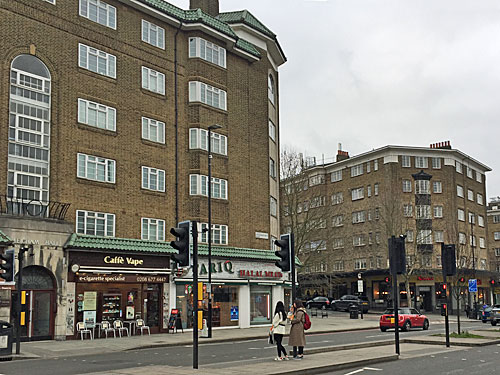
Streatham's high street lays claim to being the longest in Europe (which means we'll still be on it at Six Miles South). On this occasion we're at the top end, nearer Streatham Hill, slap bang in the immediate vicinity of Nando's. Diners at windowside tables can be clearly seen tucking into peri-peri, forking salad into their mouths or fiddling with their phones while they wait for chicken to arrive. Across the street is Tariq Halal Meats, its windows larger, its counter display brighter, its website more prominent and its meat offering more varied... mutton, lamb, goat, quails. For coffee and e-cigarettes, try Caffe Vape. For disco equipment, obviously Fizz DJ. On a Saturday afternoon businesses are ticking over nicely.
What's unusual is that the shopping parades meeting here both sit beneath enormous mansion blocks. Leigham Hall forms one end of Streatham Court, designed in classic late-30s style by Reginald Toms, hence the lovely coppery-green tiles arrayed along porches and roofs. Across the street is The High, built one year later with similarly Art-Deco-ish entrance doors tucked inbetween the shops at ground level. Look up, however, and the windows of The High are original and miserably peeling, whereas Leigham Hall's have been renewed and look like they might keep the heat in a bit better. I'm not sure if either still boasts a Billiards Room or Uniformed Porters, and rents must now be well above the original £80 per annum, but how great to live at the heart of things in a building of character.
SIX MILES SOUTH: Streatham Common
(southwest corner)
Six Miles South serendipitously lands in the bottom left-hand corner of Streatham Common, alongside the High Road, just opposite Sainsbury's. Lush slopes, intermittently fenced off with orange netting, spread uphill towards the tearoom and the distant Rookery. Down here there's simply an avenue of horse chestnuts, in full blossom, and a plane tree which may or may not be dead. Criss-crossing paths lead off across the common, carefully following desire lines so nobody feels the need to divert onto the grass. Shoppers trudge by, variously laden, followed by a glum youth in a NASA hoodie smoking a rollup. A gardener from Lambeth Landscapes edges his white van down the footpath taking care not to run anybody over.
At the bus stop a posse of homebound schoolkids in maroon blazers hurl swear words, and in one case a heavy log, at one another. A procession of hearses crawls by, kicking off with Grandad, then a floral tribute in the shape of a football, then various members of his family. The Friends of Streatham Common invite you to a Bat Walk on Friday, a Bird Box Survey on Saturday and a Kite Day on Sunday. Silvana Ices have parked up opposite the entrance to the playground hoping that someone will take their advice and 'try a twin cone today'. The clock on the tower of Immanuel and St Andrew's Church is 70 minutes slow. Dad kicks a football through the dandelions, and Small Son passes it back. 'Celebrate Streatham', says the banner hung from the streetlamp, and here you would.
SEVEN MILES SOUTH: Northborough Road, SW16
(Norbury/Pollards Hill)
Northborough Road breaks off from the main road by Norbury's Wetherspoons and dives deep into Edwardian suburbia. The estate agent on the corner appears to have the monopoly on house sales and flat rentals further up. Initially they're quite terracy, with front gardens barely large enough to hold Croydon's full complement of three bins. Then a few gabled properties intrude, then it gets quite mixed, but always stitched together with no direct rear access. The house numbers are my favourite feature, each embedded in the wall as separate digits on glazed tiles, one brick's length from the edge of the porch. The precise location we're looking for is in the high hundreds, by the stinkpipe, right on the brow of the hill.
The view to the west is remarkably lowrise, with Merton Civic Centre the sole tower along a woody skyline. Lined up to the east are the Crystal Palace TV mast, a church spire and the former Windsor House office block. A learner from the Polka Driving School ascends the road with caution, slowing for each hump, trailing a procession of vehicles behind her. The council streetsweeper smiles by, earbuds drooping, although he has yet to reach the fox-ripped bag spilling takeaway trays across the pavement. A family emerges from behind a high hedge in their Eid finest before piling into an estate and driving off to celebrate. Two recycling sacks have been left on a damp pillow at the end of Norton Gardens. A blackbird sings.
EIGHT MILES SOUTH: Mitcham Road Cemetery, CR0
(previously Croydon Cemetery)
I wondered how long it'd take this feature to hit a cemetery, and here we are, if not quite dead centre. Croydon Cemetery opened in 1897 as overspill for Queen's Road Cemetery, the other side of Thornton Heath. It's big and it's irregular, having been extended once in 1935 towards Mitcham Common and again in 1937 towards Mitcham Road. 8 Miles South is to be found within the northwestern strip, specifically in section U, just over the wall from Archbishop Lanfranc Academy. Look for the Jamaican flag, then nudge back a bit towards the central lime avenue. Other parts of the cemetery had mourners, shortcutting pedestrians, even learner drivers enjoying off-road practice, but nobody interrupted me here.
The graves hereabouts are a particularly motley assortment, mostly from 1935 but with infill from dates clustered around 1960 and 2014. Older headstones commemorate Alfreds, Louisas and Mildreds, the most recent Luigis, Franciscos and Murildas. Most graves are low-edged and weed-topped, a few sparkle with plastic blooms and it seems only Jane merits real gladioli. A deflated balloon hangs from Margaret's temporary marker. A tennis ball and an empty can of Scrumpy Jack rest in the trimmed grass. Most of the interred had a good innings, notably Major Dorothy Bristow who hit 93, but Skye barely reached 15 and Our Baby Eileen Patricia just 2½. Undoubtedly the saddest tale is that of Cicely Boswell who lost her husband in an accident in May 1939, then her 18 year-old son in an accidental drowning on Easter Day 1949, while she herself lived on until 1998. Here they all lie, the remembered and the forgotten.
NINE MILES SOUTH: Beddington Industrial Area, CR0
(junction of Marlowe Way and Beddington Farm Road)
This isn't pleasant. We're on the site of Beddington Sewage Works, since relocated to the other side of Beddington Lane to leave space for a huge wodge of industrial estate. The closest landmark is Croydon's IKEA, but that and the remainder of the Valley Park Retail and Leisure Complex is deliberately segregated from the Beddington Industrial Area resource management hub, which is very much Sutton's grubbiest quarter. I trekked in dodging trucks and vans, and a one-off pony and trap, heading for the line of pylons crossing Marlowe Way. At the end of the road is the backside of a very big Asda, and across the road a major distribution centre for another supermarket, namely Sainsbury's. Most of it is lorry park, and several of the dozen bays have Eddie Stobart containers poking out.
The Nine Mile point is occupied by the Beddington Conference Centre, reputedly "the ideal place for organising business meetings, conferences or a complete solution for events and receptions ideal for corporate clients". I hope the interior's something special because from the outside my first thought was provincial motel. A rim of barbed wire and a security guard with a barrier combine to ensure nobody gets to wander in off-spec. Also within this perimeter is the HQ of Fruitful Office, a company who deliver baskets of fruit to offices because that's a thing now. Their chief selling point is that they split the bunches of bananas and grapes in advance to stop employees taking too many, but they must be doing well because I counted 20 delivery vans outside. If your company needs a regular wellbeing perk, never ever tell your staff that their plums arrive via a former sewage works.
TEN MILES SOUTH: The Chase, South Beddington SM6
(backing onto Godalming Avenue)
Finally here's another residential one. We're in Beddington, between Wallington in Sutton and Waddon in Croydon, and administratively in the former. A hundred years ago these were open fields outside the hamlet of Bandon Hill, facing an aerodrome that would shortly become London's first airport. The march of suburbia then claimed the available space between main road and railway, forming the High View Estate, hence I find myself amid very Thirties houses along very Thirties avenues built with the lower middle class very much in mind. The Chase is the spine road, and runty Central Avenue would have provided the retail focus but has now been reduced to three shops. One's a convenience store that still does newspaper delivery, one's the HQ for a slotcutting company and the third belongs to the 'Sausage Master'. Drop in and Daniel Parker will sell you Pork, Stilton & Cranberry, Black Porkies or a full-on Venison, because that's what fourth generation butchers now do.
The local housing stock consists of what looks like several semis joined together. This makes rear access tricky, so the architects also squeezed long narrow alleyways round the back between the avenues. This is also where they stuck the garages, because motorists' needs were less important then, but driving today's vehicles in and out would be far more impractical so everyone now parks out front. Down The Chase each front garden is large enough to accommodate a family saloon, but on Godalming Avenue most bonnets poke out onto the pavement. Because I visited on Sunday morning cars were being washed, hoovered and generally worshipped. Unmodified porches still had their original stained glass house numbers. The lower branches of one conifer were heavy with bird feeders. One pink rose looked like it'll hang on into winter. A tabby cat padded past. Such is London life, ten miles from the centre.
MILES NORTH
MILES EAST
MILES SOUTH
MILES WEST