Back in 1543, King Henry VIII was getting on a bit and had become more than a bit of an obese lardarse. This made climbing onto a horse, let alone hunting the royal deer, rather difficult. What was Henry to do but construct a great big three-storey platform in the middle of Waltham Forest from which he could shoot at things. He called this building his Grand Standing, although it was probably more of a Grand SittingDown. Even the central staircase was built less steeply than usual to give Henry a fighting chance of being able to climb it. Out in the forest expert huntsmen tracked down deer, then penned them up, before letting them run loose across Chingford Plain past the monarch's steely gaze. One crossbow shot later and the deer would conveniently drop dead, whether the King had hit it or not. Damned fine shots, those covert royal archers. But not really proper hunting.
King Henry died a few years after the lodge was finished. It was Queen Elizabeth who later ordered that the decaying building be repaired, and that's how it came to be named after her instead. The lodge continued to be used for the 16th century equivalent of corporate hospitality, as a special hideaway where influential nobles wined and dined on the day's carnivorous spoils. The middle floor was the posh one, with lesser noblemen posted up top and the servants confined as far as possible to the lower floor. There were no glass windows at the time, this was very much a grandstand open to the elements, gaudily painted and draped with fluttering banners. Not a good place to stay the night, hence everyone having to lodge elsewhere after nightfall.
In the 17th century the building became a forest keeper's residence, with the local crown court installed on the upper floor. The Victorians insisted on slapping gallons of plaster all over the walls, semi-wrecking the place in the process, and then a tearoom moved in to cater for day-trippers from London arriving via the new-fangled steam railway. For most of the 20th century the building doubled up as a museum packed with stuffed animals and almost-thrilling historical artefacts. I think my uncle took me there once, back when I was quite little, although I don't remember the interior very clearly. So I thought I ought to go back.
No, that huge Tudorbethan mansion beside the golf course wasn't the hunting lodge, it was a rather large Victorian Harvester-type pub. So I tried the bijou limewashed buildingnextdoor, the one wth the Corporation of London sign outside. It's only open from 1 til 4 at weekends at this time of year (and attracts a mammoth seven visitors per hour, according to the tally chart on the desk inside). I'd like to thank the lady at the desk for her highly informative talk about the history of the house, and also for not commenting on my heavily mud-splattered trousers. It's damned squelchy out in Epping Forest at the moment, and I'd taken a rather ill-advised route through the woods from Buckhurst Hill to get here.
On into the kitchen/scullery, where there's a not quite convincing display of fake foods (such as fruits and spices) like what Elizabethan aristocracy would have eaten. And then up the stairs (ooh yes, very gentle) to the shooting room on the first floor. There are a couple of appropriately dressed mannequins in the near corner, as well as a box of clothes so that children (and childish adults) can attempt to dress themselves similarly. It's quite an empty room otherwise, and therefore not especially easy to imagine as the heart of the royal hunting party's festivities. At least the view from the window is pretty much as Henry might have remembered it (apart from the golf course where the deer would have been kept, that is, and a rather out-of-place suburban dwelling nextdoor).
And finally up to the top of the building, beneath a magnificent timbered roof. In fact if you like woodwork you'll really enjoy a visit to the Lodge, not just because it was assembled by master carpenters but also because a surprisingly high proportion of the exhibits and information panels are about joints and carving and superior timber-based craftsmanship. Up here on the second floor there are also a couple of stuffed deer left over from the building's more museum-y days - one just an antlered head peering beadily down over the stairs. And, of course, there are a few more displays about hunting. Seen enough? Spiral back down to the entrance, and don't think you're escaping without filling in one of the nice lady's photocopied questionnaires. It's a small price to pay for free admittance to this fascinating survivor from a long-gone era of violent excess. by train: Chingford by bus: 97, 179, 212, 313, 379, 444
Marsh Lane is just a temporary set-up while Olympic construction occurs. Sometime after 2012 every allotment holder will be relocating once more, this time back to sustainable new premises within the Olympic Park. For the best part of a decade, however, this uninspiring patch of Waltham Forest will have to do. And I doubt that this windswept space beneath the pylons will ever reclaim the sense of community cultivated back at ManorGarden. diamond geezer 05/01/08
That "uninspiring patch of Waltham Forest" was our wild life meadow. Now it is gone, and most likely forever. SteveE10 10/01/08
Bleak and characterless the allotments may be, but the Birse Civils contractor who had to help the plotholders move their possessions onto the site in November was really proud of their uninhabited perfection. "This shouldn't be allowed," he said as corrugated tin, old garden gates and dismantled greenhouses were unloaded, "the place looks really nice and they're going to ruin it with all this junk".
I hope Birse Civils are better at building nuclear power stations than allotments. After £1.5million and 10,000 tons of soil replaced, you'd expect an ideal growing environment ready for cultivation. But it's so waterlogged and poorly draining nothing wants to grow except moss and algae, and bulbs planted to cheer the place up are just rotting. There's no worms to break up the heavily compacted soil - and no way for them to get in due to the plastic barrier protecting the site from surrounding contamination. Charlie C 11/01/08
Another group of evictees are the Clays Lane residents who have been scattered to the four winds. They too have lost their community. The LDA actually said we were not a community, unlike the Travellers, who were moved as a community... Residents are considerably worse off in financial terms and some are worse off in terms of the quality and size of their new accommodation...
In evidence to the Compulsory Purchase Inquiry the LDA also claimed we were 'isolated' by our neighbouring green space, the Eastway Cycle Track, which was a sign of how desperate they were to rubbish everything to do with our estate and community to justify its demolition. Clays Lane is to be the site of the Athletes' Village and the LDA claimed this would create 9000 new homes. This has now been altered to 4,500. Either way much of the Village will be built at Stratford City and is not new housing but housing which would have been built anyway and modified. The LDA/ODA still claim it as an Olympic benefit...
But then who can be surprised by this? Our former MP, Lyn Brown, goes around telling her local party she was visiting the estate when she never came near us, the Mayor of Newham apparently said we were 'peasants' even though he also said he would come but never did. Livingstone and Higgins of the ODA failed to respond to invitations while Coe said he would come but never followed up. The media couldn't get past our human interest value so it was impossible to discuss anything of substance. That's politics! julian cheyne 09/01/08 [more here]
The announcements are everywhere. Please, TfL urge. Please keep away from two of the busiest stations on the network. Please don't change at Bank/Monument. Please don't change trains here. Even though there's a huge great big intersection marked between Bank and Monument on every single London Underground map. Please go almost anywhere else and change there instead. Please stay away, and then we can repair our escalators in peace.
TfL have all sorts of travel advice for passengers whose journeys normally take them through B/M, some of which would take you miles and miles out of your way. Want to change to the DLR? Nah, please go to Stratford or Bow or Tower Hill instead. Want to change between the Central and Northern lines? Nah, Charing Cross is a much preferred option. Please plan ahead, TfL hope, and please plan to go very much elsewhere.
But is this nannyish redirection advice really necessary? Well, yes and no. The series of tunnels between Bank and Monument is a badly laid-out warren of narrow walkways and awkward level changes, constrained by local roads and awkwardly-placed bank vaults. Block off just one tunnel and the repercussions elsewhere can be serious. In this case there are two escalators out of action, both downward, both between the Central line and DLR platforms. Scurrying passengers are having to descend a very narrow stairway instead, which is proving fairly nightmarish in any kind of busy conditions. Let me show you on this map. The two out-of-commission escalators are between 5 and 6 and 8. [the full key to the map is back here]
It seems that TfL are once again writing their travel advice for a lowest common denominator audience. (See also "Don't use Covent Garden, get out a station early and walk") There is absolutely no reason to avoid the Bank/Monument interchange for the next couple of months, not point blank, not in its entirety. Changing between the Central and Waterloo & City lines isn't affected at all. Changing between the DLR and Northern lines is still a doddle, up/down a set of back stairs. Most other changes are perfectly OK too, as you can see from the map, because they go (or can go) nowhere near the offending escalators. During less busy periods, outside peak hours, even the narrow staircases are perfectly passable. At three o'clock on a Thursday afternoon, for example, or at any time over the weekend, there's absolutely no need to avoid 5 to 6 to 8 at all. Piece of cake.
And yet TfL still insist on warning everybody away, all the time, because giving more accurate advice might be confusing for stupid people. Stupid people can only cope with simple instructions, like "Stay away", rather than the more realistic "Avoid changing at Bank/Monument during peak hours if you're intending to get to or from the DLR platforms via the Bank side, and watch out because the Northern line platforms could get rather busy. Until March." Or even "If changing between Bank and Monument, why not exit the station and walk down the street instead." Actually, that's quite good advice even when the escalators are working. In the meantime, don't let an over-simplistic warning massage scare you away. Not all the time, anyway.
London's largest bird reserve is the London Wetland Centre, a vast swathe of marshy sogginess located in a bend in the Thames near Hammersmith. It's busy and it's delightful, but it'll cost you eight quid to get in. London's second largest bird reserve is rather different. It's hidden off the Lea Bridge road near Leyton, it's considerably more deserted, and entrance is free. It's the Waterworks Nature Reserve, and I can't believe I've only just noticed it exists.
Back in the late 19th century Victorian engineers built several filter beds in the Lea Valley to purify the capital's drinking water, helping to keep cholera at bay. A century later technology had moved on somewhat, and the beds were abandoned to natural colonisation. They're currently owned by the Lee Valley Regional Park Authority, who six years ago opened a series of bird hides and a visitors centre. Most of the visitors seem to be of the feathered variety, swooping in to swim and flap and feed in the reedy pools. But the occasional human turns up, as I discovered last weekend when I had the place completely and utterly to myself.
I stumbled across the nature reserve by following a footbridge across the road and railway from the allotments I mentioned yesterday. A short walk through an unexpected golf course and there was the visitors centre (and club house), with a car park full of pitchers, putters and drivers. I wandered inside, to general disinterest from the management, and took a look round the interactive exhibits in the large gallery to the rear. I think I was 30 years too old to enjoy the limited information on display, and slightly put off by the mildly hectoring tone throughout. "Children must be accompanied by an adult at all times in this area." "This screen is for adults only." "Why not have a go at weaving a willow basket. Take care not to hurt anyone with the sharp ends". Ignoring the cafe (and golfy shop) I headed back outside to explore the nature reserve proper.
Access is only via a single narrow footbridge, first passing a newly constructed nature garden. There's a small pond ("Danger, deep water!") and a benched seating area("Keep off the chalk ridge!") and a specially-constructed mini willow tunnel. There's a lot of willow about, and the next three filter beds have been almost completely colonised by it. I think you're supposed to be able to walk through one of them on a raised wooden walkway, but that was sealed off with red tape (presumably because of some unseen hazard or perilous risk). Never mind, the best part of the reserve was just round the corner, past a mini-aqueduct. This way to the hides.
The main area of filter beds is square in shape, divided up into six different radial sectors (a bit like Trivial Pursuit counters). Each has been given over to a slightly different habitat (open water, reedbeds, grassland, willow marsh, etc), providing ideal conditions for a wide variety of bird, insect and plantlife. And each of the six can be viewed from behind a giant wooden screen, which runs the full radius of the site and completely round the central wellhead area. There are hatches to lift at regularly-spaced intervals, allowing visitors to peer out across each bed and observe the waterfowl's comings and goings. I moved from window to window, watched over by a single security camera, and wholly unobstructed by twitchers with huge binoculars, vacuum flasks and lunchboxes. Alas there was just a single heron flapping around, occasionally, plus a few ducks and moorhens who'd chosen not to migrate this winter. My ornithological timing could have been better, which perhaps explained why I appeared to be the only large mammal in attendance. But there was still plenty to see, both environmentally and historically, at this most underappreciated location. by bus: 48, 55, 56
Friday, January 04, 2008
Olympic update Relocation, relocation, relocation
It's now been six months since the Olympic Park was sealed off, and everybody who lived and worked there was turfed out. The outcasts had to go somewhere, of course, and quite a lot of them have ended up one mile further upriver near Leyton. The new sites are tucked in beside a bleak arterial road, in the shadow of a couple of giant gasholders, nowhere with any character whatsoever. Few pedestrians ever walk down Orient Way, but plenty of traffic thunders by (most of it setting off the wholly unnecessary 30mph speed warning sign). A few lonely horses graze in a muddy field nearby, and there's also a great big £400m Eurostarmaintenance depot whacked down in the general nothingness. But I'm sure most of the relocated businesses don't mind swapping old tumbledown warehouses for shiny modern hangars. These giant tiger-striped metal boxes are a million miles away from their former premises, and all paid for out of your taxes too.
And some other Olympic evictees have ended up here too. You may remember the huge fuss kicked up by users of the Manor Garden allotments when it became clear that the Olympic Park would not contain a special area given over to runner beans. A shame really, because those 100-year-old allotments are merely destined to end up beneath a vast temporary footpath - no ultimate sporting destiny awaits. The allotment holders had to be pacified with the promise of new plots elsewhere, which didn't really keep them happy at all, but they got new plots all the same. The replacement allotments are also along Orient Way, in the corner of a well-hidden recreation ground, but accessible only up a far-distant muddy track. It's taken a lengthy planning battle to get the new allotments established, but here they are laid out for the start of the new growing season.
They're, erm, not quite as characterful as the old allotments, are they? The old allotments had charm, and personality, and vegetation. The new allotments are formed from a rectangle of freshly ploughed earth with a concrete path down the middle, divided up into equal-sized patches of empty mud. A tall green metal fence surrounds the perimeter, with tiny saplings planted all around to provide eventual privacy. Standing guard on each plot are identikit green huts, regularly spaced, each waiting for their new owner to arrive and provide a bit of individuality. A few plots show the very first signs of cultivation - a trowel, a chair, a waterbutt - but it'll be a long time before these feel like proper allotments.
Maybe that's OK, because Marsh Lane is just a temporary set-up while Olympic construction occurs. Sometime after 2012 every allotment holder will be relocating once more, this time back to sustainable new premises within the Olympic Park. For the best part of a decade, however, this uninspiring patch of Waltham Forest will have to do. And I doubt that this windswept space beneath the pylons will ever reclaim the sense of community cultivated back at Manor Garden.
Tuesday, January 01, 2008
Unhappy New Year
You may, one New Year, be tempted to come to London to see the midnight fireworks. Don't bother. However much Mayor Ken may trumpet the excellence of the spectacle, however much Visit London may plead with you to attend, don't waste your time. Stay at home, party with friends and watch it all on the telly instead. Because that was the biggest pile of pants I've ever not seen.
Q. What time should I arrive for the fireworks? Experience in previous years suggests that you be at your chosen vantage point by 23:00, to avoid any last-minute rush. Note that Westminster tube station will close at 21:00, so don't leave it until the last minute, as you may be disappointed. Other nearby stations may close temporarily if they become overcrowded.
If I can get to Temple station by 22:30, I thought, that should work nicely. But no. I was forced to abandon my train at Blackfriars, along with a platform-full of drunken revellers, because the three subsequent stations were closed due to overcrowding. It took ages to escape from the platform, and then I had to negotiate the madding crowds on the Embankment. This was not easy, not least because several idiots had chosen to bring pushchairs to the event and were trying to shove their sleeping offspring through the barely penetrable throng. Never mind, it wasn't quite 11pm and I was closing fast on Waterloo Bridge.
As I watched, a temporary metal gate beneath the bridge suddenly clanged shut, blocking access to the remainder of the Embankment. The good half of the Embankment, immediately opposite the Eye, was now inaccessible. "Sorry, we're not letting anybody through any more," growled a security guard. "Not until the event is over. But there's still a decent view of the fireworks back the way you've just come. Anywhere between here and Blackfriars should do." So I turned round and headed back through a mob of people still pushing forwards, unaware that the road ahead had been closed off. There were no re-direction signs, no public announcements, no clues that they were completely wasting their time. It was like watching lab rats scurrying blindly towards an experimental dead end.
I took up position just along from Temple station, close to the river's edge. I knew that this would be a good place to watch the fireworks because the London Eye was clearly visible, and the spot was marked as an official viewing area on my official map in my official leaflet. Great, there was now 'only' an hour to wait. It turned out to be quite a wet hour, and I was worried that my view might be obscured by umbrellas wielded by wimpy boys with gelled hair. Thankfully the deluge stopped with minutes to spare. I was also stuck directly behind several 6-foot-plus blokes, one of whom had the temerity to wear a woolly hat with a floppy bit on top (a bit like the teat on the tip of a condom) which blocked my view even further. Still, at least I had a better view than the ten rows of people behind me, including the Polish youth jamming his rucksack into my side as he attempted to steady his video camera in readiness for the imminent extravaganza. Eagerly the crowd counted down the final 60 seconds of 2007.
Bong! Boom! The first fireworks of 2008 exploded from the rim of the London Eye. Oooh! Aaah! Hmmm!?! Where had the fireworks gone? A cloud of billowing black smoke had rapidly obscured our view, so utterly and so completely that only the sound of distant explosions told us that the display was still continuing. It was a bit like being in London during the Blitz - all smoke and bangs and blackout. The impenetrable darkness continued, minute after agonising minute, with only the occasional high-flying rocket trail visible above the glowing cloud. The crowd and I stood unmoved in muted disappointment. Even the Polish guy stopped filming after the first five minutes. Were we really going to see absolutely nothing at all? All that hassle to get here, all that standing around, and all for eleven minutes of invisibility. The organisers had forgotten to mention one very important additional key fact - never stand downwind of a firework display.
Bollocks. The hundred thousand of us standing on Waterloo Bridge or on the eastern half of the Embankment had a good view of the London Eye yet saw virtually no fireworks whatsoever. We'd been herded by officialdom into a viewing space which turned out to be worse than useless. Our journey to central London had been a complete waste of time, money and energy. We saw nothing. And to top off a miserable night we still had to face the nightmare journey home, creeping slowly along packed streets trying in vain to find a sideroad up which the police might eventually allow us to escape. No fun. No fun at all.
Best Fireworks In London The event, organised by the Mayor of London and Visit London, promises to be one of the best fireworks displays in Europe.
I think not. Not from where we were standing anyway. I only discovered what I'd missed when I got home and watched the whole smoky event on video (and, even then, I've seen better). So please, don't bother coming to London to see the 2009 fireworks next year. Celebrate well away from the centre of the capital, and spend your money somewhere more welcoming instead. And then, just maybe, there'll be room for me to squeeze into the proper viewing area in your place...
Thursday, December 27, 2007
London Journeys: To the centre of Hampton Court Maze
Hampton Court Maze has been baffling visitors for more than three centuries. It was laid out in the palace gardens in 1690, one of four mazes planted for the enjoyment of King William III and his court. The original hornbeam hedges have long since been replanted in yew, but the same half mile of paths survive to this day. The key to the maze's longevity is its forward-looking design. This is no simple one-track medieval labyrinth. This is a proper puzzle with seductive junctions, frustrating loops and deceptive dead ends. Fancy testing yourself?[1]
[1] "The aim of the Hampton Court Maze", reads the information board outside the entrance, "is to get to the centre." Just in case you though otherwise. Cough up £3.50 (or wave your Palace entrance ticket) and venture inside. It's not a difficult start. The dead end immediately to your right has been blocked off to form a storage area and an exit passage, so veer left and trek around the western perimeter. It's easy to be over-confident at this point, striding ahead as yet unchallenged. But the first junction - a narrow gap carved through the hedge - introduces initial indecision. Take your pick. Through the gap and left? [2] Through the gap and right? [3] Or continue along the original path? [3]
[2] This looks promising. A long twisty-turny-path between high green walls, with what looks like a hidden right turn at the end. Damn, no, it's a dead end. OK, time to save face. Turn round slowly and head back, grinning innocently at the steady stream of equally misguided tourists shuffling to a similar fate. Should any of them ask whether this is a dead end or not, just smile and lie. Then pray you don't meet them again further along in your travels. Try that first junction again. Straight ahead? [3] Or through the gap and straight ahead? [3]
[3] That's right, it doesn't matter which of these two paths you take, you still end up at the same second junction. This is one of those cunningly-designed loops where you could keep walking round and round in circles for ever. But don't. It's just a short distance ahead to the next fork in the path. Hmm, isn't it foolproof to keep your hand on the left-hand hedge? [4] Or maybe it's the right-hand hedge? [5]
[4] On into the heart of the maze, bend after bend after bend. But rounding the fifth and final corner reveals - damn - an impenetrable green barrier. You've been unlucky here. Contrary to what you might expect there are only three dead ends inside Hampton Court Maze, and you've just wandered down the longest of them. If it's any consolation, King William III probably made exactly the same mistake. Retrace your steps to the previous junction and take the other path [5]
[5] This long path skirts around the central clearing, where jubilant finishers can be glimpsed oh-so tantalisingly close on the other side of the hedge. But no premature short-cut through the foliage is possible - the maze's iron-railing skeleton makes certain of that. Although you can pass through the hedge at the next junction, where 20th century gardeners have cut an elegant archway to link two of the original pathways. Are you tempted through? [left 6, right 8] Or will you ignore the arch and carry on round the bend? [6]
[6] Two of the paths from the arch follow opposite ends of a single hedge, recombining at another junction on the maze's perimeter. A motion sensor is hidden here, one of several installed a couple of years ago as part of a permanent "sound installation". Your passing might trigger genteel laughter, or some softly spoken quotation, or the clang of tiny cymbals - a randomly-generated sound at every location. Rest assured that the overall effect is enchanting rather than intrusive. And that any swearing you might hear is real-life frustration, not art. Head north, away from the arch [7] Or go back [5]
[7] When Harris took a stroll around Hampton Court Maze in Three Men in a Boat, it was probably within this eastern section that he and the baying crowd got horribly lost. There's one pathway in particular where, no matter which wall you try to follow, the maze will always bring you back to the same spot. Bring along a penny bun and drop it in the right spot, and this truth is easily proved. But Jerome K Jerome was undoubtedly exaggerating the maze's difficulty for comic effect - eternal entrapment is an entirely improbable outcome. Back west? [6] Down south? [8] Or away to the east? [9]
[8] If you've brought a toddler with you, they're probably gurgling merrily by now. You'd better run after them before they totter headlong down the next leafy canyon and disappear round yet another corner. Back west? [6] Up north? [7] Or away to the east? [9]
[9] At this point your sense of direction will be screaming that you must, surely, be going the wrong way. The centre of the maze is far behind you, and you really ought to be heading back. So when a new path appears leading even further away from the centre, you'd be forgiven for ignoring it, wouldn't you? Take it [10] Ignore it [7] or [8]
[10] A single decision stands between you and salvation. One of the two paths ahead looks like the correct route but is in fact a dead end. And the other looks like a dead end but is in fact the correct route. You know which way to go [11]
[11] Look, the mazekeepers really do have a big green stepladder, over there on the other side of the hedge. Presumably they clamber up and bark directions during periods of labyrinthine crisis, such as when a school party is in danger of missing their coach home. But no assistance is needed from this point on. A small green sign is now visible ahead, blatantly announcing that the "centre" is just around the corner. They've had to erect it here in case disoriented punters stop at the gate labelled "fast exit" immediately beforehand, and pass out through the turnstile without ever reaching their goal. It would be a crying shame to miss out. On to the centre! [12]
[12] Is this the central courtyard, or is this a concrete patio knocked together by some Channel 4 lifestyle programme? Bland wooden trelliswork holds back a ring of replanted hornbeam. To left and right, where two tall trees once cast a welcome shadow, sit clumps of squat stools awaiting weary backsides. And, in the very centre of the centre, an upturned conic pedestal bears the legend "We found the Maze Centre at Hampton Court Palace 2007" (with the final "7" daubed on in thick temporary paint). You might want to ask those two foreign students over there to take your photograph, before they ask you. Smile - you’ve just solved a classic 17th century puzzle. Bet you want to go back and solve it again [1]
Originally butchered by over-zealous sub-editors in Time Out Magazine London [12 September 2007]
Tuesday, December 25, 2007
Monday, December 24, 2007
A Christmas Tale of Two Cities
1 Now when Christmas was nigh in Mayfair of Westminster in the days of Nigella the Great, behold, there came fur-coated ladies from the shires to OldBond Street, 2 saying, Where are they who are selling Bling and the shoes? for we have seen their adverts in the glossies, and have driven our 4×4s to worship him.
3 When Ken the Mayor had heard these things, he was troubled, and all London with him. 4 And when he had gathered all the chief policemen and councillors of the people together, he demanded of them where this shopping madness should be borne. 5 And they said unto him, In Mayfair of Westminster: for thus it is written by the Evening Standard, 6 And thou Mayfair, in the land of Congestion Charge, art not the least among the wealth of aristocracy: for out of thee shall come luxury purchases, that shall tempt my people decadently.
7 Then Prince Boris, when he had privily called the fur-coated ladies, inquired of them diligently what time the pre-Christmas sales appeared. 8 And he sent them to Mayfair, and said, Go and search diligently for the shiniest jewellery and designer-iest handbags; and when ye have found them, bring me word again, that I may come and spend my fortune also.
9 When they had heard the floppy-fringed one, they departed; and, lo, the deluxe brand awareness, which they saw in the West End, went before them, till it came and stood over where the exclusive retail destination was. 10 When they saw the shops, they rejoiced with exceeding great joy. 11 And when they were come into the boutiques, they saw the fabulous riches with Dolce and Gabbana, and fell down, and worshipped them: and when they had purchased their treasures, they presented unto themselves gifts; gold, and fine fragrance, and accessories.
12 And being warned by Boris in a dream that they should not return to Ken, they hailed a taxi and departed into their own country another way.
1 And there were in the same country East Enders abiding in the estates, keeping watch over their budgets by night. 2 And, lo, the economic decline of the country came upon them, and the taxation of the Chancellor shone round about them; and they were sore afraid.
3 And the market inspector said unto them, Fear not: for, behold, I bring you good tidings of great joy, which shall be to all immigrants and indigenous Cockneys. 4 For unto you is sold this day in the market of ChrispStreet a Special Offer, which is Three For Two. 5 And this shall be a sign unto you; Ye shall find the bargains wrapped in a blue plastic bag, lying on a trestle table.
6 And suddenly there was with the inspector a multitude of the heavenly stallholders trading goods, and saying, 7 Glorious plastic toys are the cheapest, and on racks t-shirts, fake trainers toward men.
8 And it came to pass, as the stallholders were gone away from them into Fred's Cafe, the residents said one to another, Let us now go even unto the pawnbrokers, and sell our things which have come to pass, to pay for that which the Christmas adverts hath made known unto us. 9 And they came home with haste, and found three Uncles and Grandma, and the kids lying on a sofa. 10 And after they had seen Christmas, they made savings which were required of them concerning the New Year.
11 And all they that heard it wondered at these things.
Sunday, December 23, 2007
No longer true... • There are 12 London Underground lines. No longer true. There are now 11, and will be for the foreseeable future. When the East London line reopens in 2010 it'll be part of the London Overground, not the Underground network. • The Underground has 274 stations. No longer true. There are now 268. Today we've lost Wapping, Rotherhithe and Surrey Quays, which now exist only as replacement bus service stops. We've lost New Cross and New Cross Gate, which now exist only as National Rail stations. And we've lost Shadwell, which is now only on the DLR (which isn't a London Underground line, as any fule know). • The Underground runs over 253 miles (408km) of line. No longer true. Now it's 248 miles (400km)... plus four particularly useless replacement bus services. • The East London Line is the only line without a station in Zone 1. No longer true. All the remaining lines do. • Five London boroughs are not served by the London Underground. No longer true. Today Lewisham joins that list to make six, along with Bexley, Bromley, Croydon, Sutton and Kingston. • The Jubilee line is the only Underground route that connects with all others. No longer true. (I wonder how long it'll take the O2 website to change this one. Ages probably, given the number of other howlers on the same page). Let's work this one out. Any line which connects with all others must connect with the Waterloo & City line. So we're only interested in lines that pass through either Waterloo or Bank. Through Waterloo we have the Jubilee, Northern and Bakerloo (all of which link up). And through Bank we have the Central (which also links) plus maybe the Circle (if we're allowed to treat Bank/Monument as one station, which TfL increasingly do). But we can't have the District, because that just misses the Metropolitan by a few metres (at Aldgate). So the newly-updated statement should be "The Jubilee, Northern, Bakerloo, Central and Circle lines are the only Underground routes that connect with all others." Which just isn't interesting any more, sorry. • The Thames Tunnel is the oldest section of tunnel in the London Underground. No longer true. Now the oldest is along the original Metropolitan railway tunnel between Paddington and Farringdon, opened 1863. Probably. Unless you know better. • Wapping is the only station which has no letters in common with the word 'lobster'. No longer true. Now every Underground station shares at least one letter with the word 'lobster'. Is nothing sacred?
The East London line, now departing If you ever seek to meet London's entire population of trainspotters, take a ride on the final service to an about-to-be-disused tube station. And if the last train runs well after midnight don't worry, because you'll easily spot them earlier in the day too. They're the blokes wielding big-lensed cameras on the platforms, and the blokes sitting by themselves in each carriage with a sad but contented smile on their face, and the blokes who stay aboard the train at the end of the line so that they can travel straight back again. And so it was yesterday on the East London line. It's not every day an entire line closes, even if it is only for 30 months, so any excuse to spend a Saturday well away from the wife and the Christmas shopping. Even if the last day is actually the very worst day to try to take photos, because every shot ends up full of other blokes trying to take photos.
All the stations on the East London line were busy, noticeably busier than usual. TfL appeared to have rostered an additional member of staff on every platform keeping an eye on the all the additional enthusiasts lest they accidentally misbehave. You know the sort of thing - using flash photography, or trying to walk into off-limits bits of the station, or leaning out in front of passing trains in search of the perfect photo. I'm not sure what grim fate faces these members of staff today now that their stations are closed until 2010. Pointing passengers towards replacement bus services, maybe, or perhaps redeployed in less important posts at other stations elsewhere. Amputating a limb from the Underground network has a human cost as well as a financial price.
I do wonder what the line's usual passengers made of it all. They expect to be sharing their carriage with the odd well wicked hoodied bro, not a crowd of excitable photographers. They expect to have plenty of room to stand on the platform, not having to walk round a phalanx of eager snappers. And they expect to be able to walk up the stairs at Rotherhithe unhindered, whereas yesterday afternoon I wandered straight into a bunch of paid-up enthusiasts on the Brunel Museum's Tunnel Tour. Thanks for turning on the floodlights in the tunnels, guys, I got a much better photograph as a result. Erm, yes, I admit, I was there taking a few photographs myself. Sorry if I got in the way of your shot.
Saturday, December 22, 2007
The East London line: a farewell
Today is the very last day of service on the East London line. Tonight, after the last train to New Cross Gate (probably about quarter past one), the entire line faces prolonged shutdown. Come back in June 2010 and the tracks and stations will have been re-engineered and reborn as part of the London Overground network. But come back tomorrow and you'll have to ride the replacement bus service instead. It's not an exciting prospect.
As you'll remember from my in-depth feature 18 months ago, the East London line is a historic little railway. It includes Sir Marc Brunel's pioneering Thames Tunnel, the very first tunnel to be bored beneath a navigable river, as well as some wonderfully atmospheric subterranean Victorian brick stations. And it's also a very modern railway. The entire line was shut down for three years as recently as 1995, enabling the tracks and tunnel to be restored and a brand-spanking new station to be built at Canada Water. As you'll remember. Look, I'm not going to go into all the history again. It's over here if you're interested, in 6000 words and 70 pictures. Think of it as a pen portrait of an endangered species, facing extinction tonight.
But for this week at least, it's been business as usual on the East London line. At Whitechapel folk still descend the steps from the District line platforms to catch a little four-coach train south. At Shadwell they still ride the lift down to almost-platform level rather than taking the stairs. At Wapping they still stand somewhat precariously on what must be the narrowestplatform on the entire tube network, watching down the tunnel beneath the Thames for the headlamps of an approaching train. At Rotherhithe they still listen to the ominous dripping of pumped-out water rushing somewhere above their heads. At Canada Water they still swarm down the escalators to ride the much more popular Jubilee line into town. At Surrey Quays they still wait beneath the orange-topped columns and ornate iron work clutching bags from the nearby shopping centre. And at bifurcated New Cross and New Cross Gate they still wait patiently for an all-too-rare train to arrive, and pause, and eventually depart. Nothing ever happens quickly here, nor on a grand scale, and that's part of the line's subterranean charm.
The East London line's not the busiest on the tube network. If you ever want to get a seat during the rush hour, head here. A mere 34000 souls use its services daily (compared to half a million on the Piccadilly and two-thirds of a million on the Northern), perhaps because it doesn't really go anywhere useful. But for local residents and cross-river commuters it's an extremely convenient lifeline, and one they're going to have to learn to live without. Let's hope that the shiny new East London Railway which finally emerges in 2½ years time will be worth the wait.
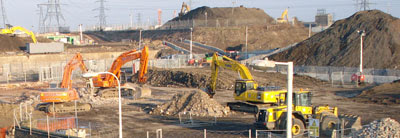
Well that didn't take long. It's still less than six months since the 2012Olympic Park was sealed off, but the wholesale demolition of the site has been extremely rapid. Back in July there were warehouses and factories where the running track will be laid, but they've all been knocked down. Back in July there was a river where the grandstand will be erected, but that's been piped underground. Back in July there were trees where the hotdogs will be sold, but they've all been cut down. Back in July the view from the Greenway bridge was green, but now it's brown. Not one single building now remains on the stadium site, bar a couple of electricity substations just to the south. All that's left are the original roads, a row of lampposts, some walls and fences, and an awful lot of piles of earth.
There are now enough piles of earth in the Lower Lea Valley to make me think that London ought to have applied for the Winter Olympics instead. All it would take is a major snowfall and, hey presto, we'd have ourselves a ready-built range of mountainous downhill sporting facilities. But no, by next summer this entire area needs to be flat as a pancake, ready for the construction of the Olympic Stadium to begin. All the piles of earth and rubble have to be moved out, or at least moved to a different part of the site to be recycled as landfill. This is a sustainable Olympics, remember, so little of the rock-y brick-y debris will be wasted.
No time is being wasted in clearing the land. On Sunday morning the Olympic Park was crawling with big yellow lorries, each carrying yet another truckload of former-factory away from the site. A steady stream of lorries, approximately as frequent as buses along Regent Street, rumbled up and down Marshgate Lane. Each branched off down some different sideroad, through the wreckage of some demolished building, or away across some newly constructed temporary bridge. Diggers swarmed over every distant hillock, like giant orange ants on a compost heap, busy removing every trace of the area's former existence. It won't be long before their endless scavenging leaves the land barren, level and ready for renewal. The only constant in my monthly series of bridge-top photos is irreversible change. Hmm, do you think that curvy embankment down there could be the very first signs of the stadium perimeter?
Sunday, December 16, 2007
First sight of the new January 2008 tube map, at Langdon Park DLR station, has made me shudder. From a simple and elegant 1930s design, the tube map appears to have evolved fairly recently into a rampant visual monster, jam-packed with unnecessary information. The emphasis has shifted very much from lines to stations, with every square inch of the map increasingly crammed with "local" detail. It's about close-up complexity, rather than zoomed-out ease of use. It's a mess. And it can only get worse.
Here are a few photo snapshots of some of the latest abominations on the new map...
Here's the reason the updated January tube map is needed. The East London Line closes next weekend, and will eventually reopen as part of the new London Overground. There'll be no more tubing from Whitechapel to New Cross, just four replacement bus services for the next 2½ years. Two of those bus services meet here, at Canada Water. Previously this was a very simple-looking single-blob interchange, but not any more. Now it appears as a triple-blobbed mega-interchange, as does Whitechapel on the opposite side of the river. This over-complex rearrangement ensures that nobody thinks they can travel from Rotherhithe to Surrey Quays on one bus, because that would be a terrible mistake to make. Incidentally the replacement bus service will be wheelchair accessible, but the wheelchair symbol is only used to show step-free access to a platform. Brilliant, eh?
Here's the first appearance of the new stations being built on the East London Line extension. It's good news for residents of central Hackney, but perhaps not for tube map users. These stations don't open until summer 2010, but they'll still be clogging up the map and confusing tourists for the next 30 months. Even more uselessly, the "under construction" connection from Dalston Junction to Canonbury is also shown, and that won't be opening until 2011. Meanwhile the southern section of the extended ELL (from New Cross Gate to West Croydon) also appears on the new map. It's already open, but still being run by Southern trains so Oyster pay-as-you-go isn't yet valid. As a lot of very small orange print tells you.
Here's a ghastly redesign of one major interchange, attempting (but failing) to better represent reality. As anyone who's ever changed trains in Docklands will know, there are two Canary Wharf stations, a five minute slog apart. The new map makes this a lot more explicit, replacing a single interchange blob with this triangular mess. Linkage is now via the walking distances between Canary Wharf Jubilee line station and its two DLR neighbours. If your eyesight is good enough you may be able to spot that Heron Quays DLR is 50m nearer than Canary Wharf DLR. If the map designer had been good enough he/she might have spotted that the DLR stations are to the west of the Jubilee line, not to the east. And above it, not below it. Come on TfL, if you're attempting to better depict reality, at least do it consistently.
Here's an even grimmer interchange revamp. There are three stations at West Hampstead, all along the same busy road - one on the Jubilee line, one on the London Overground and one served by First Capital Connect. As this graphic attempts to make clear, it's a 100m walk from the Jubilee to the Overground. The third station, West Hampstead Thameslink, is apparently 200m away - but from which of the other two? Real life evidence suggests it's 200m from the Jubilee, but you can't tell this from the map. Would a single blob really be so bad?
Here's the northwest corner of the new map. The big difference here is the appearance of ticket zones 7, 8 and 9 (replacing A, B, C and D). This isn't too messy - it actually makes more sense that the previous zoning. Except in nearby Watford. Watford Metropolitan line station is in Zone 7, but nearby Watford High Street station is in Zone 8 and even nearer Watford Junction isn't in a zone at all, not even zone 9. Oh, and doesn't Chalfont and Latimer station look complicated? The perfect example of how the designers think they've added clarity, but have actually taken it away.
And finally, here's the new map layout for "Heathrow Airport". There are three stations named after terminals, one of which doesn't open until Easter. I hope you can understand how the loopy one-way system works. Travellers can't get directly from Terminal 4 to Terminal 5, nor directly from Terminals 1, 2, 3 or 5 to Terminal 4. I'm sure that tourists just arrived by plane will find this crystal clear to understand and to follow. Oh, and see that big red dagger next to Terminal 4? There are more than 30 of these littered across the tube map, and they all refer to additional text in the station index beneath. In this case TfL want to warn you that Terminal 4 station closes at quarter to midnight (whereas most stations close nearer half past). Somebody presumably cares. One day, maybe, all this "crucial" red dagger information will be plastered across the map itself. Like I said, the way tube map design is going, information pollution can only escalate.
Friday, December 14, 2007
Olympic update High Street 2012
The road east from Aldgate to Stratford has a long and mighty history. It's been the main road to Essex from London for the best part of a millennium - the route taken by armies and revolting peasants and stagecoaches and trams. It's part of one of the UK's great trunk roads, the A11, home to traffic jams and exhaust fumes and bendy buses. And in five years time, for a few short hours, it'll be part of the route of the Olympic Marathon. Hundreds of the world's fastest long-distance athletes will be puffing past my front door, just one mile from glory in a billion pound stadium. But Tower Hamlets wants the Olympic legacy to last a bit longer than a couple of brief afternoons. They've had a transformational idea. And that idea is called "High Street 2012". Anybody interested in bringing their vision to life?
An invitation to tender has just been issued, attempting to recruit a team who can enable the delivery of transformational change along three and a half miles of East End street. Someone, surely, can breathe new life into the Whitechapel Road, Mile End Road, Bow Road and Stratford High Street. Someone, surely, can suggest improvements which will enhance the area's ambience for both visitors and residents alike. And hopefully something a bit more exciting than tying multi-coloured balloons to all the lampposts.
The original plan was to name this scheme "Olympic Boulevard", but presumably that was too difficult for local people to spell (and a bit too French), so "High Street 2012" it is. The chosen scheme could be a really exciting blueprint that brightens up my local linear neighbourhood and acts as a catalyst for future regeneration. I could be stepping out of my front door into a thriving cosmopolitan community buzzing with excited tourists and re-energised East End citizens. There might be landscaped public spaces, dynamic transport projects and fully-restored historic buildings. How exciting. But it'll be crucial to assemble the best possible planning team, or else the end result might be nothing more than a few replaced roadsigns and the 2012 Olympic logo painted repeatedly onto the pavement.
The successful planning team will have between 150 and 200 thousand pounds to play with, and six months to deliver a coherent vision strategy for the High Street 2012 project. There's nothing in the tender application which says that ordinary citizens can't apply, so long as they have economic, technical and financial capability. So I wondered if any of you lot were interested in joining me to form a multi-disciplinary consortium to take on the big guys and bid for the big prize. Any architects out there, or urban planners, or bureaucrats who like writing mind-numbing technical documents in project management-speak, please make yourselves known. We've got until noon on 11th January to put together the pre-qualification questionnaire, and then the council will let us know by 21st January whether or not "DG Regeneration Inc" will be invited to participate in the tendering process. Wouldn't it be exciting to be asked to formulate an overarching design vision to shape the foundations of legacy-based renewal in a challenging inner-urban environment? Because I'd love to live somewhere great, and not a street full of plastic palm trees and Starbucks.
London's ten busiest tube stations (2006) 1) Victoria (73m)2) Waterloo (72.9m)3) Oxford Circus (68.4m)4) Liverpool Street (57.9m)5) Kings Cross St Pancras (52.5m)6) London Bridge (51m)7) Paddington (38.7m)8) Canary Wharf (38.5m)9) Bank/Monument (38.2m)10) Piccadilly Circus (37.6m)
London's ten busiest tube stations that aren't also National Rail stations (2006) 1) Oxford Circus (68.4m)2) Canary Wharf (38.5m)3) Bank/Monument (38.2m)4) Piccadilly Circus (37.6m)5) Tottenham Court Road (32.8m)6) Bond Street (32.7m)7) Leicester Square (32.6m)8) Green Park (28m)9) Hammersmith (District & Piccadilly) (27.7m)10) Holborn (27.5m)
London's ten busiest tube stations outside Zone 1 (2006) 1) Canary Wharf (38.5m)2) Hammersmith (District & Piccadilly) (27.7m)3) Finsbury Park (26.3m)4) Stratford (22.4m)5) Brixton (19.7m)6) Camden Town (18m)7) Ealing Broadway (14.9m)8) Wimbledon (13.6m)9) Highbury & Islington (13.3m)10) Tooting Broadway (12.2m)
London's ten least busy tube stations (2006) 1) Roding Valley (179000)2) Chigwell (258000)3) Grange Hill (287000)4) Chesham (404000)5) Fairlop (526000)6) Theydon Bois (562000)7) Barkingside (620000)8) Croxley (656000)9) Ruislip Gardens (672000)10) Moor Park (694000)
London's ten least busy tube stations that aren't on the Central line (2006) 1) Chesham (404000)2) Croxley (656000)3) Moor Park (694000)4) South Kenton (697000)5) Upminster Bridge (822000)6) Mill Hill East (872000)7) North Ealing (894000)8) Kensington (Olympia) (902000)9) Ickenham (921000)10) West Harrow (957000)
London's ten busiest National Rail stations (2005/6) 1) Waterloo (61m)2) Victoria (48m)3) Liverpool Street (47m)4) London Bridge (37m)5) Charing Cross (29m)6) Euston (27m)7) Paddington (26m)8) King's Cross (20m)9) Cannon Street (18m)10) Fenchurch Street (16m)
London's ten busiest National Rail stations that aren't central London termini (2005/6) 1) East Croydon (15.4m)2) Clapham Junction (13.4m)3) Wimbledon (11.8m)4) Kings Cross Thameslink (8.8m)5) Stratford (7.7m)6) Vauxhall (7.7m)7) Richmond (7.3m)8) Ealing Broadway (6m)9) Surbiton (5.8m)10) Finsbury Park (5m)
» Tube passenger data here(total annual entry and exit frequencies) » Rail passenger data here(total annual entry, exit and interchange frequencies)
Sunday, December 09, 2007
...new station
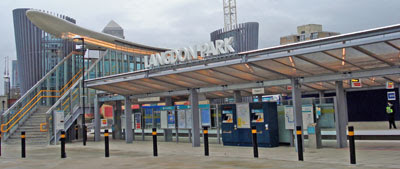
Langdon Park DLR Opened: 9 December 2007 [i.e. yesterday] Initial feasibility case: May 2000 [blimey, look how long it takes to launch a station] Reasons for opening: neighbourhood regeneration, too long a gap between adjacent stations.
When the DLR was built, back in 1987, there was a glaringly long gap on the Stratford extension between Devons Road and All Saints. It might have looked obvious on a map but nobody really cared, because there was nothing important in the gap apart from a couple of crumbling housing estates. There was no "business case" for a station here, apparently. And anyway wasn't it more important that Essex commuters travelling to and from Canary Wharf should be able to save precious seconds by speeding through without stopping? So residents of the Lansbury and Teviot estates got used to watching DLR trains whizzing by behind a big fence, and carried on catching the bus instead. It's taken 20 years to finally put a stop to this rather blatant case of transport neglect.
Here we are in Poplar, just north of the East India Dock Road and close to Chrisp Street Market. The Germans bombed the area quite heavily during the war, and the existing landscape owes much to the un-pretty era of postwar council block redevelopment. The authorities did at least try - the Lansbury was a showpiece estate built for the Festival of Britain, and Erno Goldfinger's Balfron Tower is almost as big an icon as its big sister Trellick on the other side of town. But years of neglect and disinterest eventually led to increasing crime levels and greater marginalisation. If Tower Hamlets ever offer you a council flat here, you'd think twice.
But now there's a new way out, with the opening of a brand new DLR station at the heart of the community. It opened today without any fanfare whatsoever, not even a mention on the TfL website (which still has the opening date listed as "Late 2007"). I think the Mayor is due to pop along and perform some official ceremony sometime this week, but presumably he has better things to do on Sunday mornings than eulogise about regeneration in a speech littered with media soundbites. The station was, I suspect, due to open on Saturday because the DLR had scheduled a mini "open day" with leaflets and giveaways for local residents. But the entrances remained boarded up while workmen scurried around finishing off a few urgent paving slabs, leaving a surprisingly long queue of damp souls waiting patiently beneath umbrellas in the howling rain. Anything for a freebie.
The new station gleams like a shiny alien mothership, miraculously landed in the midst of some decaying backwater spaceport. Its signature feature is the elegantly curved glass footbridge, with a splayed metal cone at each end encircling a pair of liftshafts. Unlike the footbridge it replaced, you'd not feel unsafe crossing the tracks here after dark. Access from Chrisp Street is fairly mundane, up a brief alley, but the plaza on the eastern side is rather more impressive. Up on the roof the station's name has been picked out in big white plastic letters, a bit like at Wembley Park, while down below a row of black bollards prevents local joyriders from smashing into the glass platform walls for a laugh. They would do, I'm sure, given half a chance.
So, will you be stopping off at Langdon Park DLR in the near future? Probably not. Really, there's nothing much around here you might want to come and see. Langdon Park itself is just a threadbare grassy quadrilateral with playground equipment and football pitches - you probably have one of those where you live. Across the road at Langdon Park School (sorry, "Specialist Sports College") there's not yet a blue plaque commemorating Dizzee Rascal's musical scholarship. And festival-goers may have traipsed round the Lansbury Estate in 1951, but you wouldn't want to wander inbetween the apartment blocks today, not for the fun of it. But for those who live here the new station is a precious lifeline to the outside world, and a beacon of hope that somebody somewhere actually cares. Every five minutes, in both directions, life round here just got better.
 ND
Back in 1543, King Henry VIII was getting on a bit and had become more than a bit of an obese lardarse. This made climbing onto a horse, let alone hunting the royal deer, rather difficult. What was Henry to do but construct a great big three-storey platform in the middle of Waltham Forest from which he could shoot at things. He called this building his Grand Standing, although it was probably more of a Grand SittingDown. Even the central staircase was built less steeply than usual to give Henry a fighting chance of being able to climb it. Out in the forest expert huntsmen tracked down deer, then penned them up, before letting them run loose across Chingford Plain past the monarch's steely gaze. One crossbow shot later and the deer would conveniently drop dead, whether the King had hit it or not. Damned fine shots, those covert royal archers. But not really proper hunting.
On into the kitchen/scullery, where there's a not quite convincing display of fake foods (such as fruits and spices) like what Elizabethan aristocracy would have eaten. And then up the stairs (ooh yes, very gentle) to the shooting room on the first floor. There are a couple of appropriately dressed mannequins in the near corner, as well as a box of clothes so that children (and childish adults) can attempt to dress themselves similarly. It's quite an empty room otherwise, and therefore not especially easy to imagine as the heart of the royal hunting party's festivities. At least the view from the window is pretty much as Henry might have remembered it (apart from the golf course where the deer would have been kept, that is, and a rather out-of-place suburban dwelling nextdoor).
Olympic update
Another group of evictees are the Clays Lane residents who have been scattered to the four winds. They too have lost their community. The LDA actually said we were not a community, unlike the Travellers, who were moved as a community... Residents are considerably worse off in financial terms and some are worse off in terms of the quality and size of their new accommodation...


Please do not change trains at Bank/Monument
Blue: station entrances
Back in the late 19th century Victorian engineers built several filter beds in the Lea Valley to purify the capital's drinking water, helping to keep cholera at bay. A century later technology had moved on somewhat, and the beds were abandoned to natural colonisation. They're currently owned by the Lee Valley Regional Park Authority, who six years ago opened a series of bird hides and a visitors centre. Most of the visitors seem to be of the feathered variety, swooping in to swim and flap and feed in the reedy pools. But the occasional human turns up, as I discovered last weekend when I had the place completely and utterly to myself.
It's now been six months since the Olympic Park was sealed off, and everybody who lived and worked there was turfed out. The outcasts had to go somewhere, of course, and quite a lot of them have ended up one mile further upriver near Leyton. The new sites are tucked in beside a bleak arterial road, in the shadow of a couple of giant gasholders, nowhere with any character whatsoever. Few pedestrians ever walk down Orient Way, but plenty of traffic thunders by (most of it setting off the wholly unnecessary 30mph speed warning sign). A few lonely horses graze in a muddy field nearby, and there's also a great big £400m Eurostar maintenance depot whacked down in the general nothingness. But I'm sure most of the relocated businesses don't mind swapping old tumbledown warehouses for shiny modern hangars. These giant tiger-striped metal boxes are a million miles away from their former premises, and all paid for out of your taxes too.
They're, erm, not quite as characterful as the old allotments, are they? The old allotments had charm, and personality, and vegetation. The new allotments are formed from a rectangle of freshly ploughed earth with a concrete path down the middle, divided up into equal-sized patches of empty mud. A tall green metal fence surrounds the perimeter, with tiny saplings planted all around to provide eventual privacy. Standing guard on each plot are identikit green huts, regularly spaced, each waiting for their new owner to arrive and provide a bit of individuality. A few plots show the very first signs of cultivation - a trowel, a chair, a waterbutt - but it'll be a long time before these feel like proper allotments.
I took up position just along from Temple station, close to the river's edge. I knew that this would be a good place to watch the fireworks because the London Eye was clearly visible, and the spot was marked as an official viewing area on my official map in my official leaflet. Great, there was now 'only' an hour to wait. It turned out to be quite a wet hour, and I was worried that my view might be obscured by umbrellas wielded by wimpy boys with gelled hair. Thankfully the deluge stopped with minutes to spare. I was also stuck directly behind several 6-foot-plus blokes, one of whom had the temerity to wear a woolly hat with a floppy bit on top (a bit like the teat on the tip of a condom) which blocked my view even further. Still, at least I had a better view than the ten rows of people behind me, including the Polish youth jamming his rucksack into my side as he attempted to steady his video camera in readiness for the imminent extravaganza. Eagerly the crowd counted down the final 60 seconds of 2007.
Bong! Boom! The first fireworks of 2008 exploded from the rim of the London Eye. Oooh! Aaah! Hmmm!?! Where had the fireworks gone? A cloud of billowing black smoke had rapidly obscured our view, so utterly and so completely that only the sound of distant explosions told us that the display was still continuing. It was a bit like being in London during the Blitz - all smoke and bangs and blackout. The impenetrable darkness continued, minute after agonising minute, with only the occasional high-flying rocket trail visible above the glowing cloud. The crowd and I stood unmoved in muted disappointment. Even the Polish guy stopped filming after the first five minutes. Were we really going to see absolutely nothing at all? All that hassle to get here, all that standing around, and all for eleven minutes of invisibility. The organisers had forgotten to mention one very important additional key fact - never stand downwind of a firework display.
Q. Where can I go to watch the fireworks?Bollocks. The hundred thousand of us standing on Waterloo Bridge or on the eastern half of the Embankment had a good view of the London Eye yet saw virtually no fireworks whatsoever. We'd been herded by officialdom into a viewing space which turned out to be worse than useless. Our journey to central London had been a complete waste of time, money and energy. We saw nothing. And to top off a miserable night we still had to face the nightmare journey home, creeping slowly along packed streets trying in vain to find a sideroad up which the police might eventually allow us to escape. No fun. No fun at all.[1] "The aim of the Hampton Court Maze", reads the information board outside the entrance, "is to get to the centre." Just in case you though otherwise. Cough up £3.50 (or wave your Palace entrance ticket) and venture inside. It's not a difficult start. The dead end immediately to your right has been blocked off to form a storage area and an exit passage, so veer left and trek around the western perimeter. It's easy to be over-confident at this point, striding ahead as yet unchallenged. But the first junction - a narrow gap carved through the hedge - introduces initial indecision. Take your pick.
[5] This long path skirts around the central clearing, where jubilant finishers can be glimpsed oh-so tantalisingly close on the other side of the hedge. But no premature short-cut through the foliage is possible - the maze's iron-railing skeleton makes certain of that. Although you can pass through the hedge at the next junction, where 20th century gardeners have cut an elegant archway to link two of the original pathways.
[8] If you've brought a toddler with you, they're probably gurgling merrily by now. You'd better run after them before they totter headlong down the next leafy canyon and disappear round yet another corner.
[12] Is this the central courtyard, or is this a concrete patio knocked together by some Channel 4 lifestyle programme? Bland wooden trelliswork holds back a ring of replanted hornbeam. To left and right, where two tall trees once cast a welcome shadow, sit clumps of squat stools awaiting weary backsides. And, in the very centre of the centre, an upturned conic pedestal bears the legend "We found the Maze Centre at Hampton Court Palace 2007" (with the final "7" daubed on in thick temporary paint). You might want to ask those two foreign students over there to take your photograph, before they ask you. Smile - you’ve just solved a classic 17th century puzzle.

1 Now when Christmas was nigh in Mayfair of Westminster in the days of Nigella the Great, behold, there came fur-coated ladies from the shires to Old Bond Street,
9 When they had heard the floppy-fringed one, they departed; and, lo, the deluxe brand awareness, which they saw in the West End, went before them, till it came and stood over where the exclusive retail destination was.
1 And there were in the same country East Enders abiding in the estates, keeping watch over their budgets by night.
6 And suddenly there was with the inspector a multitude of the heavenly stallholders trading goods, and saying,
No longer true...
• The Underground runs over 253 miles (408km) of line. No longer true. Now it's 248 miles (400km)... plus four particularly useless replacement bus services.
All the stations on the East London line were busy, noticeably busier than usual. TfL appeared to have rostered an additional member of staff on every platform keeping an eye on the all the additional enthusiasts lest they accidentally misbehave. You know the sort of thing - using flash photography, or trying to walk into off-limits bits of the station, or leaning out in front of passing trains in search of the perfect photo. I'm not sure what grim fate faces these members of staff today now that their stations are closed until 2010. Pointing passengers towards replacement bus services, maybe, or perhaps redeployed in less important posts at other stations elsewhere. Amputating a limb from the Underground network has a human cost as well as a financial price.
Today is the very last day of service on the East London line. Tonight, after the last train to New Cross Gate (probably about quarter past one), the entire line faces prolonged shutdown. Come back in June 2010 and the tracks and stations will have been re-engineered and reborn as part of the London Overground network. But come back tomorrow and you'll have to ride the replacement bus service instead. It's not an exciting prospect.
But for this week at least, it's been business as usual on the East London line. At Whitechapel folk still descend the steps from the District line platforms to catch a little four-coach train south. At Shadwell they still ride the lift down to almost-platform level rather than taking the stairs. At Wapping they still stand somewhat precariously on what must be the narrowest platform on the entire tube network, watching down the tunnel beneath the Thames for the headlamps of an approaching train. At Rotherhithe they still listen to the ominous dripping of pumped-out water rushing somewhere above their heads. At Canada Water they still swarm down the escalators to ride the much more popular Jubilee line into town. At Surrey Quays they still wait beneath the orange-topped columns and ornate iron work clutching bags from the nearby shopping centre. And at bifurcated New Cross and New Cross Gate they still wait patiently for an all-too-rare train to arrive, and pause, and eventually depart. Nothing ever happens quickly here, nor on a grand scale, and that's part of the line's subterranean charm.
The East London line's not the busiest on the tube network. If you ever want to get a seat during the rush hour, head here. A mere 34000 souls use its services daily (compared to half a million on the Piccadilly and two-thirds of a million on the Northern), perhaps because it doesn't really go anywhere useful. But for local residents and cross-river commuters it's an extremely convenient lifeline, and one they're going to have to learn to live without. Let's hope that the shiny new East London Railway which finally emerges in 2½ years time will be worth the wait.
Well that didn't take long. It's still less than six months since the 2012 Olympic Park was sealed off, but the wholesale demolition of the site has been extremely rapid. Back in July there were warehouses and factories where the running track will be laid, but they've all been knocked down. Back in July there was a river where the grandstand will be erected, but that's been piped underground. Back in July there were trees where the hotdogs will be sold, but they've all been cut down. Back in July the view from the Greenway bridge was green, but now it's brown. Not one single building now remains on the stadium site, bar a couple of electricity substations just to the south. All that's left are the original roads, a row of lampposts, some walls and fences, and an awful lot of piles of earth.
Here's the reason the updated January tube map is needed. The East London Line closes next weekend, and will eventually reopen as part of the new London Overground. There'll be no more tubing from Whitechapel to New Cross, just four replacement bus services for the next 2½ years. Two of those bus services meet here, at Canada Water. Previously this was a very simple-looking single-blob interchange, but not any more. Now it appears as a triple-blobbed mega-interchange, as does Whitechapel on the opposite side of the river. This over-complex rearrangement ensures that nobody thinks they can travel from Rotherhithe to Surrey Quays on one bus, because that would be a terrible mistake to make. Incidentally the replacement bus service will be wheelchair accessible, but the wheelchair symbol is only used to show step-free access to a platform. Brilliant, eh?
Here's the first appearance of the new stations being built on the East London Line extension. It's good news for residents of central Hackney, but perhaps not for tube map users. These stations don't open until summer 2010, but they'll still be clogging up the map and confusing tourists for the next 30 months. Even more uselessly, the "under construction" connection from Dalston Junction to Canonbury is also shown, and that won't be opening until 2011. Meanwhile the southern section of the extended ELL (from New Cross Gate to West Croydon) also appears on the new map. It's already open, but still being run by Southern trains so Oyster pay-as-you-go isn't yet valid. As a lot of very small orange print tells you.
Here's a ghastly redesign of one major interchange, attempting (but failing) to better represent reality. As anyone who's ever changed trains in Docklands will know, there are two Canary Wharf stations, a five minute slog apart. The new map makes this a lot more explicit, replacing a single interchange blob with this triangular mess. Linkage is now via the walking distances between Canary Wharf Jubilee line station and its two DLR neighbours. If your eyesight is good enough you may be able to spot that Heron Quays DLR is 50m nearer than Canary Wharf DLR. If the map designer had been good enough he/she might have spotted that the DLR stations are to the west of the Jubilee line, not to the east. And above it, not below it. Come on TfL, if you're attempting to better depict reality, at least do it consistently.
Here's an even grimmer interchange revamp. There are three stations at West Hampstead, all along the same busy road - one on the Jubilee line, one on the London Overground and one served by First Capital Connect. As this graphic attempts to make clear, it's a 100m walk from the Jubilee to the Overground. The third station, West Hampstead Thameslink, is apparently 200m away - but from which of the other two? Real life evidence suggests it's 200m from the Jubilee, but you can't tell this from the map. Would a single blob really be so bad?
Here's the northwest corner of the new map. The big difference here is the appearance of ticket zones 7, 8 and 9 (replacing A, B, C and D). This isn't too messy - it actually makes more sense that the previous zoning. Except in nearby Watford. Watford Metropolitan line station is in Zone 7, but nearby Watford High Street station is in Zone 8 and even nearer Watford Junction isn't in a zone at all, not even zone 9. Oh, and doesn't Chalfont and Latimer station look complicated? The perfect example of how the designers think they've added clarity, but have actually taken it away.
And finally, here's the new map layout for "Heathrow Airport". There are three stations named after terminals, one of which doesn't open until Easter. I hope you can understand how the loopy one-way system works. Travellers can't get directly from Terminal 4 to Terminal 5, nor directly from Terminals 1, 2, 3 or 5 to Terminal 4. I'm sure that tourists just arrived by plane will find this crystal clear to understand and to follow. Oh, and see that big red dagger next to Terminal 4? There are more than 30 of these littered across the tube map, and they all refer to additional text in the station index beneath. In this case TfL want to warn you that Terminal 4 station closes at quarter to midnight (whereas most stations close nearer half past). Somebody presumably cares. One day, maybe, all this "crucial" red dagger information will be plastered across the map itself. Like I said, the way tube map design is going, information pollution can only escalate.
The road east from Aldgate to Stratford has a long and mighty history. It's been the main road to Essex from London for the best part of a millennium - the route taken by armies and revolting peasants and stagecoaches and trams. It's part of one of the UK's great trunk roads, the A11, home to traffic jams and exhaust fumes and bendy buses. And in five years time, for a few short hours, it'll be part of the route of the Olympic Marathon. Hundreds of the world's fastest long-distance athletes will be puffing past my front door, just one mile from glory in a billion pound stadium. But Tower Hamlets wants the Olympic legacy to last a bit longer than a couple of brief afternoons. They've had a transformational idea. And that idea is called "High Street 2012". Anybody interested in bringing their vision to life?
"Title attributed to the contract by the contracting authority:An invitation to tender has just been issued, attempting to recruit a team who can enable the delivery of transformational change along three and a half miles of East End street. Someone, surely, can breathe new life into the Whitechapel Road, Mile End Road, Bow Road and Stratford High Street. Someone, surely, can suggest improvements which will enhance the area's ambience for both visitors and residents alike. And hopefully something a bit more exciting than tying multi-coloured balloons to all the lampposts.Here we are in Poplar, just north of the East India Dock Road and close to Chrisp Street Market. The Germans bombed the area quite heavily during the war, and the existing landscape owes much to the un-pretty era of postwar council block redevelopment. The authorities did at least try - the Lansbury was a showpiece estate built for the Festival of Britain, and Erno Goldfinger's Balfron Tower is almost as big an icon as its big sister Trellick on the other side of town. But years of neglect and disinterest eventually led to increasing crime levels and greater marginalisation. If Tower Hamlets ever offer you a council flat here, you'd think twice.
The new station gleams like a shiny alien mothership, miraculously landed in the midst of some decaying backwater spaceport. Its signature feature is the elegantly curved glass footbridge, with a splayed metal cone at each end encircling a pair of liftshafts. Unlike the footbridge it replaced, you'd not feel unsafe crossing the tracks here after dark. Access from Chrisp Street is fairly mundane, up a brief alley, but the plaza on the eastern side is rather more impressive. Up on the roof the station's name has been picked out in big white plastic letters, a bit like at Wembley Park, while down below a row of black bollards prevents local joyriders from smashing into the glass platform walls for a laugh. They would do, I'm sure, given half a chance.