"The Circle, District, Hammersmith & City and Metropolitan lines will get new air-conditioned trains from late 2009."[pressrelease] good: And about time too. There's nothing tube travellers complain about more in the summer than sweaty overheated tube carriages. And now it'll be lovely and cool, like a New York apartment. bad: But for the other 10 months of the year, air conditioning really isn't very important at all, and tube passengers have completely different grumbles. bad: But air conditioning is only being introduced on four of London's twelve tube lines - the ones in the shallowest tunnels - and not the deep level lines where all the sweatiest sweat is. bad: But aircon won't be arriving until late 2009, so that's another three record-breakingly sweltering summers to survive unaided. bad: But it's only the Metropolitan line which gets new air-conditioned carriages in 2009. The rest of this rolling stock upgrade doesn't start until 2012. bad: But the full fleet of 190 ice-cool trains won't be in place on these four lines until 2015, by which time we may all have died from overheating.
"Trains on the Circle and Hammersmith & City lines will increase in size from six to seven carriages, an overall capacity increase of 17 per cent." good: And about time too. Current 6-carriage trains always stop short of the end of the platform, leaving hordes of passengers rushing forward to cram into the last doors of the rear carriage. There'll be less pushing and shoving in future. bad: But 16 of the platforms on the Circle and Hammersmith and City lines are going to be too short for these new longer trains. Either somebody's got to find the money to extend them (and we've got to put up with long-term engineering works) or some of the doors on the new trains will have to stay shut when they pull into the shorter stations. bad: But the new 7-carriage trains won't fit into some of the existing railway sidings. The sidings at Farringdon, for example, only just fit 6-carriage trains, and will be useless come 2015.
"Train interiors will be larger thanks to a new seating layout and door design. This will help ease congestion."[pictureshere] good: And about time too. The new carriages will be able to carry 9% more passengers, which means fewer people left standing on the platform. bad: But if there's more space, then something's got to be removed to make room for it. And what's being removed are several of the seats. "More capacity" really means fewer people sitting and more people standing. bad: But at the moment every train on the Metropolitan line has a nominal 448 seats. The new trains will have only 307 individual seat places. If you're commuting for over an hour all the way from Amersham into town, that lack of seats is really going to hurt. Perhaps not surprisingly, Metropolitan commuters are seething. bad: But the new seats will be hard plastic things with thin cushions, and not the comfy upholstered seats passengers are currently used to. bad: But there are overhead luggage racks and coat hooks in today's Metropolitan carriages, and none of these will be replaced. Where is Chorleywood Man supposed to store his briefcase and brolly now? bad: But the needs of the long distance Metropolitan commuter are completely different to the needs of the one-stop Circle line user. Why should all these new trains have to use the same carriage layout?
"Trains will have wide aisles and an end-to-end walk-through design" good: And about time too. There'll be space for wheelchairs and luggage and pushchairs, which can only be a good thing. And better security too, because you'll be able to see all the way from one end of the train to the other and need never feel isolated. bad: But that'll just make it easier for rag week students, buskers with accordions and gangs of muggers to work their way down the entire train seeking money and valuables. bad: But you know what the articulated interior design of these new trains really reminds me of? Bendy buses. Cavernous seat-lite bendy buses. Giant walk-through people carriers for the mass movement of human cattle. A lowest common denominator travelling experience, coming soon to a railway line near you.
"Better signalling means the upgrade will deliver 21% more trains per hour on the busiest sections of the upgraded lines." good: And about time too. More frequent trains can only be a good thing. There'll be 5 extra trains an hour to Uxbridge, for example, and as many as 34 trains per hour on the south side of the Circle/District line. Hurrah!
"The work will be undertaken by Metronet." bad: It'll be a bloody disaster, then.
Sunday, December 03, 2006
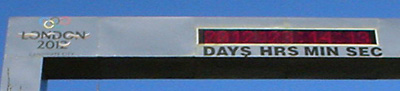
2012 days to 2012 (allegedly)
Look, there are only 2012 days remaining until the 2012 Olympics. Or so it says here, in this (blurry) photo I took this morning outside Stratford station. This is the countdown timer looming high over Meridian Square, just a hop, skip and a jump from the site of the new Olympic Stadium. Back in the summer of 2005, when London's Olympic bid had yet to be won, a giant fibreglass statue of a strangely indiscernible athlete stood here beneath this high metal bar [photo]. The timer was then counting down to the 2012 decision (and the ripping of a golden envelope) at lunchtime on 6th July. And then, after London won the Olympics, the model athlete was removed and the timer restarted. It's now counting down to the Games themselves, displaying the remaining days, hours, minutes and seconds to any Stratfordian who cares to look upwards.
Except it isn't correct. This timer isn't counting down to the opening ceremony on 27th July 2012 at all, because that's still 2063 days away. Instead it appears to be counting down to mid-morning on 7th June 2012, some 50 days earlier. I'm not quite sure how this miscalculation could have happened (and neither is the last Olympic official I spoke to), but it is a trifle embarrassing. Seb Coe and friends are going to find it hard enough to build all their stadia in time for the real July 2012 deadline, without setting themselves this even tougher imaginary target. I wonder how long it will take whoever owns this giant mis-timer, be it the London Olympic team or Newham Council, to get their act together and shift the time seven weeks into the future. The clock is ticking...
volume: A forest of flashing speakers has been erected this week in the John Madejski Garden at the Victoria and Albert Museum. This usually serene courtyard is now home to an impressive piece of interactive audio-visual sculpture, entitled volume. Each thin black post, of which there are many, is covered by rows of tiny lights and topped off with a loudspeaker. As visitors wander around amongst the installation, motion detectors control an ever-changing sound-and-light show. Groups of lights glow, and ripple, and change colour, while a random electronic symphony echoes against the surrounding walls. The musical brains behind the volume project are Robert del Naja and Neil Davidge of Massive Attack, and the end result of their efforts sounds both soothing and upbeat (like one of those New Age trippy CDs, but one you might actually buy). The composition evolves, pulsates and modulates, but only until the last visitor retreats from the platform. In the absence of any human stimulation the colours fade away and the electric forest falls silent, pulsing occasionally with white light to beckon back any distant spectators. Go on, step back in, and pump up the volume.
Very Important Pedestrians: Oxford Street and Regent Street have been closed to traffic today in attempt to attract crowds of shoppers to the capital's two main shopping streets. It's not like the pavements are usually quiet, you understand, but today it's possible to step off into the road without being mown down by a passing double decker. Crowds of shoppers have duly turned up, and are swarming around the big (and little) stores snapping up Christmas goodies like there's no tomorrow. The roads aren't completely clear, though. At the intersection of the two streets a group of mysterious white inflatable globes is causing almost as much congestion as the usual traffic lights. Mobile musical entertainment is being provided by bagpipers and a couple of Sally Army brass bands, as well as the odd steel band and ethnic drumming ensemble. Elsewhere there's free mulled wine (if you know where to look), plus the usual balloon-sculpting elves and stilt-walking angels who gravitate towards events such as this. Beside Tottenham Court Road station people are queueing to enter Banksy's annual "Santa's Ghetto" exhibition (photos here). And outside John Lewis I stumbled upon a photocall by Ken Livingstone flanked by a row of grinning Santas (alas, they all buggered off into the nearest department store before I could grab a photo myself). Today's event seems to have been a great success (so long as you weren't trying to ride a bus anywhere nearby), and can only hasten the day when Oxford Street is pedestrianised for good. As for the Christmas shopping, though, it struck me that more pedestrians just means busier shops and longer queues, so I resisted. Maybe I'll return when the cars do - it should be quieter then.
Thursday, November 30, 2006
My mp3 player's battery ran out during my journey to work yesterday, so I was forced to listen to my fellow commuters instead... • [Bow Road → Mile End] The train grinds to an unexpected halt inbetween stations. The all-enveloping silence in the carriage is suddenly punctuated by a loud snore. Sprawled across two seats is a well-fed bloke in oversized overalls, his head tipped back and his eyes firmly closed. His boots are splattered with dirty white paint, and his lunch dangles from one arm in a blue plastic bag. A second disturbingly loud snort fills the air, causing several nearby passengers to peer up from their newspapers. Intermittent snoring continue, reverberating in all directions as the train goes nowhere. The assembled audience begin to smile and glance at one another in guilty pleasure, relieved not to be the snoozing sideshow themselves. This unintended entertainment continues for three increasingly uncomfortable minutes. And then the train starts forward with a jolt, and one pair of heavy eyelids flick open. The semi-conscious traveller gathers his belongings and prepares to disembark at the next station, blissfully unaware of all the embarrassment he never felt. • [Liverpool Street → Bank] The carriage is rammed. Desperate commuters barge aboard from the platform. An off-duty London Underground employee in bulging blue uniform pushes past me to stake his claim to two square feet of spare floorspace. His over-thick head of grey speckled hair is somewhat unconvincing. A bulky laptop bag packed with official paperwork grazes my leg. As the doors clang shut, the newly-arrived tube worker taps the dreadlocked gentleman beside me on the shoulder. "Can you turn that down?" A hand emerges and pulls half a Sony headphone from one ear. No sound whatsoever can be heard. "Can you turn that down please?" Humiliated, the tapped man fiddles with an unseen volume knob and plugs himself back in. Tubebloke smiles, and looks to the rest of the carriage for implicit approval. Only one lady returns his gaze and smiles back. I feel a sudden urge to bash this sycophantic self-satisfied jobsworth over the head with a rolled up copy of the Daily Express for his totally unnecessary public intrusion, but I resist. The train screeches on through the noisiest tunnel on the entire tube network, far louder than any headphone bassbeat. Nobody utters another word.
Sunday, November 26, 2006
Low tide London
Most Londoners probably think that their nearest beach is in Southend, or maybe Brighton, but they'd be wrong. There are several beaches (or at least bits of foreshore masquerading as beaches) along the Thames, even through the middle of Central London. When the tide's high you can't see them at all, and many tourists probably never even realise that they exist. But as the river level falls, up to 6½m every twelve hours, so the river ebbs away to reveal long stretches of rock and mud. It may not be golden Mediterranean sand, but if you fancy a bit of beachcombing it's a darned sight more convenient to get to. • watch the Thames rise and fall
This is the beach at Bankside [photo], just below the Tate Modern [photo]. It's one of the longer stretches and, if you time it right, also one of the widest. With a bit of luck somebody will have unlocked the gate in the railings along the river's edge [map] and you can make your way down the low stone steps onto the sand. Yes, that's definitely sand at the top of the beach, although it soon gives way to rock and muddy shingle further down. Eroded half-bricks and pebbles litter the exposed river bed, some dark and jagged, others bleached white and smooth. Decaying wooden stumps stick up from the ground, the remnants of some old wall or Tudor jetty. Dark brown rusty pipes snake half-covered beneath the shingle, thankfully no longer dribbling ooze into the river. There's not as much washed-up litter and glass as you might fear, nor as much green slime as you might expect.
Best of all, you've probably got the whole quarter mile of beach to yourself, all the way from Blackfriars Bridge [photo] to Bankside Pier [photo]. Well, just you and a ragbag collection of feral pigeons, swooping seagulls and big black crows. Try picking your way across the rocks directly underneath the non-wobbly Millennium Bridge and looking across the river towards St Paul's Cathedral on the opposite bank [photo]. You might even spot some fragments of pottery or an old sailor's clay pipe in the mud, although I suspect that most of these were spotted and nabbed long ago. Don't stand too near the water's edge, or the backwash from a passing speedboat or Thames cruiser might overflow your boots. And ignore the funny looks you're getting from tourists wandering along the South Bank above you. Perhaps they can't work out how you got down there, or maybe they simply can't imagine why anyone would want to slum it on a low rocky shelf. But they're the ones missing out. Just make sure you get back up the steps before the beach disappears from view beneath the rising tide.
You can tell an awful lot about the history of London from its maps. Not that there were many London maps to begin with, because they weren't needed. But the British Library has amassed an enormous collection of London maps from the last 500 years or so, and their new cartographic exhibition makes for fascinating viewing. I thought I'd better visit on the first day before it gets too popular, because it surely will.
The exhibition is divided into eight sections, from the old walled City to postwar suburban sprawl. Inbetween you get to watch the capital expand, gradually at first, then with increasing speed towards the docks in the east and the prestigious estates to the west. See how quickly ye olde London was wiped from the map by the Great Fire, only to be rebuilt in ten years flat. Watch the fields north of Piccadilly sprout streets and squares and mansions. You can even track the River Fleet as it evolves from stream to ditch to underground sewer... or maybe that was just me. Some of the maps are bloody huge, which is great because it means you can get up close and inspect the really small detail. Many of the earlier maps are more pictorial than planar, but they're all equally beautiful and intricate in their own way.
What many visitors seem to do (and I'll confess to being no exception) is to pay extra special attention to the place where they live. It helps if you live somewhere fairly central, of course, and I'm fortunate that Bow often crept onto the very easternmost edge of certain maps. I was able to trace Bow first as a medieval village on the banks of the Lea, then a tiny 'town' surrounded by grassy meadowland, and finally a suburb swallowed whole by expanding London. If you'd have been wandering around the exhibition with me I'd probably have bored you silly by pointing out every time I spotted precisely where my house now stands, and you'd probably have done the same.
It's just my sort of exhibition, filled with frame after frame of cartographic porn to salivate over. I'm sure I'll be back for another visit at a later date, just so I can stare again at the million and one details I overlooked the first time. But in the meantime there's plenty to view from home. The free exhibition guide folds out to reveal a high quality print of Richard Newcourt's pre-Fire London map of 1658, which is gorgeous. I was also inspired to buy a copy of the book accompanying the exhibition, as did a surprisingly high proportion of departing visitors. At £15 a time (£25 hardback) the British Library have a worthwhile moneyspinner here, and very lovely the book is too. And if you can't get to the exhibition yourself, or can't get there yet, there's an excellent website to explore complete with images of several of the maps. It's based on a virtual Google map, of course, and there are some real gems tucked away on there. You've got three months to get your A-Z out and find your way to the British Library to see for yourself.
As of yesterday, if you travel on the tube using a pay-as-you-go Oyster card and fail to touch in or touch out, you'll now be charged a "maximum cash fare". To assist you in understanding the new penalty system, Transport for London have helpfully provided a detailed online FAQ explaining all the changes. It's only 2600 words long, and is therefore easily assimilated by any Londoner. Come on, this is important, because if you don't know these rules inside out you might end up paying extra for your ignorance. Just in case you can't spare the time to read the full rules in depth, allow me to present my own simplified Oyster FAQ below:
Q: How much is the new "maximum cash fare"? A: It's £4 per journey. Which is a bit sneaky, because the maximum Oyster fare for the longest possible Zone 1-6 journey is only £3.50.
Q: Is it always £4? A: No, it's £5 if you're using National Rail from certain mainline stations (Blackfriars, City Thameslink, Elephant & Castle, Euston, Fenchurch Street, Liverpool Street, London Bridge and Marylebone). Apparently £5 is the "average fare" from these stations, so you deserve to be charged more. Here's a map showing the (not many) National Rail routes where use of Oyster is permitted.
Q: Surely this "maximum penalty fare" only affects miscreants and barrier jumpers? A: Not at all. Life would be simple if all Oyster journeys started and finished at a ticket barrier, but they don't. Exit the tube at Finsbury Park without swiping and you'll be fined. Start your journey on the DLR without swiping and you'll be fined. Change onto National Rail at Farringdon without swiping and you'll be fined. It's all too easy to forget, and to end up paying for your mistake.
Q: How does this new system penalise you for not touching in? A: If you didn't touch in, then when you eventually touch out at the other end the system assumes you've made the longest possible journey (eg from Heathrow Airport) and slaps down a maximum fare Exit Charge of £4.
Q: How does the system penalise you for not touching out? A: Every time you touch in at the start of a journey, an Entry Charge of £4 is automatically applied to your Oyster. If you don't touch out at the end of your journey, then this £4 is automatically deducted. If you do later touch out, like you're meant to, then the correct fare is charged instead.
Q: So, pay-as-you-go travellers are assumed to be "guilty until proven innocent"? A: Yes, although the £4 Entry Charge is never actually deducted while you're travelling, so you can have less than £4 pay-as-you-go and still be able to travel.
Q: How does the system know that I haven't touched out? A: You're allowed up to two hours to complete your journey, but take any longer and a penalty fare applies. Even a tube journey from Epping to Chesham on a Sunday evening allegedly only takes 1 hour 58 minutes, so anybody taking longer than two hours is clearly a criminal.
Q: What if my journey is delayed? A: If your journey exceeds two hours because of service disruption, you should seek assistance from a helpful member of staff or call the Oyster helpline. Calls cost only 3½p per minute, unless you're calling from your mobile (which, given the circumstances, you probably will be).
Q: And what if I don't touch in and I don't touch out? Do I get to travel for free? A: Yes, you do. Unless an inspector catches you along the way, in which case you'll be charged £4. Or maybe prosecuted.
Q: Is it ever cheaper not to touch out? A: Yes, but only for Metropolitan line passengers travelling beyond Rickmansworth. For example, if you travel from Baker Street to Chorleywood and exit through the car park on the westbound platform, then you'll pay a fare of £4.50 if you touch out but a penalty of only £4 if you don't.
Q: Are there any special rules about Wimbledon station? A: Funny you should ask. Yes, Wimbledon is an Oyster-user's tram/train/tube charging nightmare. Please read this scarily complicated list of extra instructions.
Q: I have a season ticket on my Oyster card, not pay-as-you-go, so I'm OK aren't I? A: Not if you venture outside your paid-for zones. If you touch in at a station outside your chosen zones but fail to touch in later, then you'll be charged an extension fare of either £1 or £1.50. But if you touch in at a station inside your chosen zones and later fail to touch out at a station outside your chosen zones, then the system won't notice and you won't be charged extra.
Q: What if there's major disruption and I get turfed off my usual tube route onto a bus? A: In these circumstances you shouldn't touch out when leaving the station, but you must touch in on the bus, but only if you've been told that buses are accepting tube tickets, otherwise you might be overcharged. Simple.
Q: What if there's an accident or something and I get carted off the tube network on a stretcher without touching out? A: No problem, they'll refund your £4 Entry charge later, so long as you don't go catching a bus before you get back on the tube again in which case the £4 won't have been refunded yet and you might be refused entry until you top your card up again. Honest.
Q: The Oyster system is full of over-complex badly thought-out inconsistencies, isn't it? A: Yes, but please try not to mention them because it frightens people.
Q: So, to summarise, please? A: Expect to be charged £4 at the start of your journey for not touching out, or £4 at the end of your journey for not touching in.
Q: I am new to London and my English it is poor. Can you please be explaining these rule again? A: No, sorry. Just pay up.
Q: I don't understand what an Oyster card is. A: My apologies for wasting your time.
Sunday, November 19, 2006
Bow Creek: The most impressive meander in London isn't the wiggle on the Thames around Docklands, although that is close by. It's the final meander on the River Lea, which twists and turns right back on itself (twice) before exiting into the Thames immediately opposite the Millennium Dome. This lower part of the Lea is called Bow Creek, and the area around the mouth of the Lea is called (with typical medieval originality) Leamouth. The best views of curving Bow Creek can be seen from a train, looking down from the DLR viaduct between East India and Canning Town. But if you're willing to explore on foot, these strangely remote riverside lands are well worth a wander.
Bow Creek Ecology Park The meandering Lea sandwiches two very long and very thin interlocking tongues of land. The easternmost of these is a sprawl of rundown industrial units, and will remain so until property developers move in and build scores of new apartments instead. But the western peninsula is something more natural, and rather more special. 150 years ago there was a coal wharf here, supplying the nearby Thames Iron Works (they built ships, and founded West Ham football club). In 1960s the docks closed down and the site fell into disrepair, along with much of the surrounding area. And then the Docklands Light Railway came along, and engineers spotted that this thin strip of land was the perfect route for new tracks to Canning Town. A viaduct was built straight up the middle, and the land beneath tidied up to form an ecology park. But health and safety issues got in the way, and the park was only finally opened to the public this summer, 10 years late.
You enter Bow CreekEcology Park over a modern footbridge, along an expensive unused road, through some arty gates. There's just one main path down to the tip of the peninsula, and another up the other side, with the DLR rumbling away through the centre. Passing passengers are probably the only people you'll see here, and they're no doubt looking out wondering what on earth you're doing in this isolated spot. Well, you'll be enjoying such delights as the artificial water meadow, the squelchy reedbeds and the tree-lined pond in this brand new nature reserve. There are several rare plant species on site, and some elusive otters, and even some relocated lizards (although I didn't spot any). There's also a large wooden platform where schoolkids can try their hand at pond-dipping, plus a special outdoor classroom tucked beneath the railway. For a bit of peace, sit down on one of the twisty metal benches and take in the view across the river (or, if the tide's out, across the mud). You can easily see Canary Wharf and the Dome in the near distance, but at the same time it's rather hard to ignore the vegetable oil refinery and building works in the foreground. It may not be truly beautiful looking out, but it's quite charming looking in.
East India Dock Basin The EastIndiaDocks were opened exactly 200 years ago in 1806 by (who else) The East India Company. The docks were extremely successful, with an entrance wide enough to accommodate the larger tea clippers and merchant ships which plied the Far Eastern trade routes. Spices, silks and Persian carpets were unladen here, as well as millions of pounds of imported tea. But trade declined steadily during the 20th century and, in 1967, these were the first London docks to be closed. Today only the entrance basin remains, surrounded by new residential and office developments, and redesignated as a bird and wildlife sanctuary. Big black waterfowl flap and glide across the water, retiring (if disturbed) to perch on wooden rafts in the middle of the mud. Around the perimeter of the basin are patches of reed bed, woodland and meadow, as well as one of the big black beacons erected by British Gas to celebrate the Millennium. The dock gates have been refurbished and can be walked across, while from the riverfront there's a perfect view of the Dome on the opposite side of the Thames. Barges and speedboats chug by, planes from City Airport swoop overhead and in the distance the DLR rattles by. It's a lovely spot, and yet every time I've visited I've had the whole place to myself. Well, just me and a bunch of birds. • aerial view / map
You know how it is when you build something new. A new kitchen, or a new conservatory, or a new extension, or something. You get a quote in from the builders and they give you a reasonably tolerable estimate. But when the project's finally completed it always ends up having cost you far more. There were all those unforeseen extras and unexpected delays and sudden price hikes, and the final total is always unpleasantly astronomical. But the new kitchen's a great improvement on the old, and the new conservatory becomes a much-loved place to sit, and the new extension is well worth the effort in the end. If we never built anything because it might cost more than we expected, we'd never build anything. Even if it sometimes does turn out a bit rubbish and leaves us in debt, it's always worth a try.
The increasing cost of the London Olympics £3.4bn Original cost outlined in Olympic Bid £0.3bn Unexpected VAT bill courtesy of EU regulation £1.3bn Big number added by UK media to bring original total up to a scarily round five billion £3bn Installation of ten million extra CCTV cameras throughout south-east England to prevent unexpected terrorist attack £0.7bn Erection of electric security barricade around fifty acres of duck-infested marshland £1bn 'Cash-for-Olympic-honours' slush fund £0.036bn Ken Livingstone's holiday fund £1.2bn Cost of redesigning the stadium after David Cameron refuses to sanction Gordon Brown's chosen design £0.4bn Projected losses after government Obesity Tsar Jamie Oliver enforces "healthy-only" Olympic refreshment policy £0.2bn Bureaucratic uplift created by over-excessive health and safety legislation £0.2bn Bureaucratic uplift created by over-excessive quality assurance procedures £1bn Accumulated losses when 24992 spectators' seats are left empty once Leyton Orient take over the main stadium in 2013 £0.9bn Erection of 20-foot tall gold statue of Tony Blair in Stratford High Street £0.8bn Contingency fund for construction of extra arena in case the IOC suddenly decide to reintroduce naked mud wrestling as an Olympic sport £0.5bn Spurious Daily Mail addition attributed to "migrant workers" £1.4bn Cost of building 5000 affordable homes throughout the Thames Gateway £1.3bn Cost of building 50000 affordable homes in marginal constituencies elsewhere throughout the UK, renamed "Thames Gateway Gateway" £0.08bn Cost of sending Tessa Jowell on monthly roadtrips to try to persuade northerners that the Olympics really will be beneficial for them, honest £1.50 Six-pack of green glowsticks to liven up the Olympic opening ceremony 27p Box of matches to light Olympic torch £0.5bn Amount of working time lost over the next five years by Olympic pessimists ringing up talk radio and shouting "You know how many NHS nurses we could get for this money, don't you?" £0.5bn Amount of working time lost over the next five years by Olympic pessimists leaving comments on internet talkboards reading "And who will be paying for this fiasco, eh? The British taxpayer, that's who!" £–20bn Long-term regeneration benefits to some of Britain'spoorestboroughs
Monday, November 13, 2006
Cultural update(books/photography/design/pie)
• A book to get somebody else to buy you for Christmas, or to buy now for yourself if you can't wait until then: Chambers London Gazetteer by Russ Wiley (£25) There's always room for another book about London on your bookshelf, particularly one as comprehensive as this. Most city guides concentrate on the central tourist locations, whereas this thick volume affords each square mile of the capital equal importance. The author's taken every minor London neighbourhood, from Abbey Mills to Yiewsley, and written a detailed pen-portrait of each. There's a bit of history, a bit of geography, a bit about who lives there and usually a quirky fact or two for good measure. You've probably never been to Tokyngton, Bridgen and Temple Fortune, for example, let alone known they even existed, but these and 1300 other locations are all included here. There are several refreshingly non-landmark photographs too, in full colour, from all around the capital. For a taster of the book visit the author's splendid "Hidden London" website (via which you can also get £10 off the cover price)
• The Pet Shop Boys are almost as well-known for their ever-changing image as for their music. On one album Neil and Chris may be staring deadpan into the camera and on the next hiding beneath ridiculous pointy hats, but there's always a certain inimitable PSB style. This autumn the boys have bought out a retrospective coffee-table book, called Catalogue, as a scrapbook of every video, every record sleeve and every behind-the-scenes photoshoot from their 20 year career. If you don't have £30 to spare, a small selection of appropriately inventive images are now on display at the National Portrait Gallery, admission free. Head downstairs to the 'bookshop gallery' and enjoy reacquainting yourself with 26 carefully selected examples of the iconic and the ironic. Don't expect to be looking around for more than ten minutes, but if you're in the Trafalgar Square area between now and the beginning of March (and you probably are) then it's worth a look.
• The Geffrye Museum on the Kingsland Road reopens its newly renovated17th and 18th century galleries tomorrow. There'll be four new rooms, each recreating a different period of domestic interior design and each based on a typical London middle class home of the time. If you've visited the museum before then you'll know it's well worth going back, and if not then you're in for an unexpected treat. Yes, in the middle of Hackney, who'd have thought?
• Goddard's Pie Shop in Greenwich closed down for good last night. Owner Jeff Goddard left a comment here last week saying "I just wanted to let you know that the "family circumstances" are that my brother and I have small children who, at the moment, we see very little of as the shop is so busy 7 days per week. Hopefully people will understand. Thanks to everyone who has eaten at our Pie Shop over the years." Which was sweet of him. Now I learn that the shop is being sold off to a burger chain called Gourmet Burger Kitchen. Their "innovative and exotic" cuisine will feature Chorizo Burgers, Falafel and Garlic Mayo Sauce, which is presumably just what Greenwich's tourist hordes deserve. But pie and mash it ain't. My stomach feels somehow cheated.
Monday, November 06, 2006
Londoners of note
Since 1970, a total of twelve famous people have graced the back of the banknotes issued by the Bank of England. It's a very exclusive list. And, with one exception, each of these people lived in London for at least some of their life. So I've been out to track down these noteworthy celebrities, to see where they lived, worked and/or died. Join me on the trail of twelve Londoners of note.
You have to be a bit special to be celebrated on an Englishbanknote. It's not everybody whose portrait is deemed worthy of being stuffed into millions of wallets, purses and piggy banks. You have to be British, you have to be dead, you have to be fairly non-controversial, and apparently it helps if you have a beard because that makes your portrait harder to counterfeit. Several potential candidates are considered, but it's down to the Bank of England's Governor to make the final decisions. Here are the twelve who've made the grade so far, distributed across three separate series of banknotes.
Series D £1 Isaac Newton (1978-1988) £5 Duke of Wellington (1971-1991) £10 Florence Nightingale (1975-1994) £20 William Shakespeare (1970-1993) £50 Christopher Wren (1981-1996)
Series E £5 George Stephenson (1990-2003) £10 Charles Dickens (1992-2003) £20 Michael Faraday (1991-2001) £50 John Houblon (1994-)
Series E(revised) £5 Elizabeth Fry (2002-) £10 Charles Darwin (2000-) £20 Edward Elgar (1999-)
Londoners of note £1: Isaac Newton(1643-1727) Let's start with possibly the greatest genius England ever produced. The discoverer of gravity, the inventor of calculus, the father of optics and the founder of mechanics. Any one of these achievements would be sufficient for IsaacNewton's scientific immortality, let alone the complete set. But they all happened either at home in Lincolnshire or at university in Cambridge, and not in London, so I'm going to ignore them. But in 1696 Newton finally moved from Cambridge to the capital to take up a job with the Royal Mint. Newton took his role as Master of the Mint very seriously, and it was for his financial achievements rather than as a scientist that he later received his knighthood. He became president of the Royal Society in 1703, and ruled this scientific organisation through a mixture of fear and intimidation until his death in 1727. And between 1696 and 1709 Newton lived here at 87 Jermyn Street, just south of Piccadilly.
Jermyn Street today is a backwater of timewarp tailoring, with fusty shops selling outfits and accessories to moneyed gentlemen from the shire counties. Here they can still buy a decent pair of brogues, or be fitted for a pinstripe blazer, or get their balding locks tended by a traditional wet-shave barber. The street is especially famous for shirts - distinctive shirts which scream class, breeding and colour-blindness. So perhaps it's not surprising that there's a tailor's, of sorts, on the site of Newton's old house. Disappointingly it's only a Hackett, catering for the upwardly mobile who can't quite afford a polo pony but can stretch to an overpriced jersey. An ornate plaque on the wall outside appears to be the best tribute to Sir Isaac's scientific genius that London can muster.
Londoners of note £5: Duke of Wellington(1769-1852) Poor old Arthur Wellesley didn't even get his name on the back of the old blue fiver, just his title. Arthur earned his fame stomping round Spain and Portugal during the Peninsular War, first becoming Viscount Wellington (because the name sounded a bit like Wellesley) and later the Duke. Only then did he cap a successful military career by defeating Napoleon at the battle of Waterloo, with the resultant adulation eventually propelling him to the giddy heights of Prime Minister. And in 1817 he moved into a grand town house on the edge of Hyde Park, where his successor lives to this day in private apartments on the third floor.
You've probably seen Apsley House, at least in passing, because it looks out over the six-lane gyratory system at Hyde Park Corner. But you may never have taken the time to go inside, which would be a pity because this is a top class stately home slap bang in the centre of London. I ventured inside "No. 1 London" for the first time last weekend, and was impressed to discover a bubble of grandeur and opulence in the traffic-choked heart of the West End. There's drawing room after drawing room after drawing room, as well as a huge dining room and the lavish Waterloo Gallery. Here the Duke held famed candlelit soirées, and here still hangs his impressive collection of European art. One room on the ground floor is given over to gifts of plate and china given by the crowned heads of Europe - far more impressive than any modern collection of Oscars or Nobel Prizes. But the most unexpected original feature of the house, and the most striking, is the 11 foot tall nude statue of Napoleon which stands at the foot of the main stairwell. Wellington had a grudging respect for his greatest adversary, and was pleased to accept the statue following the Battle of Waterloo when the French decided they no longer wanted it. But it's still a very odd experience to discover the mighty emperor, his dignity covered only by a figleaf, scaring old lady tourists at the foot of the main staircase.
Across the (very busy) road stands the WellingtonArch, upon which once stood a vastly oversized statue of the Duke. Now there's a magnificent winged statue of "The Angel of Peace Descending on the Chariot of War" on top instead, to which you can get right up close by paying a bit more money and taking the lift to the third floor [photo]. The suite of rooms inside the arch once housed London's second smallest police station with a staff of 10 constables, two sergeants and a cat. Now there's just a bit of an exhibition to see, but the visit's really only worthwhile for the view. You can stare across into Hyde Park, you can look down at the traffic circling Hyde Park Corner, and best of all you can peer high over the walls into the back garden of Buckingham Palace. Just the bottom of the garden, mind, but I can exclusively reveal that the Queen wasn't out at the weekend playing tennis or doing the gardening in her wellingtons.
Londoners of note £5: George Stephenson(1781-1848) Here's the one banknote bloke who never lived in London. The father of railways was born in Northumberland and spent his working life linking the northern industrial heartlands. He never lived anywhere further south than Chesterfield, but today his greatest invention resides in the capital. In 1825 George engineered the world's first steam passenger railway between Stockton and Darlington, but fame came only with his next commission building the Liverpool and Manchester Railway. A competition was held to design the line's new locomotives, and Stephenson entered a revolutionary engine named Rocket. It had a top speed of 30mph, but easily beat the other entries when they all failed to work. At the opening of the railway in 1830, Rocket had the dubious honour of knocking down and killing the local MP who thereby became the world's first railway casualty. It's a lot safer to stand in front of Rocket today, down at the Science Museum in South Kensington, although you still have to watch out for rampaging crowds of schoolchildren running amok with clipboards. The shape is instantly recognisable, with a long thin chimney perched high above a stocky iron boiler. At the rear is a narrow footplate below a hinged door concealing the coal-fired furnace, and above one of the wooden-spoked wheels is affixed an understated brass nameplate. The modern train which brought you to the museum may look nothing like it, but your journey owes everything to Stephenson's Rocket.
Londoners of note £5: Elizabeth Fry(1780-1845) Elizabeth would no doubt have been mortified to imagine that her portrait would one day appear on several million English banknotes. She was a modest Quaker who grew up in a religious community in Norwich, but her life changed in 1799 when she met wealthy East End merchant Joseph Fry. On marriage she moved to the Fry family home in Plashet (now East Ham) where she eventually decided that there was more to life than giving birth eleven times over. She started to visit the women inmates in Newgate Prison, bringing warm clothing for them and their babies, and eventually persuaded the governors to let her start up a prison school. Her influence grew and spread to other penal institutions across the country, with her undaunting emphasis always on respect and reform for female prisoners. After a pious and illustrious life she was buried in the Quaker cemetery in Barking, although no gravestone now marks the spot. And Newgate Prison, which she fought so long to reform, has also long gone - replaced by the Central Criminal Court of the Old Bailey(pictured). Justice at last.
Londoners of note £10: Florence Nightingale(1820-1910) You probably know Florence Nightingale as "the Lady with the lamp", or "that brave nurse from the Crimea". You might even associate her with the famous anagram "Flit on, cheering angel". But there's a lot more to Florence than her talent with bandages, and all is explained in one of London's least known museums hidden away beside the Thames in Lambeth.
The Florence Nightingale Museum is tucked beneath St Thomas's Hospital at the eastern end of Westminster Bridge [map]. No tourist is ever going to stumble upon it by mistake, so I was pleasantly surprised not to be the only visitor wandering around inside last weekend. It costs about half a tenner to get in, and for that you get a fairly traditional "cases and displays" walkround which leads you through the 90 years of Ms Nightingale's life. Florence was born in a certain north Italian city (you can guess which) while her well-travelled parents were on extended honeymoon. She had a privileged academic upbringing in Hampshire, but secretly hankered after an unfashionable career in nursing. The museum showcases many of her early belongings, as well as her pet owl Athena (now stuffed) who died of neglect when Flo rushed abroad to assist in the Crimean War. She wasn't so much a nurse as an administrator, and her in-depth background knowledge and logistical skills were precisely what was required to improve the horrific conditions for thousands of battleworn British soldiers. On her return to England Florence was rightly hailed as a national hero, but she shunned all such adulation in favour of continuing her reforming crusade. Her story is well told in the museum, and in the obligatory 20 minute audio-visual presentation, although (from what I saw) adults may want to linger inside rather longer than any accompanying children.
For the last half of her life Florence resided at 10 South Street, just off Park Lane, and spent her days meeting with the great, the good and the medically important. I attempted to track down her terraced townhouse by hunting for a blue plaque somewhere along the street. A tall Georgian cornerhouse looked a likely candidate, but the plaque beside the front door revealed that the famous occupant here was only "Skittles, the last Victorian Courtesan". Florence's plaque was on the opposite side of the street, high on a very ordinary concrete wall beside a suspiciously modern office entrance. The original house was long gone - her drawing room, her parlour, and the bedroom in which the frail, blind and bedridden Ms Nightingale spent her final decade. But the modern nursing profession still stands in testament to her achievements to this day.
Londoners of note £10: Charles Dickens(1812-1870) In amongst Bloomsbury's Georgian terraces stands the unassuming facade of 48 Doughty Street, once home to the great novelist Charles Dickens. He lived here with his new wife Catherine between 1837 and 1839 - only a brief spell but long enough to write The Pickwick Papers, Oliver Twist and Nicholas Nickleby. This is the only one of Dickens' many residences which still stands, and today it's home to the Charles Dickens Museum. The house is quite narrow but spreads upwards over four floors, from the dark basement scullery to the airy upper bedrooms. Plenty of memorabilia has been packed inside, including portraits, correspondence and the desk at which Charles wrote the final unfinished page of Edwin Drood. A small exhibition brings to life the author's deep-seated concern in ending social injustice, including an obsessive interest in the running of a home for "the redemption of prostitutes". And of course there are original editions of Dickens' much-loved novels, each originally published in 20 monthly parts and snapped up by an eager public. You can take a virtual tour of the museum here - you may find that this sufficiently satisfies your Old Curiosity that you need have no Great Expectations of visiting in person. [map]
Londoners of note £10: Charles Darwin(1809-1882) One of the most important, or most dangerous, houses in the world is located in Downe - a small village on the southeast fringe of London. It was here, five years after his voyage round the world aboard the Beagle, that Charles Darwin set up home [photo]. And it was here that he stayed for 40 years until his death, carrying out experiments which would shape our future. I just wish he'd lived somewhere slightly more accessible.
Getting to Down House by car is easy - it's not far from Biggin Hill off the M25. Buses are rather more infrequent, however, and if you miss one then it's at least an hour until the next. Entrance to the house is via the car park, through the big front door into the hallway and then into the obligatory giftshop. I handed over a small rectangular portrait of Charles Darwin and received £3.10 in change, then entered the ground floor to see where the great man lived and worked. All the fixtures and fittings have been restored just as they would have looked in the late 19th century. An audio guide narrated by David Attenborough provides full background information, both of Darwin's scientific discoveries and of his everyday life here at Down House. You really get the atmosphere of a comfortable but happy Victorian family home in which something extraordinary was being thought through.
The highlight of the tour is the opportunity to stand inside Darwin's wallpapered study. Here he examined thousands of specimens he'd brought back from around the world, using that microscope on the table, and here he mulled over the importance of his many findings, sat in that chair beside the desk. There's the board on which he wrote up his notes, and that's the pen he used for answering his correspondence. Right here is where On The Origin of Species was written, the very spot where men suddenly turned into apes. In this very room evolution was intelligently designed. Even 150 years later Darwin's central argument, created here, still reverberates on.
Londoners of note £20: William Shakespeare(1564-1616) Like many an ambitious twenty-something, William Shakespeare was strangely drawn from the shire counties to the bright lights of London. Nobody's quite certain when he arrived, but by 1592 he had a career of sorts as an actor and emerging playwright. Will joined up with a company of players called The Lord Chamberlain's Men and helped establish a theatre (called, originally enough, The Theatre) just outside the City boundaries in Shoreditch. Tax records catalogue a succession of London lodgings beginning in nearby Bishopsgate, later crossing the river to Bankside and then back again closer to St Paul's. In 1599 the increasingly successful Mr Shakespeare became a one-eighth shareholder in the Globe Theatre. Such classic plays as Julius Caesar, Macbeth and Hamlet were first performed here (to packed crowds of appreciative Londoners and not to bored field-trip GCSE students). A second winter-only theatre opened rather later at Blackfriars, where William bought up the old monastery gatehouse as his final London residence. The Blackfriars Theatre lingers on only as a streetname (Playhouse Yard), but the reconstructed Globe lives again as a thatched tourist magnet very close to its original site. Those who flock to Shakespeare's birthplace in Stratford are somehow missing the point.
Londoners of note £20: Michael Faraday(1791-1867) At long last in this series of banknote characters, a Londoner born and bred. MichaelFaraday grew up in Newington Butts (better known today as "just south of Elephant and Castle"). At the age of 14 he was apprenticed to a bookseller and bookbinder in Blandford Street, just off Baker Street, and started to take an interest in matters scientific. A customer's chance gift of four Royal Institution lecture tickets drew young Michael to the attention of Sir Humphrey Davy, who promptly took him on as his laboratory assistant. Faraday rose through the ranks at the RI to become a Professor of Chemistry, discovering electrolysis and inventing the Bunsen burner along the way. But it's for his pioneering work on electricity that he's best remembered. Ooh look, moving this wire through that magnetic field creates an electric current, as does moving the magnet instead of the wire. Hey presto - the electric motor, the dynamo and the entire modern science of electromagnetism. The fulllist of Faraday's accomplishments is astonishing, and all this from a very humble, religious man.
Unfortunately the Royal Institution in Albermarle Street is closed for major refurbishment at the moment, so the Faraday Museum inside is closed too. But Michael spent his entire life based in London, so there's a lot more elsewhere still to track down. Southwark council have erected a blue plaque on a library in Walworth Road close to the site of his birth (although Southwark council are renowned for slapping a blue plaque on anything for almost anyone). More impressive, though less well-known, is this striking steel-box sculpture in the middle of the Elephant & Castle roundabout. Most passers-by probably think it's an electricity substation (which, in fact, it is, for the Northern line below), but it's also the official MichaelFaradayMemorial. It beats the usual bog-standard statue, although there are a couple of those around the town as well. The bookshop in Marylebone where Michael served his apprenticeship is marked by a brown 'blue plaque', and the building is currently occupied by an estate agents named Faradays. Over in the East End, beside the mouth to Bow Creek, is TrinityBuoyWharf lighthouse where Faraday experimented at great length to improve offshore illumination. At Hampton Court is the grace and favour house where he lived out the last two decades of his life. And to see his grave you'll have to travel to the evocative Highgate Cemetery. Faraday's current legacy is everywhere.
Londoners of note £20: Edward Elgar(1857-1934) Elgar was born, and lived out most of his life, in the idyllic surroundings of rural Worcestershire. He was a man who found even the hustle and bustle of a market town like Malvern too distracting and preferred to compose his work in rented country cottages. So it's perhaps surprising to discover that, of the 25-or-so different residences in which he lived during his life, four were in London. Elgar's need to move to the capital was forced after works such as the Enigma Variations and the Pomp and Circumstance marches caused his fame to grow. In 1912 he moved into an expensive Queen Anne mansion in Netherhall Gardens, Hampstead, and named it Severn House. But a stream of visitors, and the onset of the First World War, led to a marked decline in his creative output and eventually a return to the Worcestershire countryside beckoned. Elgar's Hampstead home has long since been demolished, and only one of his London residences remains standing. It's this five storey townhouse in Avonmore Road, close to the Olympia exhibition centre, and now converted into flats. Edward lived here for just one year during an early abortive attempt to establish himself in the capital. But I bet he wouldn't have left overflowing binbags, a roll of manky carpet and an old TV set out on the steps in front of his house. A blue plaque is no longer a guarantee of class.
Londoners of note £20: Adam Smith(1723-1790) Next year's new addition to the banknote hall of fame may be a Scot, but even DrAdamSmith spent a couple of years of his life in London hobnobbing with the literary hoi polloi. Today his political and economic outlook lives on in the capital in the form of the Adam Smith Institute, currently housed in temporary accommodation round the back of Westminster Abbey above an obscure timbered shop selling ecclesiastical vestments. As Adam's not yet officially noteworthy, I shan't say any more... but his libertarian disciples blog regularly on his behalf, if you're interested to dig deeper.
Londoners of note £50: Christopher Wren(1632-1723) In the spring of 1666 a young architect named Christopher Wren returned from Europe with plans for the rebuilding of St Paul's Cathedral. And then, only a few months later, the entire medieval cathedral burnt to the ground in the Great Fire of London. But this was no suspicious coincidence, it was just precisely the right man in precisely the right place at precisely the right time. The wholesale destruction of two-thirds of the City by fire gave Wren his big chance, and earned him an everlasting reputation. Wren's initial plans for regeneration were grand and geometric, based on the ordered elegance of Renaissance European cities. But landowners were reluctant to sell up their blaze-gutted plots, so the roads of post-Fire London retained the original medieval street pattern. In 1669 Wren was appointed the King's Surveyor of Works and took control of the rebuilding of St Paul's Cathedral. Several designs were proposed, and refused, and it was nearly 40 years before the great building we see today was complete. When Wren died he was buried in a vault in the cathedral's crypt, inscribed with the epitaph (in Latin) "Reader, if you seek his monument,look around you". The crypt's cafe, gift shop and toilets are, today, thankfully tucked just out of sight.
Wren'sdome is truly one of the iconic sights of London. Stump up nine quid to enter the cathedral and you too can climb up inside to admire the views both within and without. It's 259 steps up to the WhisperingGallery, although the legendary acoustics didn't work for me when I visited. Another 119 steps are needed to reach the Stone Gallery, this time on the exterior of the building immediately beneath the dome. And then, good grief, the last 152 steps ascend a succession of spiralmetal staircases inside the hollow void between inner and outer domes. If that doesn't give you vertigo, the view from the Golden Gallery probably will. You're on the tip of St Paul's nipple here, with just enough space to shuffle precariously round a narrow parapet and look down across the city. It used to be possible to ascend even further, right up inside the golden ball (holds 10), but health and safety rules put paid to this particular treat several years ago.
St Paul's is only one of Wren's great London buildings. The eastern wing of Hampton Court Palace, that's one of his, and the Monument, and Temple Bar, and the Royal Naval Hospital and Royal Observatory at Greenwich. He was also the architect responsible for the rebuilding of more than 50 ofthe City's churches. Few of these have survived intact to the modern day, although both St Clement Dane's in the Strand and St Clement's (of Oranges & Lemons fame) are welcome exceptions. Several of today's other 'Wren' churches are really post-WW2 rebuilds, damaged by a second City firestorm, including St Bride's in Fleet Street and St Mary-le-Bow in Cheapside. But several more of Wren's mini masterpieces have been wiped away by later redevelopment. The church at St Christopher-le-Stocks in Threadneedle Street, for example, was sacrificed in 1781 to make way for an expanding financial institution. Courtesy of the other fifty quid bloke...
Londoners of note £50: John Houblon(1632-1712) John who? He's a nobody in comparison to the other 11 notables on my list, but the Bank of England thought him important enough to slap on the back of their highest value banknote. And that's because JohnHoublon was their very first governor, back in 1694, and because the Bank cared about him 300 years later even if we didn't. John was a rich merchant from a rich family of merchants, although they'd started out a century earlier as a bunch of persecuted Belgian immigrants. He was one of a group of City gentlemen whose ready cash helped to establish London's first public bank in temporary accommodation in Lincoln's Inn Fields. John got to be Lord Mayor, and he was MP for Bodmin, and he was a friend of Samuel Pepys, and sorry, he really wasn't a terribly interesting chap. But he had a nice house in Threadneedle Street which the Bank bought after his death to use as their new permanent headquarters. As the Bank grew in importance they also grew in size, gradually buying up all the surrounding land. In 1791 they knocked down the church nextdoor, this being St Christopher-le-Stocks, in whose grounds Sir John had been buried. Today a seven storey economic fortress covers the entire block, and the first Governor's remains lay somewhere beneath the world-renowned financial institution he helped to create.
If you've ever wanted to see inside the Bank of England for yourself, they organise free public tours twice a year. I can highly recommend the experience, especially if you fancy standing in Merv the Governor's office or the octagonal room where the Monetary Policy Committee met yesterday to raise interest rates to 5%. Your next opportunity is in July as part of the City of London Festival, or else you can wait for Open House in September. But the bank also contains a permanent museum, open every weekday (and specially tomorrow for the Lord Mayor's Show), and entrance is free. The exhibits will tell you a bit more about Sir John Houblon and a lot more about the history of the nation's banknotes.
 ND
NDbad: But at the moment every train on the Metropolitan line has a nominal 448 seats. The new trains will have only 307 individual seat places. If you're commuting for over an hour all the way from Amersham into town, that lack of seats is really going to hurt. Perhaps not surprisingly, Metropolitan commuters are seething.
2012 days to 2012
volume: A forest of flashing speakers has been erected this week in the John Madejski Garden at the Victoria and Albert Museum. This usually serene courtyard is now home to an impressive piece of interactive audio-visual sculpture, entitled volume. Each thin black post, of which there are many, is covered by rows of tiny lights and topped off with a loudspeaker. As visitors wander around amongst the installation, motion detectors control an ever-changing sound-and-light show. Groups of lights glow, and ripple, and change colour, while a random electronic symphony echoes against the surrounding walls. The musical brains behind the volume project are Robert del Naja and Neil Davidge of Massive Attack, and the end result of their efforts sounds both soothing and upbeat (like one of those New Age trippy CDs, but one you might actually buy). The composition evolves, pulsates and modulates, but only until the last visitor retreats from the platform. In the absence of any human stimulation the colours fade away and the electric forest falls silent, pulsing occasionally with white light to beckon back any distant spectators. Go on, step back in, and pump up the volume.
Very Important Pedestrians: Oxford Street and Regent Street have been closed to traffic today in attempt to attract crowds of shoppers to the capital's two main shopping streets. It's not like the pavements are usually quiet, you understand, but today it's possible to step off into the road without being mown down by a passing double decker. Crowds of shoppers have duly turned up, and are swarming around the big (and little) stores snapping up Christmas goodies like there's no tomorrow. The roads aren't completely clear, though. At the intersection of the two streets a group of mysterious white inflatable globes is causing almost as much congestion as the usual traffic lights. Mobile musical entertainment is being provided by bagpipers and a couple of Sally Army brass bands, as well as the odd steel band and ethnic drumming ensemble. Elsewhere there's free mulled wine (if you know where to look), plus the usual balloon-sculpting elves and stilt-walking angels who gravitate towards events such as this. Beside Tottenham Court Road station people are queueing to enter Banksy's annual "Santa's Ghetto" exhibition (photos here). And outside John Lewis I stumbled upon a photocall by Ken Livingstone flanked by a row of grinning Santas (alas, they all buggered off into the nearest department store before I could grab a photo myself). Today's event seems to have been a great success (so long as you weren't trying to ride a bus anywhere nearby), and can only hasten the day when Oxford Street is pedestrianised for good. As for the Christmas shopping, though, it struck me that more pedestrians just means busier shops and longer queues, so I resisted. Maybe I'll return when the cars do - it should be quieter then.
Low tide London
This is the beach at Bankside [photo], just below the Tate Modern [photo]. It's one of the longer stretches and, if you time it right, also one of the widest. With a bit of luck somebody will have unlocked the gate in the railings along the river's edge [map] and you can make your way down the low stone steps onto the sand. Yes, that's definitely sand at the top of the beach, although it soon gives way to rock and muddy shingle further down. Eroded half-bricks and pebbles litter the exposed river bed, some dark and jagged, others bleached white and smooth. Decaying wooden stumps stick up from the ground, the remnants of some old wall or Tudor jetty. Dark brown rusty pipes snake half-covered beneath the shingle, thankfully no longer dribbling ooze into the river. There's not as much washed-up litter and glass as you might fear, nor as much green slime as you might expect.
Best of all, you've probably got the whole quarter mile of beach to yourself, all the way from Blackfriars Bridge [photo] to Bankside Pier [photo]. Well, just you and a ragbag collection of feral pigeons, swooping seagulls and big black crows. Try picking your way across the rocks directly underneath the non-wobbly Millennium Bridge and looking across the river towards St Paul's Cathedral on the opposite bank [photo]. You might even spot some fragments of pottery or an old sailor's clay pipe in the mud, although I suspect that most of these were spotted and nabbed long ago. Don't stand too near the water's edge, or the backwash from a passing speedboat or Thames cruiser might overflow your boots. And ignore the funny looks you're getting from tourists wandering along the South Bank above you. Perhaps they can't work out how you got down there, or maybe they simply can't imagine why anyone would want to slum it on a low rocky shelf. But they're the ones missing out. Just make sure you get back up the steps before the beach disappears from view beneath the rising tide.
What many visitors seem to do (and I'll confess to being no exception) is to pay extra special attention to the place where they live. It helps if you live somewhere fairly central, of course, and I'm fortunate that Bow often crept onto the very easternmost edge of certain maps. I was able to trace Bow first as a medieval village on the banks of the Lea, then a tiny 'town' surrounded by grassy meadowland, and finally a suburb swallowed whole by expanding London. If you'd have been wandering around the exhibition with me I'd probably have bored you silly by pointing out every time I spotted precisely where my house now stands, and you'd probably have done the same.
Bow Creek: The most impressive meander in London isn't the wiggle on the Thames around Docklands, although that is close by. It's the final meander on the River Lea, which twists and turns right back on itself (twice) before exiting into the Thames immediately opposite the Millennium Dome. This lower part of the Lea is called Bow Creek, and the area around the mouth of the Lea is called (with typical medieval originality) Leamouth. The best views of curving Bow Creek can be seen from a train, looking down from the DLR viaduct between East India and Canning Town. But if you're willing to explore on foot, these strangely remote riverside lands are well worth a wander.
The meandering Lea sandwiches two very long and very thin interlocking tongues of land. The easternmost of these is a sprawl of rundown industrial units, and will remain so until property developers move in and build scores of new apartments instead. But the western peninsula is something more natural, and rather more special. 150 years ago there was a coal wharf here, supplying the nearby Thames Iron Works (they built ships, and founded West Ham football club). In 1960s the docks closed down and the site fell into disrepair, along with much of the surrounding area. And then the Docklands Light Railway came along, and engineers spotted that this thin strip of land was the perfect route for new tracks to Canning Town. A viaduct was built straight up the middle, and the land beneath tidied up to form an ecology park. But health and safety issues got in the way, and the park was only finally opened to the public this summer, 10 years late.
You enter Bow Creek Ecology Park over a modern footbridge, along an expensive unused road, through some arty gates. There's just one main path down to the tip of the peninsula, and another up the other side, with the DLR rumbling away through the centre. Passing passengers are probably the only people you'll see here, and they're no doubt looking out wondering what on earth you're doing in this isolated spot. Well, you'll be enjoying such delights as the artificial water meadow, the squelchy reedbeds and the tree-lined pond in this brand new nature reserve. There are several rare plant species on site, and some elusive otters, and even some relocated lizards (although I didn't spot any). There's also a large wooden platform where schoolkids can try their hand at pond-dipping, plus a special outdoor classroom tucked beneath the railway. For a bit of peace, sit down on one of the twisty metal benches and take in the view across the river (or, if the tide's out, across the mud). You can easily see Canary Wharf and the Dome in the near distance, but at the same time it's rather hard to ignore the vegetable oil refinery and building works in the foreground. It may not be truly beautiful looking out, but it's quite charming looking in.
The East India Docks were opened exactly 200 years ago in 1806 by (who else) The East India Company. The docks were extremely successful, with an entrance wide enough to accommodate the larger tea clippers and merchant ships which plied the Far Eastern trade routes. Spices, silks and Persian carpets were unladen here, as well as millions of pounds of imported tea. But trade declined steadily during the 20th century and, in 1967, these were the first London docks to be closed. Today only the entrance basin remains, surrounded by new residential and office developments, and redesignated as a bird and wildlife sanctuary. Big black waterfowl flap and glide across the water, retiring (if disturbed) to perch on wooden rafts in the middle of the mud. Around the perimeter of the basin are patches of reed bed, woodland and meadow, as well as one of the big black beacons erected by British Gas to celebrate the Millennium. The dock gates have been refurbished and can be walked across, while from the riverfront there's a perfect view of the Dome on the opposite side of the Thames. Barges and speedboats chug by, planes from City Airport swoop overhead and in the distance the DLR rattles by. It's a lovely spot, and yet every time I've visited I've had the whole place to myself. Well, just me and a bunch of birds.
£3.4bn Original cost outlined in Olympic Bid
Londoners of note
Londoners of note
Let's start with possibly the greatest genius England ever produced. The discoverer of gravity, the inventor of calculus, the father of optics and the founder of mechanics. Any one of these achievements would be sufficient for Isaac Newton's scientific immortality, let alone the complete set. But they all happened either at home in Lincolnshire or at university in Cambridge, and not in London, so I'm going to ignore them. But in 1696 Newton finally moved from Cambridge to the capital to take up a job with the Royal Mint. Newton took his role as Master of the Mint very seriously, and it was for his financial achievements rather than as a scientist that he later received his knighthood. He became president of the Royal Society in 1703, and ruled this scientific organisation through a mixture of fear and intimidation until his death in 1727. And between 1696 and 1709 Newton lived here at 87 Jermyn Street, just south of Piccadilly.
You've probably seen Apsley House, at least in passing, because it looks out over the six-lane gyratory system at Hyde Park Corner. But you may never have taken the time to go inside, which would be a pity because this is a top class stately home slap bang in the centre of London. I ventured inside "No. 1 London" for the first time last weekend, and was impressed to discover a bubble of grandeur and opulence in the traffic-choked heart of the West End. There's drawing room after drawing room after drawing room, as well as a huge dining room and the lavish Waterloo Gallery. Here the Duke held famed candlelit soirées, and here still hangs his impressive collection of European art. One room on the ground floor is given over to gifts of plate and china given by the crowned heads of Europe - far more impressive than any modern collection of Oscars or Nobel Prizes. But the most unexpected original feature of the house, and the most striking, is the 11 foot tall nude statue of Napoleon which stands at the foot of the main stairwell. Wellington had a grudging respect for his greatest adversary, and was pleased to accept the statue following the Battle of Waterloo when the French decided they no longer wanted it. But it's still a very odd experience to discover the mighty emperor, his dignity covered only by a figleaf, scaring old lady tourists at the foot of the main staircase.
Across the (very busy) road stands the Wellington Arch, upon which once stood a vastly oversized statue of the Duke. Now there's a magnificent winged statue of "The Angel of Peace Descending on the Chariot of War" on top instead, to which you can get right up close by paying a bit more money and taking the lift to the third floor [photo]. The suite of rooms inside the arch once housed London's second smallest police station with a staff of 10 constables, two sergeants and a cat. Now there's just a bit of an exhibition to see, but the visit's really only worthwhile for the view. You can stare across into Hyde Park, you can look down at the traffic circling Hyde Park Corner, and best of all you can peer high over the walls into the back garden of Buckingham Palace. Just the bottom of the garden, mind, but I can exclusively reveal that the Queen wasn't out at the weekend playing tennis or doing the gardening in her wellingtons.
The father of railways was born in Northumberland and spent his working life linking the northern industrial heartlands. He never lived anywhere further south than Chesterfield, but today his greatest invention resides in the capital. In 1825 George engineered the world's first steam passenger railway between Stockton and Darlington, but fame came only with his next commission building the Liverpool and Manchester Railway. A competition was held to design the line's new locomotives, and Stephenson entered a revolutionary engine named Rocket. It had a top speed of 30mph, but easily beat the other entries when they all failed to work. At the opening of the railway in 1830, Rocket had the dubious honour of knocking down and killing the local MP who thereby became the world's first railway casualty. It's a lot safer to stand in front of Rocket today, down at the Science Museum in South Kensington, although you still have to watch out for rampaging crowds of schoolchildren running amok with clipboards. The shape is instantly recognisable, with a long thin chimney perched high above a stocky iron boiler. At the rear is a narrow footplate below a hinged door concealing the coal-fired furnace, and above one of the wooden-spoked wheels is affixed an understated brass nameplate. The modern train which brought you to the museum may look nothing like it, but your journey owes everything to Stephenson's Rocket.
Elizabeth would no doubt have been mortified to imagine that her portrait would one day appear on several million English banknotes. She was a modest Quaker who grew up in a religious community in Norwich, but her life changed in 1799 when she met wealthy East End merchant Joseph Fry. On marriage she moved to the Fry family home in Plashet (now East Ham) where she eventually decided that there was more to life than giving birth eleven times over. She started to visit the women inmates in Newgate Prison, bringing warm clothing for them and their babies, and eventually persuaded the governors to let her start up a prison school. Her influence grew and spread to other penal institutions across the country, with her undaunting emphasis always on respect and reform for female prisoners. After a pious and illustrious life she was buried in the Quaker cemetery in Barking, although no gravestone now marks the spot. And Newgate Prison, which she fought so long to reform, has also long gone - replaced by the Central Criminal Court of the Old Bailey (pictured). Justice at last.
The Florence Nightingale Museum is tucked beneath St Thomas's Hospital at the eastern end of Westminster Bridge [map]. No tourist is ever going to stumble upon it by mistake, so I was pleasantly surprised not to be the only visitor wandering around inside last weekend. It costs about half a tenner to get in, and for that you get a fairly traditional "cases and displays" walkround which leads you through the 90 years of Ms Nightingale's life. Florence was born in a certain north Italian city (you can guess which) while her well-travelled parents were on extended honeymoon. She had a privileged academic upbringing in Hampshire, but secretly hankered after an unfashionable career in nursing. The museum showcases many of her early belongings, as well as her pet owl Athena (now stuffed) who died of neglect when Flo rushed abroad to assist in the Crimean War. She wasn't so much a nurse as an administrator, and her in-depth background knowledge and logistical skills were precisely what was required to improve the horrific conditions for thousands of battleworn British soldiers. On her return to England Florence was rightly hailed as a national hero, but she shunned all such adulation in favour of continuing her reforming crusade. Her story is well told in the museum, and in the obligatory 20 minute audio-visual presentation, although (from what I saw) adults may want to linger inside rather longer than any accompanying children.
For the last half of her life Florence resided at 10 South Street, just off Park Lane, and spent her days meeting with the great, the good and the medically important. I attempted to track down her terraced townhouse by hunting for a blue plaque somewhere along the street. A tall Georgian cornerhouse looked a likely candidate, but the plaque beside the front door revealed that the famous occupant here was only "Skittles, the last Victorian Courtesan". Florence's plaque was on the opposite side of the street, high on a very ordinary concrete wall beside a suspiciously modern office entrance. The original house was long gone - her drawing room, her parlour, and the bedroom in which the frail, blind and bedridden Ms Nightingale spent her final decade. But the modern nursing profession still stands in testament to her achievements to this day.
In amongst Bloomsbury's Georgian terraces stands the unassuming facade of 48 Doughty Street, once home to the great novelist Charles Dickens. He lived here with his new wife Catherine between 1837 and 1839 - only a brief spell but long enough to write The Pickwick Papers, Oliver Twist and Nicholas Nickleby. This is the only one of Dickens' many residences which still stands, and today it's home to the Charles Dickens Museum. The house is quite narrow but spreads upwards over four floors, from the dark basement scullery to the airy upper bedrooms. Plenty of memorabilia has been packed inside, including portraits, correspondence and the desk at which Charles wrote the final unfinished page of Edwin Drood. A small exhibition brings to life the author's deep-seated concern in ending social injustice, including an obsessive interest in the running of a home for "the redemption of prostitutes". And of course there are original editions of Dickens' much-loved novels, each originally published in 20 monthly parts and snapped up by an eager public. You can take a virtual tour of the museum here - you may find that this sufficiently satisfies your Old Curiosity that you need have no Great Expectations of visiting in person. [map]
Getting to Down House by car is easy - it's not far from Biggin Hill off the M25. Buses are rather more infrequent, however, and if you miss one then it's at least an hour until the next. Entrance to the house is via the car park, through the big front door into the hallway and then into the obligatory giftshop. I handed over a small rectangular portrait of Charles Darwin and received £3.10 in change, then entered the ground floor to see where the great man lived and worked. All the fixtures and fittings have been restored just as they would have looked in the late 19th century. An audio guide narrated by David Attenborough provides full background information, both of Darwin's scientific discoveries and of his everyday life here at Down House. You really get the atmosphere of a comfortable but happy Victorian family home in which something extraordinary was being thought through.
Like many an ambitious twenty-something, William Shakespeare was strangely drawn from the shire counties to the bright lights of London. Nobody's quite certain when he arrived, but by 1592 he had a career of sorts as an actor and emerging playwright. Will joined up with a company of players called The Lord Chamberlain's Men and helped establish a theatre (called, originally enough, The Theatre) just outside the City boundaries in Shoreditch. Tax records catalogue a succession of London lodgings beginning in nearby Bishopsgate, later crossing the river to Bankside and then back again closer to St Paul's. In 1599 the increasingly successful Mr Shakespeare became a one-eighth shareholder in the Globe Theatre. Such classic plays as Julius Caesar, Macbeth and Hamlet were first performed here (to packed crowds of appreciative Londoners and not to bored field-trip GCSE students). A second winter-only theatre opened rather later at Blackfriars, where William bought up the old monastery gatehouse as his final London residence. The Blackfriars Theatre lingers on only as a streetname (Playhouse Yard), but the reconstructed Globe lives again as a thatched tourist magnet very close to its original site. Those who flock to Shakespeare's birthplace in Stratford are somehow missing the point.
At long last in this series of banknote characters, a Londoner born and bred. Michael Faraday grew up in Newington Butts (better known today as "just south of Elephant and Castle"). At the age of 14 he was apprenticed to a bookseller and bookbinder in Blandford Street, just off Baker Street, and started to take an interest in matters scientific. A customer's chance gift of four Royal Institution lecture tickets drew young Michael to the attention of Sir Humphrey Davy, who promptly took him on as his laboratory assistant. Faraday rose through the ranks at the RI to become a Professor of Chemistry, discovering electrolysis and inventing the Bunsen burner along the way. But it's for his pioneering work on electricity that he's best remembered. Ooh look, moving this wire through that magnetic field creates an electric current, as does moving the magnet instead of the wire. Hey presto - the electric motor, the dynamo and the entire modern science of electromagnetism. The full list of Faraday's accomplishments is astonishing, and all this from a very humble, religious man.
Unfortunately the Royal Institution in Albermarle Street is closed for major refurbishment at the moment, so the Faraday Museum inside is closed too. But Michael spent his entire life based in London, so there's a lot more elsewhere still to track down. Southwark council have erected a blue plaque on a library in Walworth Road close to the site of his birth (although Southwark council are renowned for slapping a blue plaque on anything for almost anyone). More impressive, though less well-known, is this striking steel-box sculpture in the middle of the Elephant & Castle roundabout. Most passers-by probably think it's an electricity substation (which, in fact, it is, for the Northern line below), but it's also the official Michael Faraday Memorial. It beats the usual bog-standard statue, although there are a couple of those around the town as well. The bookshop in Marylebone where Michael served his apprenticeship is marked by a brown 'blue plaque', and the building is currently occupied by an estate agents named Faradays. Over in the East End, beside the mouth to Bow Creek, is Trinity Buoy Wharf lighthouse where Faraday experimented at great length to improve offshore illumination. At Hampton Court is the grace and favour house where he lived out the last two decades of his life. And to see his grave you'll have to travel to the evocative Highgate Cemetery. Faraday's current legacy is everywhere.
Elgar was born, and lived out most of his life, in the idyllic surroundings of rural Worcestershire. He was a man who found even the hustle and bustle of a market town like Malvern too distracting and preferred to compose his work in rented country cottages. So it's perhaps surprising to discover that, of the 25-or-so different residences in which he lived during his life, four were in London. Elgar's need to move to the capital was forced after works such as the Enigma Variations and the Pomp and Circumstance marches caused his fame to grow. In 1912 he moved into an expensive Queen Anne mansion in Netherhall Gardens, Hampstead, and named it Severn House. But a stream of visitors, and the onset of the First World War, led to a marked decline in his creative output and eventually a return to the Worcestershire countryside beckoned. Elgar's Hampstead home has long since been demolished, and only one of his London residences remains standing. It's this five storey townhouse in Avonmore Road, close to the Olympia exhibition centre, and now converted into flats. Edward lived here for just one year during an early abortive attempt to establish himself in the capital. But I bet he wouldn't have left overflowing binbags, a roll of manky carpet and an old TV set out on the steps in front of his house. A blue plaque is no longer a guarantee of class.
In the spring of 1666 a young architect named Christopher Wren returned from Europe with plans for the rebuilding of St Paul's Cathedral. And then, only a few months later, the entire medieval cathedral burnt to the ground in the Great Fire of London. But this was no suspicious coincidence, it was just precisely the right man in precisely the right place at precisely the right time. The wholesale destruction of two-thirds of the City by fire gave Wren his big chance, and earned him an everlasting reputation. Wren's initial plans for regeneration were grand and geometric, based on the ordered elegance of Renaissance European cities. But landowners were reluctant to sell up their blaze-gutted plots, so the roads of post-Fire London retained the original medieval street pattern. In 1669 Wren was appointed the King's Surveyor of Works and took control of the rebuilding of St Paul's Cathedral. Several designs were proposed, and refused, and it was nearly 40 years before the great building we see today was complete. When Wren died he was buried in a vault in the cathedral's crypt, inscribed with the epitaph (in Latin) "Reader, if you seek his monument, look around you". The crypt's cafe, gift shop and toilets are, today, thankfully tucked just out of sight.
Wren's dome is truly one of the iconic sights of London. Stump up nine quid to enter the cathedral and you too can climb up inside to admire the views both within and without. It's 259 steps up to the Whispering Gallery, although the legendary acoustics didn't work for me when I visited. Another 119 steps are needed to reach the Stone Gallery, this time on the exterior of the building immediately beneath the dome. And then, good grief, the last 152 steps ascend a succession of spiral metal staircases inside the hollow void between inner and outer domes. If that doesn't give you vertigo, the view from the Golden Gallery probably will. You're on the tip of St Paul's nipple here, with just enough space to shuffle precariously round a narrow parapet and look down across the city. It used to be possible to ascend even further, right up inside the golden ball (holds 10), but health and safety rules put paid to this particular treat several years ago.
John who? He's a nobody in comparison to the other 11 notables on my list, but the Bank of England thought him important enough to slap on the back of their highest value banknote. And that's because John Houblon was their very first governor, back in 1694, and because the Bank cared about him 300 years later even if we didn't. John was a rich merchant from a rich family of merchants, although they'd started out a century earlier as a bunch of persecuted Belgian immigrants. He was one of a group of City gentlemen whose ready cash helped to establish London's first public bank in temporary accommodation in Lincoln's Inn Fields. John got to be Lord Mayor, and he was MP for Bodmin, and he was a friend of Samuel Pepys, and sorry, he really wasn't a terribly interesting chap. But he had a nice house in Threadneedle Street which the Bank bought after his death to use as their new permanent headquarters. As the Bank grew in importance they also grew in size, gradually buying up all the surrounding land. In 1791 they knocked down the church nextdoor, this being St Christopher-le-Stocks, in whose grounds Sir John had been buried. Today a seven storey economic fortress covers the entire block, and the first Governor's remains lay somewhere beneath the world-renowned financial institution he helped to create.