The Bloomsbury Festival is taking place this weekend. If you've never heard of it before that's because it's new, and because it wasn't terribly well advertised (unless you just happened to be wandering the backstreets behind Russell Square tube station). The festival purports to be a celebration of the arts, although in reality it's been sponsored by the local shopping centre. It's not a bad little shopping centre either, so long as you've come to admire the Modernist terraced architecture and not the revamped parade of trendy mainstream shops therein. Various stalls and arty activities were on offer in the local park yesterday, as well as blokes on stilts and a farmers market. Also as part of the festival a couple of local museums which usually charge a fiver were open for free, so I went along.
In amongst Bloomsbury's Georgian terraces stands the unassuming facade of 48 Doughty Street, once home to the great novelist Charles Dickens. He lived here with his new wife Catherine between 1837 and 1839 - only a brief spell but long enough to write The Pickwick Papers, Oliver Twist and Nicholas Nickleby. This is the only one of Dickens' many residences which still stands, and today it's home to the Charles Dickens Museum. The house is quite narrow but spreads upwards over four floors, from the dark basement scullery to the airy upper bedrooms. Plenty of memorabilia has been packed inside, including portraits, correspondence and the desk at which Charles wrote the final unfinished page of Edwin Drood. A small exhibition brings to life the author's deep-seated concern in ending social injustice, including an obsessive interest in the running of a home for "the redemption of prostitutes". And of course there are original editions of Dickens' much-loved novels, each originally published in 20 monthly parts and snapped up by an eager public. You can take a virtual tour of the museum here - you may find that this sufficiently satisfies your Old Curiosity that you need have no Great Expectations of visiting in person. [map]
Well hidden off Brunswick Square, the Foundling Museum is an unusual collection of 18th century treasures. The building was once part of the Foundling Hospital, established on this site 250 years ago to care for the welfare of London's abandoned children. Poverty in the capital was rife, and three quarters of children never lived to see their fifth birthday. Fortunate orphans ended up here in Bloomsbury Fields to train as apprentices or domestic servants. The story of the hospital and its founding philanthropist Thomas Coram is well told on the ground floor. On the first floor, and throughout, several impressive portraits adorn the walls. Many are by William Hogarth, one of the hospital's original benefactors, and through his efforts this became London's very first ever public art gallery. The top floor of the museum is given over to the life and work of George Frideric Handel, another generous patron of the hospital. He gave benefit performances in the chapel, kicking off with the newly-written Messiah, and bequeathed a manuscript of his masterwork to the hospital. In the upper room today you can see Handel's will and a small selection of memorabilia, and even sit in red leather armchairs to listen to the great man's music. Meanwhile outside in the original grounds are Coram's Fields, a very special children's playpark where no unaccompanied adults are admitted. You can read more about the history of the Foundling Hospital here, or bring a child and take a look for yourself. [map]
Yesterday I ended up in the south eastern corner of London in the randomly selected borough of Bromley. This is the big one. Bromley is the largest borough in the capital, greater in area than the eight smallest boroughs put together. A lot of it is green belt, and the southern fringe is unexpectedly rural and remote. The rest is classic suburbia, filled with two-car households, leafy avenues and the occasional commuter railway. It wasn't easy getting around, but I hope I managed to pick out several interesting parts of the borough all the same.
Somewhere pretty: ChislehurstCaves Location: Old Hill, Chislehurst BR7 5NB [map] Open: 10am - 4pm (tours on the hour, closed Mondays and Tuesdays) Admission: £5 5-word summary: a lantern-lit underground mine tour Website:www.chislehurstcaves.co.uk Time to set aside: an hour
There may be no tube stations in the London borough of Bromley, but there is an underground. Twenty-two miles of underground tunnels, to be exact, carved into the chalk beneath Chislehurst Hill. Nobody's sure quite how long they've been there, but they're definitely not natural. Maybe the Druids built the tunnels as a temple, maybe the Saxons dug them to extract chalk and lime, or more likely post-medieval Britons came down here in search of flint for weapons. But the end result is a vast labyrinth of artificial catacombs - not so much caves as a network of interconnected mines. And, as you'll discover if you visit, thousands of wartime Britons had good reason to be thankful it was here.
Your underground tour begins beyond the cafe and gift shop (cheques made payable to Kent Mushrooms Ltd) at the entrance to three interlinked cave systems. Adults get a flickering oil-lit lantern to carry, which adds greatly to the whole experience. Not far along the tunnels there's a fully consecrated 'church' (number of baptisms: one) and also a low stone concert stage. A surprising number of famous names once played down here, including Lonnie Donegan, Jimi Hendrix, David Bowie, Pink Floyd and some local lads called (appropriately enough) the Rolling Stones. On, deeper into the chalk hillside, with a succession of shadowy passages leading off in all directions. The guide may know precisely where he's going, but before long you'd not have a hope of finding your way out without him.
At one of the deepest points, 30 metres beneath the local cricket pitch, there's a raised stone alcove which may (or may not) have been a Druidic sacrificial altar. In another cavern there's a pool of crystal clear water, dripped and filtered through the chalk above, which may (or may not) be haunted. And every now and then you pass a sign on a brick wall which reads "Ladies Toilets" or even "Citizens Advice Bureau", or something else equally incongruous. During the Second World War these caves were used as a vast underground shelter, and thousands paid a penny a night to sleep in bunk beds far from the bombs falling overhead. A subterranean settlement the size of a small town grew up, complete with its own canteen, barber shop and even hospital. It was stuffy and it was spooky, but at least it was safe.
I enjoyed my hour-long tour of the caves far more than I was expecting. Most of this was thanks to our tour guide, a young black-clad gentlemen who'd clearly spent far too much of his life in the dark and who kept us entertained with dry wit and drama. It was also a masterstroke to be on the same tour as a group of teenage boys celebrating one of their number's 13th birthday - the perfect age for mixing bravado, awe and downright terror. Judging by the way these lads attacked the gift shop afterwards, I wouldn't be at all surprised if a couple of them started turning goth within weeks, then came back to play real-life role playing games in the tunnels at weekends. If you own some wide-eyed adolescents who need to be kept occupied for an hour, or if you just fancy a bewitching Hallowe'en-tide day out, I'd heartily recommend a visit. by train: Chislehurst by bus: 162, 269
Somewhere retail: Bromley High Street Every time I make one of these 'random borough' visits, only one of the six locations I visit is ever full of people. And it's always the shops. Bromley High Street was no exception. You can tell shopping's important round here because they make a special announcement the second you get off the train - "This is Bromley South. Alight here for the Glades Shopping Centre". There must be little else of any importance in the town centre. The long High Street looks just like any other, although we're talking major chain stores rather than pound shops. Single-sex gangs of youths stalk the malls, the girls striding purposefully from fashion outlet to shoe shop, the boys out for a laugh beneath gelled haystack hair. Out in the street there's an upmarket market where pushchairs jostle with shopmobility buggies. It's not too late to buy a shrub for the garden, and it's not too early to buy a homemade teddy bear for Christmas. In Market Square the wall beside Argos has been painted with a giant green mural depicting Charles Darwin's 'tree of evolution' (more from him tomorrow). Until last year the mural featured the life and works of HG Wells instead, which is perhaps more appropriate given that he was born in Atlas House just across the High Street. His birthplace is now a department store, until recently an Alders but since metamorphosed into a featureless Primark. And HG's upstairs window, marked by a small blue plaque, now looks out over a kiddies' mini-fairground ride and a garish pink Ann Summers. No one would have believed it in the last years of the nineteenth century. by train: Bromley South, Bromley North
Somewhere historic: Down House Location: Luxted Road, Downe BR6 7JT [map] Open: 10am - 6pm (closed Mondays and Tuesdays and January) Admission: £6.90 5-word summary: where Charles Darwin created evolution Website:English Heritage Time to set aside: a couple of hours
One of the most important, or most dangerous, houses in the world is located in Downe - a small village on the southeast fringe of London. It was here, five years after his voyage round the world aboard the Beagle, that Charles Darwin set up home [photo]. And it was here that he stayed for 40 years until his death, carrying out experiments which would shape our future. I just wish he'd lived somewhere slightly more accessible.
Getting to Down House by car is easy - it's not far from Biggin Hill off the M25. Buses are rather more infrequent, however, and if you miss one then it's at least an hour until the next. Entrance to the house is via the car park, through the big front door into the hallway and then into the obligatory giftshop. I handed over a small rectangular portrait of Charles Darwin and received £3.10 in change, then entered the ground floor to see where the great man lived and worked. All the fixtures and fittings have been restored just as they would have looked in the late 19th century. An audio guide narrated by David Attenborough provides full background information, both of Darwin's scientific discoveries and of his everyday life here at Down House. You really get the atmosphere of a comfortable but happy Victorian family home in which something extraordinary was being thought through.
The highlight of the tour is the opportunity to stand inside Darwin's wallpapered study. Here he examined thousands of specimens he'd brought back from around the world, using that microscope on the table, and here he mulled over the importance of his many findings, sat in that chair beside the desk. There's the board on which he wrote up his notes, and that's the pen he used for answering his correspondence. Right here is where On The Origin of Species was written, the very spot where men suddenly turned into apes. In this very room evolution was intelligently designed. Even 150 years later Darwin's central argument, created here, still reverberates on.
Charles was a creature of habit and took a walk round his extensive grounds three times each day. He laid out a long tree-lined 'sandwalk' between two meadows to give himself time and space to think, surrounded by the nature he sought to understand. He used his garden as a laboratory, the perfect spot for cultivating earthworms or growing different strains of apple. In his wooden greenhouse he experimented with carnivorous plants and the cross pollination of orchids, experiments which have been recreated today. The grounds of Down House are still both immaculate and productive. I could have come home with a marrow fresh from the kitchen garden, but made do instead with a recently fallen sweet chestnut picked from the lawn. I think I'll plant it round the back of my flat... after all, given where it was born, it's surely fit enough to survive. by train (& bus): Bromley (then 146) or Orpington (then R8)
Somewhere random: Orpington I didn't mean to end up in Orpington, it's just that I missed one bus to Down House and it was a long wait for the next one. [And then when it arrived, blimey, it was just a tiny cross-country minibus]. Just in case you should ever find yourself stuck in this market town with time to kill, here are some random places you could visit. • Orpington used to be in Kent, and it still looks rather more Home Counties than metropolitan. So there are lots of quite ordinary shops. • Orpington Priory was founded in 1032. Many of the old buildings survive beside the library, and there are some nice gardens. • BromleyMuseum is situated in the old Priory. It's probably full of all sorts of thrilling local ephemera, but it has one of those big wooden doors which looks closed and uninviting even when the museum's open, so I gave it a miss. • There's a proper Roman villa next to the station, or at least the remains of one, except it's closed on Saturdays. • In Poverest Road there's an old Roman bathhouse dating back to AD270, but it's not open very often. • The War Memorial is one of the most prominent landmarks in the town, but it's in the middle of the main roundabout and quite dangerous to get to. • There are lots of 1850s coal posts in Orpington - you could go looking for them. • Oh please, hasn't that bus arrived yet? by train: Orpington by bus: anything starting with R
Somewhere famous: The Crystal Palace In the beginning this was plain old Sydenham Hill, and nobody paid it much attention. And then in 1851 the Great Exhibition in Hyde Park opened, and closed, and there was a giant iron and glass building in need of a new home. The CrystalPalace was relocated here on the ridge, high above southeast London, and a new park of entertainment and enlightenment opened up in the surrounding fields. It was a great success, attracting huge crowds by road and rail, although a gradual decline set in after a few decades. In 1936 the palace burnt to the ground in an unexpected and spectacular fire. Head to the top of Sydenham Hill today and you'll find just the artificial terraces where the Italian Gardens once stood [photo], and a few headless statues [photo], and some stone sphinxes [photo]. Be thankful that Bromley Council didn't have their way a few years ago, else there'd now be a 20-screen multiplex cinema and leisure centre on top of the hill in a building resembling an airport terminal. The only thing Londoners can see atop Sydenham Hill today is a giant 200m television mast, built on the site of John Logie Baird's TV studios. Here's hoping nothing uglier is ever slapped down beside it.
Somewhere pre-historic: Crystal Palace Dinosaur park[photo] "Please Mummy, can we go and see the dinosaurs?" "Yes certainly. They're over here in the corner of the park, down by the lake." "But Mummy, that's not a dinosaur, that's a big fibreglass mammal hanging onto a tree." "It's a Megatherium, darling, a giant sloth. And there's a family of Anoplotherium under those trees." "But Mummy, they're not dinosaurs either. Take me over the bridge past that waterfall." "Look dear, there are some artificial rock strata in that artificial cliff-face." "I'm not interested in fake geology, Mummy. I want to see the dinosaurs that Benjamin Waterhouse Hawkins built." "Heretheyare! The Iguanodon is so big that Ben held a 20-strong dinner party inside it when the park opened." "That's just an old wives tale, Mummy. Why has it got a thumb sticking out of its head?" "It's not anatomically accurate, darling. These dinosaurs were designed 150 years ago before scientists knew any better." "And the Icthyosaur has seen better days, and that Megalosaurus has pigeons sitting all down its spine, and those Labyrinthodons are just plain dull." "OK son, I know it's not Jurassic Park, but at least it's free." "They're brilliant, Mummy! Can we come again next weekend?"
Somewhere sporty: Crystal Palace Athletics Stadium[photo] In the beginning there was just a park. But no park is complete without sport, and over the years this park has seen greater sport than most. • WG Grace used to wander over from his house on Crystal Palace Road to play cricket here. • A football ground was built in the park, and all 20 FA Cup Finals from 1895 to 1914 were played right here. More than 120000 spectators watched Aston Villa beat Sunderland in 1913. • The England rugby team's first match against the All Blacks was held at Crystal Palace in 1905. Not atypically, England lost fifteen nil. • Crystal Palace FC was formed here in 1905, and remained until 1914 when the army took over the park. • A race circuit for motorcycles opened around the park in 1927, and was also used for motor racing between 1953 and 1973. Parts of the circuit are still clearly visible today. • The Crystal Palace Athletics Stadium was opened in 1964. It's capable of hosting world class events, although it doesn't get to hold many these days. You can peer down at the tracks from the grassy bank to the south. The surrounding buildings include a 10 storey accommodation block, and are a bit ugly. The sports complex houses London's only 50m swimming pool, and the whole thing will soon be utterly superseded by the new Olympic Stadium in Stratford. by train: Crystal Palace (where else?)
Wednesday, October 11, 2006
London Journeys: the Wandle Trail
The River Wandle is a chalk stream in south London which flows 12 miles from Croydon to the Thames. It's a bit suburban, a bit green, a bit industrial and in places a bit of a scrapheap. It's therefore a fascinating place for a long walk - the Wandle Trail. The trail began life as an amateurly signposted footpath between Carshalton and Wandsworth, but is slowly being transformed into a fully accessible waymarked cycle route. There are now several arty installations along the way, such as metal bridges, numbered posts and even a lamppost which makes noises. A very detailed leaflet showing the entire route is available for download. You might not want to walk the whole thing in one go, but there are few better ways to see the backwater delights of Sutton, Merton and Wandsworth.
I've written an article about a walk down the Wandle Trail in this week's Time Out. And because I know that most of you can't (or won't) read it, I've also taken lots of photographs which readers of the magazine will never see. So do please take my virtual stroll along the Wandle Trail. And if my photos take your fancy then I've provided some links below to help you visit for real.
Hurrah, I've got another article in Time Out this week. And my last article is now old enough to be shared online, so here it is. Just so that those of you living outside London don't feel like you're missing out.
London Journeys: the Woolwich Foot Tunnel
Woolwich and North Woolwich have long been inextricably linked, despite being on opposite sides of the Thames. And not just in name. Medieval men of Kent inaugurated the first ferry service in the 14th century, upgraded to the famous free Woolwich Ferry in 1889 [photo]. But dockworkers needed to be able to get across the river even during thick fog when the boats were suspended, so an alternative crossing was sought. A bridge was clearly out of the question so councillors turned their attention beneath the river instead, just as they had at Greenwich a couple of miles upstream. And so in 1912 the Woolwich Foot Tunnel was opened. It hasn't changed much since.
If you fancy risking a visit, you'll find the northern entrance to the tunnel in a paved area close to the ferry boarding point [photo]. There's a real feeling of space and isolation outside, with the river estuary stretched out ahead of you and the estates of North Woolwich stacked up far behind. Make the most of it, it's your last chance to avoid claustrophobia before you plunge headlong into subterranean confinement. Two porched entrances lead inside the glass-domed brick building at the top of the shaft [photo]. One leads to a gloomy spiral staircase, 100 or so steps down, the other to the lift. If you get the chance, take the easy option.
There's something wholly unexpected about the Woolwich Foot Tunnel lifts. For a start the fact that the lift service exists in the first place, enabling full accessibility to a little-used shortcut beneath the Thames. Then there's meeting the disinterested lift attendants, doomed to spend their days yo-yoing repeatedly into the Underworld. But mostly it's the shock of stepping back in time into a wood-panelled chamber that almost resembles a miniature Edwardian drawing room. Except for a few very modern touches. A mini hi-fi stands on the floor blaring out some lame R&B and look, there's a can of lavender-scented Glade air freshener tucked away in the corner. The lift attendant's brought his own chair and a selection of tabloids, just to block out the monotony. Meanwhile a video screen on the wall flashes up CCTV footage of the tunnels below, but nobody's watching any of it. When the lift doors finally open 50 feet later, you're on your own.
A long narrow tunnel extends out in front of you, curving downwards beneath the river. A big red sign advises No Cycling, Skateboading, Busking, Spitting or Loitering, not that you'd really want to do the latter [photo]. The walls are tiled in what once was white, now more Grimy Cream, sporadically adorned with marker pen graffiti. Several parallel cables run along the ceiling, one powering an intermittent series of strip lights. There's a dank smell reminding you just how close you are to several millions gallons of river water, but thankfully very little visual evidence of invasive damp. Take a deep breath and stride off into the subterranean gloom. [photo]
After a couple of minutes the curvature of the passage obscures the lift doors and the isolation is tangible . It's a long way back to civilisation, and even further forward. That couple approaching from the far distance are probably perfectly law-abiding, but what if they're not? And is that lively racket echoing up the tunnel behind you just a merry gang of local youths, or something more sinister? It's impossible to dial 999 down here, and by the time anybody reviews the CCTV coverage it would almost certainly be too late to respond. If you thought the London Dungeon was scary, this is the real thing. [photo]
It takes a good five minutes to reach the haven of the southern lift shaft. If you're lucky you'll find the elevator operational, otherwise you'll have to pant your way up the surrounding staircase. Eventually you'll emerge from another domed brick building into a forgotten corner of Woolwich, hidden round the back of the Waterfront Leisure Centre [photo]. It's much easier to find your way out than the way in. Indeed, the signage on the southern bank is so inadequate that it's surprising any Woolwich residents ever locate the entrance to this cross-river passageway, let alone discover it even exists in the first place.
The Woolwich Foot Tunnel may be semi-deserted now, but this underwater connection faces an even quieter future. In three years' time there'll be a new tunnel beneath Woolwich Reach as the DLR extends its tentacles further into South London. This journey will be faster and less threatening than a scurry through the Foot Tunnel, even if the convenience comes at a price. One can only hope that the old tunnel survives as a viable alternative until its centenary, and beyond.
Originally featured in Time Out Magazine London [12 July 2006]
Sunday, October 08, 2006
I SPY LONDON the definitive DG guide to London's sights-worth-seeing Part 12:New London Architecture
Location: The Building Centre, Store Street, WC1E 7BT [map] Open: 9am - 6pm (closed Sunday) Admission: free 5-word summary: what's coming up in London Website:www.newlondonarchitecture.org Time to set aside: half an hour
London is a city of building sites, forever changing, forever evolving. Old housing is replaced by new, decaying warehouses become eco-friendly community centres and unloved office blocks are reborn as dazzling glass towers. The NewLondonArchitecture exhibition exists to track the pace of this change, and to provide an overview of what's in store for London and its skyline.
The highlight of the exhibition is a giant 1:1500 scale model of Central London [photos]. From Kensington to Stratford and from Islington to Lambeth, the buildings of the capital have been lovingly miniaturised in beige plastic. Look carefully and you can spot all the familiarsights in the centre of town, as well as transport links, parkland and rows of suburban backstreets. I was particularly impressed, zooming in, to be able to identify fine detail such as the indented corners of my flat in Bow and the tiny courtyard beyond. Scattered across the model (in bright white plastic) are various major new building projects, such as the Shard at London Bridge and the cluster of skyscrapers proposed for the City. Riverside developments around Vauxhall and Chelsea are also clearly marked, while out east you can see the full extent of recent plans for the Olympic Park and Docklands. At this scale it's possible to sense whether each new structure will fit seamlessly into its existing environment or else intrusively dominate the skyline.
If you can tear your eyes away from the model, wall displays provide complementary information on individual building projects in every borough across London. Elsewhere on the ground floor, the Centre also runs a series of temporary exhibitions on a variety of issues of architectural interest. The emphasis might be on signage, or office space, or transport infrastructure, or building style, but it's almost always worth a look. You may not stay for long, but the ever-changing displays merit repeated visits. If you want to join the debate as the face of London evolves, it pays to be informed. by tube: Goodge Street, Tottenham Court Road
Sunday, October 01, 2006
I SPY LONDON the definitive DG guide to London's sights-worth-seeing Part 11:The Museum of Brands, Packaging & Advertising
Location: Colville Mews, Notting Hill, W11 2AR [map] Open: 10am - 6pm (closed Monday) Admission: £5.80 5-word summary: old packaging to brands new Website:www.museumofbrands.com Time to set aside: an hour or two
When was the last time you saw a packet of Omo washing powder? Or a tin of Libby's evaporated milk? Or a Pink Panther candy bar? Once these items were commonplace in shops and cupboards across the country, but no more. Robert Opie remembers, and retains, them all. From a single Munchies chocolate wrapper bought in 1963, he's built up an extraordinary collection of branded products and promotional items which catalogue the evolution of Britain's consumer society. Last year he moved his collection from Gloucester to London and set up shop in Notting Hill round the corner from trendy Portobello Market. It's not an easy location to find, but his new museum is well worth the effort of a visit.
The first, and largest, part of the exhibition guides you through a dimly-lit time tunnel of packaging nostalgia, from Victoriana to the present day. The early displays are a reminder of brands long since eclipsed (Rinso, Vim and Brasso, for example) as well as products nobody buys any more (liniment, desiccated soup, blancmange and effervescing liver salts). Certain older products, such as Milky Bars and Wrights Coal Tar soap, have proved far more resilient and are seen here back in their earliest incarnation. Tastes change as the decades speed by (whatever happened to tins of treacle? whatever happened to Hooch?), while packaging design has become bolder and less elaborate. A series of parallel displays showcase toys and memorabilia from each era, with blackout tape, coronation mugs and Crossroads Motel boardgames each making an appearance as appropriate.
As you walk round the exhibition you'll eventually reach an era which makes you exclaim "good grief, here's all the stuff I'd forgotten I used to eat!" For me it was the 1970s exhibit which transported me straight back to my childhood. I remember that packet of Chivers Jelly perfectly, and that box of Whitworth's currants, and that label on a Hartley's jam jar. And I used to love eating Lyons' individual fruit pies, and Tooty Frooties, and Cadbury's Bar Six, and chutney flavour Outer Spacers, and Magic Roundabout cupcakes, and Bird's Eye mini trifles in square tubs. It's no wonder my teeth are full of fillings.
After the chronological displays comes a special section detailing the evolution of individual brands. Subtle changes are evident when you're able to view several decades of development on a single shelf. Johnson's Baby Powder and Robinson's Lemon Barley Water, for example have evolved almost constantly over the past century but still retain elements of their original design. Where else could you play "spot the difference" with a row of HP sauce bottles, or Co-op 99 tea packets, or jars of Nescafe coffee? But a tin of Lyle's Golden Syrup really does look virtually identical today when compared with its original 19th century incarnation.
I was fortunate enough to have a long chat with Robert, the curator, before I left. We discussed Hartley's jam labels in some depth, like you do, and I told him how much I'd enjoyed the museum. We agreed that it's probably better to go round in a group rather than on your own, so that every memory evoked by brand nostalgia can be immediately shared. And we discussed how difficult it is to collect new examples of old packaging, because they've either long been thrown away or are sitting forgotten at the back of someone's kitchen cupboard. Richard is currently particularly keen to track down a can of wartime Spam, so if you (or an elderly relative) should have one, do please take it with you when you visit. by tube: Notting Hill Gate, Ladbroke Groveby bus: 23
Saturday, September 30, 2006
There's a new sight on the ever-fascinating streets of Tower Hamlets. Not litter bins, because we've had those for ages, but the big yellow stars recently slapped upon them. Tower Hamlets' bins are squat, black and boring, and are therefore very easily overlooked by passers by. Heaven knows how many local pedestrians have carelessly discarded an empty can or burger wrapper onto the pavement simply because they weren't able to spot a nearby bin quickly enough. They don't have this problem nextdoor in Hackney where the bins are bright green [photo], nor in Newham where all the bins are an intrusive shade of scary pink [photo]. But that won't work here. It would cost Tower Hamlets council far too much to replace all of their bins using a vibrant shade of rainbow plastic. Never mind, because a big luminous star-shaped sticker does the job just as effectively. This new campaign has provided maximum impact for minimum outlay. The stellar shape is smart without being tacky, and eye-catching without being over-intrusive. It's now easy to spot a star-stickered bin even from a long way off, as you can see here [photo]. No East End pavement need ever again be scattered with crisp packets, London Lites and chicken wings. It may have taken a month of Saturdays, but the Tower Hamlets Street Management Committee have finally got something right.
Saturday, September 23, 2006
Sign here: Bow Road
I've been keeping an eye on the streetsigns down Bow Road for the last couple of months and, in particular, following the actions of the Tower Hamlets Pointless Streetsign Erection Committee. They've been busy ripping down some of E3's older street nameplates and replacing them with modern accessibility-compliant white rectangles.
This street sign at the end of MorningtonGrove[photo] is their latest target... and about time too. It's stuck to an old wall opposite the local Magistrates Court, a few metres down from Bow Road tube station. The sign looks like an MDF offcut wedged inexpertly into a grimy brick frame, with a wafer-thin layer of white plastic slapped on top. The lettering wasn't so much designed as stencilled, with several of the characters rather too close together and others not quite properly aligned. The faded Tower Hamlets logo in the top left corner is now barely visible, and the surface is peeling in ugly random patches. The whole thing has the look of a temporary street sign which has somehow outlasted its expected shelf life. But no longer. The Tower Hamlets Pointless Streetsign Erection Committee has inspected this wall and found it wanting. The old sign didn't meet stringent inclusivity guidelines and has therefore been removed, to be replaced by one of the council's ultra-new 21st century designs. The new lettering's a bit spindly, and the gleaming white background probably won't survive a winter of lager abuse without creaming up a bit, but it's a big improvement on the old 70s atrocity.
And this signage upgrade has had a rather wonderful side-effect. An original mid 19th century street sign has been magically revealed from its hiding place, and it's a bit of a masterpiece [photo]. Look at that expert chisel work - every character chipped to perfection and not a letter out of place. The surrounding brickwork may now be cracking up, but there's still more craftsmanship on display here than on all the other street signs down Bow Road put together. A shame then that the 150-year-old sign has had to be painted black in an attempt to obscure its heritage features from the eyes of passers-by, because time has moved on since this wall was first erected. Mornington Road has somehow become Mornington Grove, a name change probably enforced by the Tower Hamlets Post-war Street Renaming Committee. The new name hints at a rural lane between orchards and smallholdings, which is what the road used to be, and not a poky backwater street where locals now dump unwanted sofas. The old carved sign may be lovely, but post-war street renaming means it's also outdated, misleading and extinct. I bet it won't be too long before some officious workman comes along and boards over it again, blocking it from view, because councils have "an obligation" not to mislead the travelling public. Which would be a great shame, because this is a rare streetscape jewel in an age of increasingly bland conformity.
• My Bow Road street sign gallery[now 14 different styles along half a mile] • Mornington Road 1830(still fields); 1862(new build); 1872(up and coming); 1885(urban sprawl); Mornington Grove 2006(dead ordinary)
100 things I love about London [because it's five years today since I moved here]
Life, nightlife, the sense of history, the Underground, canalside strolls, the view from Greenwich Park, the fact there's always somewhere new to discover, cutting-edge architecture, classical architecture, Oxford Street, the chimes of Big Ben, nightbuses, world cinema, world cuisine, the world in a city, the 2012 Olympics, the sunlight on the Thames, buying your Sunday paper on Saturday evening, the museums in South Kensington, the museums that aren't in South Kensington, not needing a car, the wobbly Millennium bridge, being able to choose from more than two local radio stations, suburbia, Tate Modern, the view from Hampstead Heath, diversity, acceptance, mind the gap, six of Arsenal's Premiership away matches being nearly at home, strolling along the South Bank, Waterloo sunset, festivals, Trafalgar Square, knowing that you could walk to Trafalgar Square but not having to, piles of arty stuff, 100% style, the top pod on the London Eye, St Pancras station, decent mobile phone reception, free newspapers, cab drivers, memories embedded in every streetscape, Routemasters, blue plaques, global landmarks, taking a shortcut down a back street you've never walked down before, realising that Dr Johnson was right, watching the dawn over Tower Bridge,the forgotten corner of a Victorian cemetery, the West End, the East End, 24 hour bagel shops, culture on your doorstep, Banksy on your wall, deckchairs in Green Park, the Embankment illuminated, eyeballing a famous person in the street, the DLR, 0° longitude, the City, parklife, the view from Primrose Hill, far less fog than everyone imagines, snow on terraced rooftops, Covent Garden, the view from the front seat on the top deck of a bus, alleys, tunnels, being out at 4am, the Gherkin, decent record shops, Soho, pie and mash, street markets, speeding down the river beneath world famous bridges, garden squares, Oyster, always having something to do even when it's raining, urban wildlife, St Paul's Cathedral, walking faster than the traffic, following in Roman footsteps, New Johnston font, crossing Westminster Bridge at night on the back of a bike, the variety of Theatreland, just a short dash to the country, the British Museum, the anonymity of not knowing your neighbours, collective consciousness, common ground, the fact it's not as scary as out-of-towners think it is, Metro-land, moquette, deserted Thames-side beaches, the buzz, infinite choice, the city's constant resilience, feeling alive, just living here.
The Dome: As part of the Open Site programme, members of the public were yesterday permitted rare access behind the scenes at the capital's largest white elephant. This was a unique opportunity to glimpse beneath the Teflon-coated roof before the site reopens next year as an entertainment arena, and was therefore a must-visit for devotees of failed government projects. It was strange to see queues again outside the Dome... almost as strange as it would have been to see them when the place was open.
The Open House brochure had promised a "hard-hat tour", but what we got instead was a walk up to the entrance and back with questions answered inbetween. The first thing we saw was the new piazza between the Dome and the tube station, still being laid out with finest granite. On the far side a "Living Wall" was being constructed... which is a bit rich given that the old Millennium Experience had its own Living Wall on the opposite side of the site which has since been left to decay. This new square was a reminder that the tip of the peninsula is now on its second revamp in under a decade, and has had more millions of pounds thrown at it than almost any other spot in the capital. Still, it'll all be worth it next July when you can come here for a cappucino and a cutting edge pop concert.
Standing just under the rim of Lord Rogers' big tent, we were able to peer into the gloom to where several new buildings are under construction. A curved wall straight ahead shields the new central arena (no trapeze artists this time). To the left is a metal shell which will one day house a casino (eventually, even if Greenwich doesn't win the upcoming super casino licence). To the right is a 10 screen cinema, then a live music venue, and between them a street the length and width of Bond Street. Or there will be. The buildings are merely bricks and steel at the moment, at least from the outside, and there was no hint that any single interior was any nearer completion. Still, I'm sure that the new post-Millennium Experience will open bang on schedule, with a complete range of exciting entertainment opportunities. Because London needs more bars and restaurants. And because nothing on this site has ever been known to fail.
Severndroog Castle[photos]: Hidden amidst the trees on Shooters Hill is a three-cornered brick tower, erected in 1784 in honour of a reformed pirate. William James lived a daring and successful life on the high seas off India, returning home a successful and wealthy man, only to drop dead on the evening of his daughter's wedding. His wife Lady James was understandably distraught, and had this quirky belvedere built to honour his greatest naval success. The volunteers at Severndroog can tell you this story in much greater detail, probably whilst wielding a jangly bucket. By the time you've been round the tower to see what all the fuss is about, you'll probably want to throw a few coins in it yourself.
Severndroog Castle is an endangered structure, not through imminent collapse but through political disinterest. Up until 1986 there was a tearoom inside, plus ready access to the roof for an entrance fee of a few pence. And then Maggie dismantled the GLC, and the tower reverted to the control of Greenwich Council. They couldn't afford to maintain the cafe, which rapidly closed, and (more recently) they've tried to sell the tower off as offices. Thankfully a group of volunteers sprang up, peddled their restoration plans on the BBC's Restoration, and the future now looks a little more promising. Admittance is still only possible on this one weekend every year, but this quirky building is worth the effort of a visit. There's an unexpectedly ornate ceiling on the first floor, beneath which Lady James would mourn her late husband, and it's hoped that this room will one day become a space for public meetings. But the finest views are to be had from the roof, from the top of the western turret, where we were permitted precisely five minutes to gaze out across South London. On a good day you can see seven counties, so we were told. I'd recommend visiting this charming folly before the surrounding trees grow so high that you can only see one.
Donnybrook Quarter: One of the newest housing developments in Bow has brought an unexpected splashof Mediterranean white to the streets of the East End. This isn't your usual social housing - it's a high density mini-estate where every residence is afforded its own front door onto the street. The idea is to foster a sense of community - isn't it always - but here in these two streets it might just work. By removing hallways, lobbies and stairwells the amount of indoor living space is maximised, and there's even room for each building to have its own small outdoor courtyard. Yesterday afternoon the development gleamed in bright sunlight, as residents scuttled in and out wondering what all the fuss was about. The architect was on hand to enthuse about his award-winning project, but always with a sense of reality. Every cutting edge architectural project is a real-time experiment, and it'll take longer than six months for the new occupants to decide how this new living space will evolve. [photo] [photo] [photo]
One final irresistable visit as part of London Open House was the opportunity to survey the 2012 Olympic site from above. A special viewing suite has been established on top of Holden Point, a 21 storey tower block in deepest Stratford. The portakabin on the roof is somewhere warm to take VIPs and and engineers when they need an overview of the Olympic Park (and it's a lot cheaper than hiring a helicopter). Various members of the IOC have been up here, as has Chancellor Gordon Brown, and even the Queen paid a visit last year. I rather like the fact that Her Majesty has been to a very ordinary yellow council block in the East End and travelled up to the 21st floor in a slightly-too-small lift, just like many of her loyal subjects suffer every day.
I spent an hour on the roof of Newham, looking out across the future. Directly in front of me was the new StratfordInternational railway station, cut deep in a broad trench running across reclaimed marshland. Eurostar trains will be speeding through here next year, but they won't be stopping for a while because there's nothing surrounding the station shell but a single road and acres of dirt. This dirt will one day be the new Stratford City development, an upmarket office/retail/residential complex (in direct contrast to the existing Poundstretcher/kebab/Woolworths shopping centre to the south). The true Olympic site lay rather further away, somewhere in the middle distance, which was a shame because that made it much harder to see. When the Queen was up here they helped her out by tying big coloured balloons to existing buildings to represent various Olympic proto-stadia. I had to make do with a pair of binoculars and a small map.
As well as enjoying the view out of the window, my group was also informed and entertained by the Olympic Delivery Authority's Head of Stakeholder Engagement. Thankfully his personality was a lot more engaging than his job title. Richard explained, with the aid of a malfunctioning DVD and various maps, how the scene below us would be transformed over the next five years. We're in the middle of a two year planning stage at the moment, which ends next summer when the bulldozers arrive. In July next year, it was confirmed, a big security fence will go up round the perimeter of the site and public access will be closed off. If you want to walk the green spaces of the Lower Lea Valley, or if you're the heron I saw stalking the Pudding Mill River at the weekend, the months are running out.
We spent too much of our hour above Stratford looking in rather than looking out. Maybe that's because there's not yet very much to see apart from the station, no major building work of any great consequence. But in five years time the view from this window will include a Waitrose, an Aquatics Centre and an Olympic Stadium. Within ten years, as the legacy phase kicks in, these should be joined by a giant waterpark and hundreds of acres of affordable housing. The Newham council representatives I met up Holden Point probably still can't believe their luck... just so long as the Olympic Delivery Authority actually delivers. On a good day from up here you can already see the Wembley Arch on the horizon. Let's hope it acts as a wake-up call and not an omen.
Saturday, September 16, 2006
More than five hundred architecturally interesting buildings have been open to the public for free across London this weekend as part of London Open House. Today I managed to visit 1% of them.
Balfron Tower: West London's Trellick Tower has a less famous older brother on the other side of the capital, just north of the Blackwall Tunnel. Both have a similar silhouette, both were designed by ErnoGoldfinger, and both are admired from the outside by people who'd never dream of living on the inside. The architect himself was an exception. Goldfinger and his wife moved into the Balfron Tower soon after it was built, and spent a couple of months living in flat 130 on the top floor to find out what living here was like. This weekend, as part of Open House, Londoners have the chance to take a look inside a flat just along the corridor.
Residents of the BalfronTower were eyeing up the growing queue outside their front door this morning with a certain degree of bafflement. What were these middle-class arty types doing here on a council estate in Poplar, and why were they willing to wait for hours to get inside. But this building is something special, a brutalist architectural masterwork with a highly original construction. I was lucky enough to be in the first small group of the day to gain entrance. The lifts to the top floor were malfunctioning so we could only ride up as far as the 18th floor before having to climb the remaining six storeys via the staircase. All the stairs and liftshafts are housed in a separate tower, joined to the main apartment block by a series of concrete bridges. We crossed the toppermost connecting walkway, our precarious mid-air state mostly shielded from view, and proceeded along to our target flat.
The owner was pleased to show us around, although he may not be quite so keen by the time the umpteenth group traipses round his living space this afternoon. He's only just moved in and is one of the block's rarer upwardly mobile residents. His flat is fairly compact, and very white, with some tasteful Erno-designed features which elevate this above the usual tower block interior. Best of all, however, were the views... or at least they would have been had London not been cursed by low grey cloud yesterday, obscuring the horizon in all directions. Curses. Canary Wharf was near enough to be obvious, as was a large swathe of East London, but the Gherkin was just a ghostly shape in the distant mist. I can definitely see the attraction of living up here inside a design classic, if only for the opportunity to stare out across the capital with a broad smile. But the tortuous journey back down to civilisation convinced me that maybe I'm better off where I am.
Bromley Hall: One of the joys of Open House weekend is discovering unexpected architectural treats on your doorstep. Bromley Hall looks like a very ordinary building beside the Blackwall Tunnel Approach Road, and I must have been past it scores of times without giving it a second look, but at its heart is the oldest brick house in London. In 1485 this was a hunting lodge with royal connections, located at the tidal limit of the River Lea. Later it became home to a series of successful merchants, each of whom made their mark on the structure and design of the building. The architect responsible for the hall's restoration, Paul Latham, was only too pleased to be able to show eager members of the public around inside his pet project. He knows every inch of the property inside out, from the old woodstained floorboards to the scrap of painted 17th century dado rail in the hallway. Particularly impressive are the patchy remains of a Tudor wall painting of a soldier wielding a crossbow, and a preserved wooden doorway carved with hunting scenes. With so many historical periods represented side-by-side, you get a real sense of domestic architectural evolution. I'm particularly astonished that Bromley Hall survived the 20th century, during which time it was damaged by wartime bombs, a passing motorway and bolted-on advertising hoardings, as well as (most recently) its use as a garage store and a carpet warehouse. All praise then to Leaside Regeneration for the sensitive way they've converted the building back to office space... although it would be tough to choose between working here or inside the pile of red containers stacked up nextdoor.
Royal Courts of Justice: If you're particularly naughty you might one day end up here, inside the big gothic building at the top of Fleet Street. The RCJ is the top civil court in the land (with the exception of the House of Lords) and also the criminal Court of Appeal. And until today I'd never quite appreciated from the outside how vast it is inside - a labyrinth of corridors, chambers and court rooms arranged around a long high vaulted hall. The building's open to the public every weekday, but yesterday there were special tours allowing us to tour behind the scenes. It was fascinating to prowl the back corridors and to hear more about the courts and their 8000 staff from some of those who work here. There was even the opportunity to go down into the cells of the Court of Appeal and follow in the footsteps of the country's more famous miscreants. I can now claim to have stood in the VIP holding cell, sat in the back of a 12-seater prison van, and even been taken up to the accused's bench in a dark and dusty courtroom via the back stairs. And next time the Lord Chief Justice gets a mention in the news I'll be able to picture his airy book-lined court room without having to rely on one of those awful artist's impressions.
Also visited • Marx Memorial Library (Clerkenwell): The repository of all things left-ish, including an upper room where Lenin spent a year writing. If you should ever need to refer to a copy of the United Mine Workers Journal (or similar) for research purposes, they'll have it in the basement. • More London (beside City Hall): A new Foster-designed office block overlooking the Thames, with two separate nine-storey wings joined by vertigo-inducing bridges across a central atrium. And filled by a bunch of accountants.
Tuesday, September 12, 2006
The annual London fare rise 'scandal'
Every Autumn, London's Mayor announces next January's fare rises for tubes and buses. Every Autumn, certain sections of the media complain very loudly. Check out the 2007 column of the following tables and you might see why...
Cost of a single central London tube journey
1999
2000
2001
2002
2003
2004
2005
2006
2007
£1.40
£1.50
£1.50
£1.60
£1.60
Oyster
£1.60
£1.70
£1.50
£1.50
Visitor
£2.00
£2.00
£3.00
£4.00
Cost of a single central London bus journey
1999
2000
2001
2002
2003
2004
2005
2006
2007
70p
£1
£1
£1
£1
Oyster
70p
80p
80p
£1
Visitor
£1
£1.20
£1.50
£2
The good news: If you have an Oyster card (and millions of Londoners do), tube and bus fares are still at 2000 prices. The bad news: If you don't have an Oyster card (and the vast majority of visitors and tourists don't), tube and bus prices have doubled in just three years.
The Evening Standard says: "£4 TO GO ONE STOP ON THE TUBE" A rational human being says: Well yes, but you'd have to be pretty stupid to travel one stop on the tube in central London. Or very lazy. Or the sort of Evening Standard reader who doesn't usually travel with the plebs but is sometimes forced against their will to use the tube when there are no taxis. A taxi driver says: Come January, a group of three tourists will be able to take a taxi across town more cheaply than take the tube. Lovely jubbly.
The better news: You can buy an Oyster card online and have it posted to your home address anywhere in the country (offer coming soon to India, Hong Kong, Singapore, Spain, Portugal and the USA) The bottom line: You can't get hold of an Oyster card without paying at least £13 (that's £10 of pre-pay and £3 refundable deposit)
Some background: Cash is now used to pay for only 5% of bus and tube journeys in London. The potentially scary bit: If you have an Oyster card, somebody at Transport for London knows precisely whereabouts in London you were last Saturday morning (and every single day since you bought one). The small print: If you're on pay-as you-go and forget to touch in or out, the amount you'll be charged rises to £4 in November.
The good news: If you have an Oyster card (and millions of Londoners do), tube and bus fares are still at 2000 prices. Which is bloody impressive really.
Sunday, September 10, 2006
Next week is London Open House weekend, when hundreds of the capital's architecturally intriguing buildings are open to the public for free. As a taster, here are some photographs I took inside the Gherkin (30 St Mary Axe) as part of London Open House Weekend 2004.
Back in 2004 it took me three and a half hours of queueing to gain access to the Gherkin [report here] but the stunning views from the top floor of the building were well worth the wait. Thousands of (very patient) people made the journey to the 40th floor during that single weekend, and I'm sure none will forget the experience. The Gherkin's open to the public again for London Open House this year, but with visitor numbers dramatically reduced. The organisers are only allowing pre-booked tours, for nine people at a time, so bad luck if you didn't apply for one of the 500 tickets three weeks ago. And this year's visitors are only getting ten minutes at the top, whereas we weren't timed at all and we got to wander round the 17th floor as well.
Next weekend there'll be crowds of people crawling across London, from the City to the suburbs, trying to take a look inside as many buildings as possible. I fear that London Open House is starting to become a victim of its own success. Every year more people find out about the event, so every year the queues get longer, so more people get to visit fewer properties. A greater number of events now require pre-booking, usually the more interesting ones, restricting access and opportunity. It's no longer possible to give away the 72-page event brochure for free - it's now only available by post or download for £4 a time. And simultaneous opening over just one weekend means it's impossible to visit even a tenth of the architecture on show, and most of these buildings won't be open to the public again for another 12 months.
But Open House is still a fantastic event and a rare opportunity. Without it I'd never have been up the Gherkin, or round the Cabinet Office, or inside the old TV studios at Alexandra Palace, or visited any one of a number of other fascinating locations. This will be my fifth year of Open House-ing, and every year it gets harder to decide where to go. Where's left I haven't been to before? Do I concentrate on the centre of town or attempt to tour the suburbs? Will certain buildings be open again next year or is this my only chance to see? Is it worth queueing to see one amazing building or better to spend the time visiting four less crowded ones? I've got a week to decide.
Some recommendations: Foreign Office (off Whitehall), Crossness Engines House (Bexley), Shri Swaminarayan Mandir (Neasden), Freemason's Hall (Camden), Bank of England (arrive early, the queues get really long), Lloyds of London (City), Severndroog Castle (Greenwich), The 02 site tour (North Greenwich), Hackney Empire, Brixton Windmill, City Hall, More London, 19 Princelet Street (Spitalfields), Portcullis House (Westminster) Some more recommendations (except you had to pre-book, and you didn't): the Gherkin (City), Churchill's Underground Bunker (Neasden), Lincoln's Inn (Camden), Mansion House (City), BBC Television Centre (White City), Grims Dyke (Harrow Weald)
Wednesday, September 06, 2006
Underground, Overground *
London's tube map is about to get more complicated, with even more coloured tentacles snaking around the capital than ever before. And this time they're orange. The Mayor announced yesterday that he's found a cunning way of extending the tube network without forking out billions on new tunnels. He's taking a couple of existing rail services - namely Silverlink's North London line and TfL's East London line - and now plans to link the two together by adding in a short stretch of relatively cheap connecting track in the Dalston area. Throw in some new trains and some revamped stations and, hey presto, you have a brand new rebranded railway. Starting in November next year. And it's to be called the "LondonOverground".
It's about time it was easier to travel by rail around non-central London. If you want to get from London outskirts to London outskirts today, you usually have to go right into the middle and back again. Or ride on a ramshackle old line with grim carriages and an infrequent service. Or take the bus. Or even (shudder) get yourself a car. The new London Overground hopes to change all that. From 2010 you'll be able to travel from Croydon to Canonbury, or Wapping to West Hampstead, or any one of hundreds of other improbable journeys, all on one train. Travelling 90 degrees round the capital will never have been easier.
Except that, as is usual with such developments, South London is missing out. Almost all of the new London Overground is north of the river, and the southern extension from Surrey Quays to Clapham Junction is the only part of the project not yet promised funding. Until that can be built, a proper outer orbital railway remains just a pipedream. Half of London will have to continue to endure less regular, less well-connected National Rail services for the foreseeable future. And the whole of London is going to have to put up with a much more complicated tube map, scarred by orange lines that aren't really tube lines at all. The future's Overground. The future's orange.
1) thelondonpaper Born: 4 September 2006 Cost: free Published by: News International (ie Rupert, Sky, the Sun) Given out by: blokes in glitzy lilac, who really weren't trying hard enough modus operandi: "Could you write the paper for us please, because we haven't got enough journalists to do it for you" The editor says: "Every day thelondonpaper.com's team will be bringing you stories about the city you live in, work in and play in. The city you love as much as we do. We'll also have guides to everything – from bars and restaurants to cinemas and the latest exhibitions. We'll have survival guides and the latest London gossip. Oh, and more reviews than there are tourists in Piccadilly Circus." And are there "more reviews than there are tourists in Piccadilly Circus"? no, not unless it's 5am Front cover: clean; well-designed; colourful enough; big photo of Bow Road (but only because Pete Doherty was being sentenced at the court there); seriously patronising weather forecast ("don't forget your umbrella") Plenty of news to read: yes, 17 pages worth, near enough Number of press releases magically transformed into 'news' items: plenty Typical features: "your views" (a quick quote from typical young Londoners); pet of the day; ask the Urban Doc; look good feel good; irrelevant statistic at top of page; thelondonbuzz City news: barely any Sports news: a bit thin, especially on local teams Number of sudoku: 3 Dodgy 'love' columns featuring the phrases "sit on my face", "fat slags" and "rug munchers": 1 Does Sky TV get undue prominence? yes, but not as blatantly as I was expecting What's the website like? not as easy to read as the paper Could you imagine reading this for 30 minutes on the way home? yes, at a push A typical reader: young, goes out a lot, lives for 'fun and mates', concerned about health and the environment, buys stuff (but not newspapers) Is it aimed at me? not really Would I take another copy tomorrow? if I had nothing else to read, yes
2) London Lite Born: 30 August 2006 Cost: free Published by: Associated Newspapers (ie Evening Standard, Metro, Daily Mail) Given out by: several pushy volunteers in cheap purple jackets (on £8 an hour) modus operandi: "You'll never guess what showbiz gossip and fashion tips we uncovered while you were at work today" The editor says: "With so much to do at work and play in London, sitting down for a long read is a luxury. That's why London Lite likes to keep things short and snappy... London Lite is the paper that never likes to come second. What's more it is as exciting and colourful as the vibrant city it covers." And is it "as exciting and colourful as the vibrant city it covers"? no, not unless London is bitty and shallow Front cover: very colourful; not much to read; big plug to article inside about cellulite; pointless claim ("London's first and original free afternoon paper") Quality of newsprint: barely better than thin 1960s toilet paper Plenty of news to read: well, sort of, but with a definite "showbiz" slant Number of press releases magically transformed into 'news' items: plenty Typical features: celeb gossip; celeb photos; Salon Secrets; eat tonight at the best veggie cafes; London tribes; songs to do the washing up to (chosen by wife of former Conservative leader Michael Howard) City news: enough Sports news: enough Number of sudoku: 2 Misuse of the word "bloggers" to refer to people who've sent in reviews of things: 5 Does the Evening Standard get undue prominence? sssh, not a mention What's the website like? exactly the same as the Evening Standard, with the news buried deep beneath entertainment and dining reviews Could you imagine reading this for 30 minutes on the way home? no, maybe 10 A typical reader: young, probably female, dines out, concerned about how and where she's seen, likes her little luxuries Is it aimed at me? not at all Would I take another copy tomorrow? not even if they were giving it away
3) Evening Standard Born: 21 May 1827 Cost: 50p (was 40p until last week) Sold by: glum-looking (and very lonely) news vendors Could anybody in the Holborn area be arsed to buy a copy today? no, they each had two free papers to read instead Doomed then? I shan't miss it
 ND
In amongst Bloomsbury's Georgian terraces stands the unassuming facade of 48 Doughty Street, once home to the great novelist Charles Dickens. He lived here with his new wife Catherine between 1837 and 1839 - only a brief spell but long enough to write The Pickwick Papers, Oliver Twist and Nicholas Nickleby. This is the only one of Dickens' many residences which still stands, and today it's home to the Charles Dickens Museum. The house is quite narrow but spreads upwards over four floors, from the dark basement scullery to the airy upper bedrooms. Plenty of memorabilia has been packed inside, including portraits, correspondence and the desk at which Charles wrote the final unfinished page of Edwin Drood. A small exhibition brings to life the author's deep-seated concern in ending social injustice, including an obsessive interest in the running of a home for "the redemption of prostitutes". And of course there are original editions of Dickens' much-loved novels, each originally published in 20 monthly parts and snapped up by an eager public. You can take a virtual tour of the museum here - you may find that this sufficiently satisfies your Old Curiosity that you need have no Great Expectations of visiting in person. [map]
Random borough (11): Bromley
There may be no tube stations in the London borough of Bromley, but there is an underground. Twenty-two miles of underground tunnels, to be exact, carved into the chalk beneath Chislehurst Hill. Nobody's sure quite how long they've been there, but they're definitely not natural. Maybe the Druids built the tunnels as a temple, maybe the Saxons dug them to extract chalk and lime, or more likely post-medieval Britons came down here in search of flint for weapons. But the end result is a vast labyrinth of artificial catacombs - not so much caves as a network of interconnected mines. And, as you'll discover if you visit, thousands of wartime Britons had good reason to be thankful it was here.
At one of the deepest points, 30 metres beneath the local cricket pitch, there's a raised stone alcove which may (or may not) have been a Druidic sacrificial altar. In another cavern there's a pool of crystal clear water, dripped and filtered through the chalk above, which may (or may not) be haunted. And every now and then you pass a sign on a brick wall which reads "Ladies Toilets" or even "Citizens Advice Bureau", or something else equally incongruous. During the Second World War these caves were used as a vast underground shelter, and thousands paid a penny a night to sleep in bunk beds far from the bombs falling overhead. A subterranean settlement the size of a small town grew up, complete with its own canteen, barber shop and even hospital. It was stuffy and it was spooky, but at least it was safe.
Every time I make one of these 'random borough' visits, only one of the six locations I visit is ever full of people. And it's always the shops. Bromley High Street was no exception. You can tell shopping's important round here because they make a special announcement the second you get off the train - "This is Bromley South. Alight here for the Glades Shopping Centre". There must be little else of any importance in the town centre. The long High Street looks just like any other, although we're talking major chain stores rather than pound shops. Single-sex gangs of youths stalk the malls, the girls striding purposefully from fashion outlet to shoe shop, the boys out for a laugh beneath gelled haystack hair. Out in the street there's an upmarket market where pushchairs jostle with shopmobility buggies. It's not too late to buy a shrub for the garden, and it's not too early to buy a homemade teddy bear for Christmas. In Market Square the wall beside Argos has been painted with a giant green mural depicting Charles Darwin's 'tree of evolution' (more from him tomorrow). Until last year the mural featured the life and works of HG Wells instead, which is perhaps more appropriate given that he was born in Atlas House just across the High Street. His birthplace is now a department store, until recently an Alders but since metamorphosed into a featureless Primark. And HG's upstairs window, marked by a small blue plaque, now looks out over a kiddies' mini-fairground ride and a garish pink Ann Summers. No one would have believed it in the last years of the nineteenth century.
One of the most important, or most dangerous, houses in the world is located in Downe - a small village on the southeast fringe of London. It was here, five years after his voyage round the world aboard the Beagle, that Charles Darwin set up home [photo]. And it was here that he stayed for 40 years until his death, carrying out experiments which would shape our future. I just wish he'd lived somewhere slightly more accessible.
Charles was a creature of habit and took a walk round his extensive grounds three times each day. He laid out a long tree-lined 'sandwalk' between two meadows to give himself time and space to think, surrounded by the nature he sought to understand. He used his garden as a laboratory, the perfect spot for cultivating earthworms or growing different strains of apple. In his wooden greenhouse he experimented with carnivorous plants and the cross pollination of orchids, experiments which have been recreated today. The grounds of Down House are still both immaculate and productive. I could have come home with a marrow fresh from the kitchen garden, but made do instead with a recently fallen sweet chestnut picked from the lawn. I think I'll plant it round the back of my flat... after all, given where it was born, it's surely fit enough to survive.
I didn't mean to end up in Orpington, it's just that I missed one bus to Down House and it was a long wait for the next one. [And then when it arrived, blimey, it was just a tiny cross-country minibus]. Just in case you should ever find yourself stuck in this market town with time to kill, here are some random places you could visit.
In the beginning this was plain old Sydenham Hill, and nobody paid it much attention. And then in 1851 the Great Exhibition in Hyde Park opened, and closed, and there was a giant iron and glass building in need of a new home. The Crystal Palace was relocated here on the ridge, high above southeast London, and a new park of entertainment and enlightenment opened up in the surrounding fields. It was a great success, attracting huge crowds by road and rail, although a gradual decline set in after a few decades. In 1936 the palace burnt to the ground in an unexpected and spectacular fire. Head to the top of Sydenham Hill today and you'll find just the artificial terraces where the Italian Gardens once stood [photo], and a few headless statues [photo], and some stone sphinxes [photo]. Be thankful that Bromley Council didn't have their way a few years ago, else there'd now be a 20-screen multiplex cinema and leisure centre on top of the hill in a building resembling an airport terminal. The only thing Londoners can see atop Sydenham Hill today is a giant 200m television mast, built on the site of John Logie Baird's TV studios. Here's hoping nothing uglier is ever slapped down beside it.
"Please Mummy, can we go and see the dinosaurs?"
In the beginning there was just a park. But no park is complete without sport, and over the years this park has seen greater sport than most.
If you fancy risking a visit, you'll find the northern entrance to the tunnel in a paved area close to the ferry boarding point [photo]. There's a real feeling of space and isolation outside, with the river estuary stretched out ahead of you and the estates of North Woolwich stacked up far behind. Make the most of it, it's your last chance to avoid claustrophobia before you plunge headlong into subterranean confinement. Two porched entrances lead inside the glass-domed brick building at the top of the shaft [photo]. One leads to a gloomy spiral staircase, 100 or so steps down, the other to the lift. If you get the chance, take the easy option.
A long narrow tunnel extends out in front of you, curving downwards beneath the river. A big red sign advises No Cycling, Skateboading, Busking, Spitting or Loitering, not that you'd really want to do the latter [photo]. The walls are tiled in what once was white, now more Grimy Cream, sporadically adorned with marker pen graffiti. Several parallel cables run along the ceiling, one powering an intermittent series of strip lights. There's a dank smell reminding you just how close you are to several millions gallons of river water, but thankfully very little visual evidence of invasive damp. Take a deep breath and stride off into the subterranean gloom. [photo]
I SPY LONDON
London is a city of building sites, forever changing, forever evolving. Old housing is replaced by new, decaying warehouses become eco-friendly community centres and unloved office blocks are reborn as dazzling glass towers. The New London Architecture exhibition exists to track the pace of this change, and to provide an overview of what's in store for London and its skyline.
When was the last time you saw a packet of Omo washing powder? Or a tin of Libby's evaporated milk? Or a Pink Panther candy bar? Once these items were commonplace in shops and cupboards across the country, but no more. Robert Opie remembers, and retains, them all. From a single Munchies chocolate wrapper bought in 1963, he's built up an extraordinary collection of branded products and promotional items which catalogue the evolution of Britain's consumer society. Last year he moved his collection from Gloucester to London and set up shop in Notting Hill round the corner from trendy Portobello Market. It's not an easy location to find, but his new museum is well worth the effort of a visit.
After the chronological displays comes a special section detailing the evolution of individual brands. Subtle changes are evident when you're able to view several decades of development on a single shelf. Johnson's Baby Powder and Robinson's Lemon Barley Water, for example have evolved almost constantly over the past century but still retain elements of their original design. Where else could you play "spot the difference" with a row of HP sauce bottles, or Co-op 99 tea packets, or jars of Nescafe coffee? But a tin of Lyle's Golden Syrup really does look virtually identical today when compared with its original 19th century incarnation.
There's a new sight on the ever-fascinating streets of Tower Hamlets. Not litter bins, because we've had those for ages, but the big yellow stars recently slapped upon them. Tower Hamlets' bins are squat, black and boring, and are therefore very easily overlooked by passers by. Heaven knows how many local pedestrians have carelessly discarded an empty can or burger wrapper onto the pavement simply because they weren't able to spot a nearby bin quickly enough. They don't have this problem nextdoor in Hackney where the bins are bright green [photo], nor in Newham where all the bins are an intrusive shade of scary pink [photo]. But that won't work here. It would cost Tower Hamlets council far too much to replace all of their bins using a vibrant shade of rainbow plastic. Never mind, because a big luminous star-shaped sticker does the job just as effectively. This new campaign has provided maximum impact for minimum outlay. The stellar shape is smart without being tacky, and eye-catching without being over-intrusive. It's now easy to spot a star-stickered bin even from a long way off, as you can see here [photo]. No East End pavement need ever again be scattered with crisp packets, London Lites and chicken wings. It may have taken a month of Saturdays, but the Tower Hamlets Street Management Committee have finally got something right.
This street sign at the end of Mornington Grove [photo] is their latest target... and about time too. It's stuck to an old wall opposite the local Magistrates Court, a few metres down from Bow Road tube station. The sign looks like an MDF offcut wedged inexpertly into a grimy brick frame, with a wafer-thin layer of white plastic slapped on top. The lettering wasn't so much designed as stencilled, with several of the characters rather too close together and others not quite properly aligned. The faded Tower Hamlets logo in the top left corner is now barely visible, and the surface is peeling in ugly random patches. The whole thing has the look of a temporary street sign which has somehow outlasted its expected shelf life. But no longer. The Tower Hamlets Pointless Streetsign Erection Committee has inspected this wall and found it wanting. The old sign didn't meet stringent inclusivity guidelines and has therefore been removed, to be replaced by one of the council's ultra-new 21st century designs. The new lettering's a bit spindly, and the gleaming white background probably won't survive a winter of lager abuse without creaming up a bit, but it's a big improvement on the old 70s atrocity.
And this signage upgrade has had a rather wonderful side-effect. An original mid 19th century street sign has been magically revealed from its hiding place, and it's a bit of a masterpiece [photo]. Look at that expert chisel work - every character chipped to perfection and not a letter out of place. The surrounding brickwork may now be cracking up, but there's still more craftsmanship on display here than on all the other street signs down Bow Road put together. A shame then that the 150-year-old sign has had to be painted black in an attempt to obscure its heritage features from the eyes of passers-by, because time has moved on since this wall was first erected. Mornington Road has somehow become Mornington Grove, a name change probably enforced by the Tower Hamlets Post-war Street Renaming Committee. The new name hints at a rural lane between orchards and smallholdings, which is what the road used to be, and not a poky backwater street where locals now dump unwanted sofas. The old carved sign may be lovely, but post-war street renaming means it's also outdated, misleading and extinct. I bet it won't be too long before some officious workman comes along and boards over it again, blocking it from view, because councils have "an obligation" not to mislead the travelling public. Which would be a great shame, because this is a rare streetscape jewel in an age of increasingly bland conformity.
100 things I love about London
As part of the Open Site programme, members of the public were yesterday permitted rare access behind the scenes at the capital's largest white elephant. This was a unique opportunity to glimpse beneath the Teflon-coated roof before the site reopens next year as an entertainment arena, and was therefore a must-visit for devotees of failed government projects. It was strange to see queues again outside the Dome... almost as strange as it would have been to see them when the place was open.
Severndroog Castle [photos]: Hidden amidst the trees on Shooters Hill is a three-cornered brick tower, erected in 1784 in honour of a reformed pirate. William James lived a daring and successful life on the high seas off India, returning home a successful and wealthy man, only to drop dead on the evening of his daughter's wedding. His wife Lady James was understandably distraught, and had this quirky belvedere built to honour his greatest naval success. The volunteers at Severndroog can tell you this story in much greater detail, probably whilst wielding a jangly bucket. By the time you've been round the tower to see what all the fuss is about, you'll probably want to throw a few coins in it yourself.
Donnybrook Quarter: One of the newest housing developments in Bow has brought an unexpected splash of Mediterranean white to the streets of the East End. This isn't your usual social housing - it's a high density mini-estate where every residence is afforded its own front door onto the street. The idea is to foster a sense of community - isn't it always - but here in these two streets it might just work. By removing hallways, lobbies and stairwells the amount of indoor living space is maximised, and there's even room for each building to have its own small outdoor courtyard. Yesterday afternoon the development gleamed in bright sunlight, as residents scuttled in and out wondering what all the fuss was about. The architect was on hand to enthuse about his award-winning project, but always with a sense of reality. Every cutting edge architectural project is a real-time experiment, and it'll take longer than six months for the new occupants to decide how this new living space will evolve. [photo] [photo] [photo]
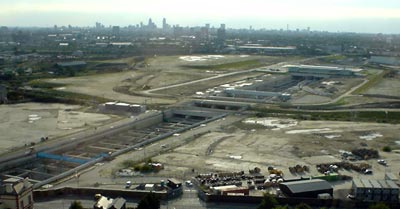
Balfron Tower: West London's Trellick Tower has a less famous older brother on the other side of the capital, just north of the Blackwall Tunnel. Both have a similar silhouette, both were designed by Erno Goldfinger, and both are admired from the outside by people who'd never dream of living on the inside. The architect himself was an exception. Goldfinger and his wife moved into the Balfron Tower soon after it was built, and spent a couple of months living in flat 130 on the top floor to find out what living here was like. This weekend, as part of Open House, Londoners have the chance to take a look inside a flat just along the corridor.
Residents of the Balfron Tower were eyeing up the growing queue outside their front door this morning with a certain degree of bafflement. What were these middle-class arty types doing here on a council estate in Poplar, and why were they willing to wait for hours to get inside. But this building is something special, a brutalist architectural masterwork with a highly original construction. I was lucky enough to be in the first small group of the day to gain entrance. The lifts to the top floor were malfunctioning so we could only ride up as far as the 18th floor before having to climb the remaining six storeys via the staircase. All the stairs and liftshafts are housed in a separate tower, joined to the main apartment block by a series of concrete bridges. We crossed the toppermost connecting walkway, our precarious mid-air state mostly shielded from view, and proceeded along to our target flat.
Bromley Hall: One of the joys of Open House weekend is discovering unexpected architectural treats on your doorstep. Bromley Hall looks like a very ordinary building beside the Blackwall Tunnel Approach Road, and I must have been past it scores of times without giving it a second look, but at its heart is the oldest brick house in London. In 1485 this was a hunting lodge with royal connections, located at the tidal limit of the River Lea. Later it became home to a series of successful merchants, each of whom made their mark on the structure and design of the building. The architect responsible for the hall's restoration, Paul Latham, was only too pleased to be able to show eager members of the public around inside his pet project. He knows every inch of the property inside out, from the old woodstained floorboards to the scrap of painted 17th century dado rail in the hallway. Particularly impressive are the patchy remains of a Tudor wall painting of a soldier wielding a crossbow, and a preserved wooden doorway carved with hunting scenes. With so many historical periods represented side-by-side, you get a real sense of domestic architectural evolution. I'm particularly astonished that Bromley Hall survived the 20th century, during which time it was damaged by wartime bombs, a passing motorway and bolted-on advertising hoardings, as well as (most recently) its use as a garage store and a carpet warehouse. All praise then to Leaside Regeneration for the sensitive way they've converted the building back to office space... although it would be tough to choose between working here or inside the pile of red containers stacked up nextdoor.
Royal Courts of Justice: If you're particularly naughty you might one day end up here, inside the big gothic building at the top of Fleet Street. The RCJ is the top civil court in the land (with the exception of the House of Lords) and also the criminal Court of Appeal. And until today I'd never quite appreciated from the outside how vast it is inside - a labyrinth of corridors, chambers and court rooms arranged around a long high vaulted hall. The building's open to the public every weekday, but yesterday there were special tours allowing us to tour behind the scenes. It was fascinating to prowl the back corridors and to hear more about the courts and their 8000 staff from some of those who work here. There was even the opportunity to go down into the cells of the Court of Appeal and follow in the footsteps of the country's more famous miscreants. I can now claim to have stood in the VIP holding cell, sat in the back of a 12-seater prison van, and even been taken up to the accused's bench in a dark and dusty courtroom via the back stairs. And next time the Lord Chief Justice gets a mention in the news I'll be able to picture his airy book-lined court room without having to rely on one of those awful artist's impressions.


