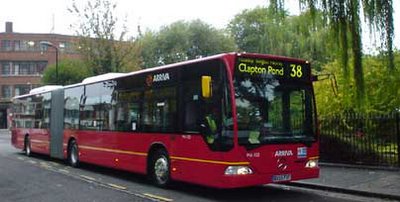
ND
NDThursday, December 01, 2005
Monday, December 05, 2005
Prime Movers
11 Routes: Fulham Broadway - Liverpool Street
Location: London southwest, inner
Length of journey: 7 miles, 11 buses
I rode the entire length of route 11 without ever travelling on a number 11 bus. Instead I took 11 different buses which just happened to follow the same route. Just to be different. And just to get a snapshot of the variety of different vehicles being used to transport people around the capital.
Bus vehicle type built comment 28 TN 33050 double decker 2001 an insipid purple interior 22 WVL 168 double decker 2005 ugly glass-fronted cuboid 49 VE 4 double decker 2004 an exercise in mediocrity 319 DWL 9 single decker 2001 dull suburban people carrier 211 TA 119 double decker 2002 nothing out of the ordinary 24 VP 316 double decker 2002 almost slightly comfortable 12 MAL 75 bendy bus 2004 artificial smelly nightmare 9 RM 1776 Routemaster 1962 charming old workhorse 15 RM 1933 Routemaster 1964 enchanting London icon 76 VLW 136 double decker 2003 disappointing blandness 23 TNA 33379 double decker 2003 polluted by on-screen ads
That's seven double deckers, one articulated bendy bus, one single decker and two Routemasters (courtesy of TfL's new heritage routes), all ridden in the space of less than two hours. I was expecting to be able to compare and contrast eleven rather different types of vehicle, but the cross section of London's bus fleet I observed turned out to be rather more homogeneous than I had anticipated.Conclusion 1) London's buses are all very new: Look at those years in my table. Every single bus I travelled on was of 21st century vintage, except for the Routemasters which were a full 40 years older and still going strong. Once the RMs disappear there'll be nothing even slightly old remaining, no heritage and, most importantly, absolutely no character.
Conclusion 2) London's buses increasingly have standing room only: More space for pushchairs and wheelchairs means fewer places to sit. The lower decks of the new double deckers could seat only about 20 people, while the single decker catered for about 30 (but without a top deck to take surplus passengers). But the evil bendy bus was by far the worst, proportionally speaking, with less than half of its crush capacity accounted for by its 48 seats. If you want to sit down, take a Routemaster.
Conclusion 3) London's modern double decker buses are all incredibly same-y: By the end of my 11-route journey it became apparent that London has a double decker design masterplan. On each of the modern vehicles there was always a rear set of nine seats, four of which faced backwards. In front there were always a few more seats facing forward, then an accessible area for pushchairs and wheelchairs opposite the exit doors. Next to the entrance doors was a luggage space, and then behind the driver's seat was the foot of the stairs, leading up to an identikit top deck. Every deck had little hemispherical cameras plastered across the ceiling, and dustbinlid mirrors above the exit doors, and plastic grab poles liberally sprinkled with 'let me off at the next stop' buttons. Each bus's character, if indeed it had any, came from minor tweaks and subtle differences in decor:
a) Different coloured seat covers: The 28's seats were sort of purple and turquoise, the 22 more speckled blue, the 49 dotty and green, and the 24 mauve with red stripes. In most cases the designs were so eye-watering that a previous passenger could have been sick all over the upholstery and nobody would have noticed.
b) Different seat cushion thickness: There's not much fabric to support you on a 28, whereas the 24's cushion thickness could be measured in inches. And I was lucky on my journey - several other new buses provide nothing more than a nasty plastic seat, rather like you'd find in a school dining room.
c) Different coloured floors: The 49's all-weather floor surface was light blue, the 22 was a darker shade of navy, the 219 was definitely grey, while the 23 and 28 boasted a faint purple. All also had speckly splattery bits in a variety of colours, like the gravel at the bottom of a fishtank or an accident in a glitter factory.
d) Different coloured plastic poles: Most buses had vertical grab poles in custard yellow, but those on the 23 and 28 were distinctly aquamarine. Sorry, maybe I'd better stop there.
Conclusion 4) Bendy buses smell: You just don't get that artificial stink on any of the other vehicles, do you?
11 links
• Route 11: anorak-level route information
• Route 11: timetable
• Route 11: last day of Routemaster service (October 2003)
Tuesday, December 06, 2005
Route 13: Aldwych - Golders Green
Location: London northwest, inner
Length of journey: 7 miles, 40 minutes
The 13 was one of the very last routes to convert from two- to one-man operation, falling victim to new accessible vehicles just a couple of months ago. But I believe in forward planning so I made my particular journey back in the summer, back when route 13 was still run by Routemasters. In the interests of true up-to-date accuracy, however, I've greyed out any part of my report which no longer holds true today. Why not read it twice?The graceful Routemaster buses of route 13 emerge at regular intervals from an Aldwych sideroad in the shadow of historic St Mary le Strand church. You can't board until the bus reaches the Strand, not unless you try leaping onto the rear platform while the bus is stopped at the Aldwych traffic lights. From here, so long as the road is jam-free, you can hurtle past the Savoy towards Trafalgar Square with the bus rattling, humming, shuddering and rocking as it goes. The driver then has to jockey for position to manouevre into the correct lane for Piccadilly Circus, before crawling slowly up Regent Street at the speed of the cyclist in front. Take a moment to admire this Georgian street and the absence of tacky commercialised illuminated decorations strung above the roadway. Then maybe you'll catch sight of a 159, not yet the only remaining Routemaster serving Oxford Street, as you take part in the usual snail's pace procession of bumper-to-bumper buses.
See the white-clad athletes out exercising their racquet skills on the tennis courts in the middle of Portman Square, and then it's all three-lane and one-way up Gloucester Place. Mind that unreliable modern bus broken down by the side of the road with its front engine door gaping open. Watch out for the squeegee spivs massing at the junction with Marylebone Road, and try to take comfort that the driver is high enough up in his cab to avoid a mucky sponge on the windscreen. The passing residential terraces become taller and grander as you approach the Regent's Park Mosque and canal. And look down from your prime top deck seat as you pass Lord's and there's a perfect view of the rear of the Nursery End grandstand where large crowds have gathered to watch Hampshire beat Warwickshire in the C&G Trophy final.
The leafy streets of St John's Wood are lined by elegant eight storey residential blocks, although architectural standards slide downhill as you pass from Westminster into Camden. Swiss Cottage turns out to be a disappointing theme pub, not a luxury Alpine chalet, while Frognal is merely a subdivision of West Hampstead and not a French enclave. Don't forget to show your ticket to the friendly conductor who's now finally found time to inspect the upper deck - that's one job less to do. For the next mile your years-old bus ascends the gentle slopes of Finchley Road, with the summit of Child's Hill offering extensive views westward over London's inner suburbs. And finally, at the end of a long and characterful journey, just wait for the security barrier to rise and then park up in front of Golders Green station. Here the driver and conductor can pause in companionship for a friendly chat to stave off the boredom before preparing for the return journey aboard this same magnificent vehicle. Who ever said 13 was unlucky?
13 links
• Route 13: anorak-level route information
• Route 13: timetable
• Route 13: last day of Routemaster service (October 2005)
Wednesday, December 07, 2005
Route 17: London Bridge - Archway
Location: London north, inner
Length of journey: 6 miles, 50 minutes
A Wednesday morning journey in five stops and four passengersBus stop 1 - Joiner Street: Scores of commuters swarm out of London Bridge mainline station. A few linger in the bus shelter outside Fitness First, but most stride on into the sidestreets of Southwark. A stream of black cabs crawls slowly by. The tip of the Gherkin rises above the bus station's spiky skylights. She waits.
Passenger 1 - 40ish female: She boards quickly, teetering towards the rear of the bus on high black heels. An understated scarf is twisted fashionably around her neck. She places her chunky black handbag on the seat beside her and shuts down. Her mind is on auto-pilot, oblivious of the passing sights and the low mist hanging above the Thames. A display of sparkly silver handbags in a Cannon Street window is the only City spectacle to catch her distant eye. She presses the button to escape, but slow-crawling traffic beside St Paul's delays her exit by several minutes. She's bored, she's unfulfilled, she's resigned to going to work. She alights.
Bus stop 2 - Ludgate Hill: City Thameslink station is in mid-morning hibernation. WH Smith is bolted shut as the trains arrive empty. Nobody stops off at the tiny International Cheese Centre, for Emmental, Edam or otherwise. Traffic queues patiently to cross the Farringdon Road. A bloke with a big fluffy microphone wanders by, cameraman in tow. Starbucks is doing a roaring trade. The first edition Evening Standards have yet to arrive. He waits.
Passenger 2 - 50ish male: He sports a gold bracelet and close-cropped grey hair. The badge on his big blue jacket reveals he's a postal worker, probably already heading home after a taxing early shift. He moves swiftly to take control of the rear cluster of seats. He opens his tabloid, whips out his reading glasses and flicks through the hyped headlines, blotting out the chatter and noise all around. Two miles and 72 pages later he re-folds his paper and rests his big black boots on the upholstery opposite. A rasping cough suggests he's missing his nicotine. Getting off can't come a moment too soon. He alights.
Bus stop 3 - Caledonian Road (Story Street): A long low-key parade of shops attracts midweek truants and old ladies pushing baskets on wheels. A speed camera nods its head at the stripy tarmac. A crocodile of schoolchildren troops up the road past a discarded fridge, their teacher resplendent in pink trainers and a slightly too bright multi-coloured scarf. Wind whips through the open-ended bus shelter. Across the road, the Tibetan Buddhist Centre lies respectfully silent. He waits.
Passenger 3 - 20ish male: Sportswear in grey and blue is the order of the day. His hoodie is mostly navy and his trackies mostly slate. A white badge on his sleeve proclaims allegiance to the Adidas tribe. His messy hair looks like it was cut to be gelled, except he's not been bothered to spike it up this morning. It's only a short trip, a couple of stops past the prison, but it saves wearing out the soles of his white trainers. He alights.
Bus stop 4 - Caledonian Road station: This is not so much a community as a building site. "Always wear your eye protection." Major renovation is underway at the tube station, concealing the Leslie Green frontage behind poles and sheeting. The buzzer beside the site office door isn't working, so workmen rap ever more impatiently to gain entry. Across the road a tall crane looms above a mountain of scaffolding and several storeys of half-built walls. One day, maybe soon, social housing and yuppie flats will coexist here. She waits.
Passenger 4 - 50ish female: She throws her cigarette to the pavement and climbs to the upper deck. Her coat is warm and blue with a fleecy collar. Her jeans are stonewashed and flared below the knee, and a cheap foldaway brolly hangs from her wrist. On almost anybody else a lumpy pink cap, big specs and gold earrings just wouldn't work, but somehow she carries the look. She digs deep into her pocket to dig out a delicate handkerchief, then fills it. Her journey is quiet and lonely, with only the view for company. She alights, and lights up.
Bus stop 5 - Archway: Ugly office blocks dominate the choked roadway at the foot of Highgate Hill. The pub across the road is adorned with cartoon characters from old Guinness ads. A newspaper seller huddles inside his kiosk for warmth, waiting to earn a few more pennies from passing purchasers. People scatter as a streetsweeping van clears the pavement. The entrance to the tube station is camouflaged at the foot of some concrete steps. I depart.
17 links
• Route 17: anorak-level route information
• Route 17: timetable
• Route 17: Exceptionally rare Routemaster sighting (June 2004)
Thursday, December 08, 2005
Route 19: Battersea Bridge - Finsbury Park
Location: London southwest/northeast, inner
Length of journey: 8 miles, 85 minutesRoutemaster operation ceased on Route 19 on April 1st this year. No joke. I took one last ride on the old 19 the week before, just so that I didn't miss out. I headed down to Thames-side Battersea one wet weekday afternoon, waiting in the light drizzle beside an upmarket reed-backed florist's kiosk. The changeover was already underway so I had to wait for 15 minutes while a couple of dull modern double deckers emerged from the tumbledown old shed that doubles as Battersea bus garage. But I successfully grabbed the top-deck front-seat view on the next vintage vehicle for a snail's pace crawl across Central London, and suddenly the wait was worthwhile. The pair of Japanese tourists sat beside me clearly agreed, and snapped away towards Chelsea Wharf and that power station as the bus queued across the river.
The best thing about riding a bus all the way along the King's Road is that you can't get off and buy anything. Instead you can look down on the ladies who lunch, lugging their haute couture carrier bags from boutique to boutique as they try to decide which designer pashmina to slap on the platinum card next. Inbetween the label-obsessed shops it's all posh terraces and garden squares, and crocodiles of blazered schoolkids trotting meekly off to prep. My bus then got stuck in Knightsbridge gridlock for a miserable 20 minutes, but (unlike now) those Japanese tourists were still able to hop off the open platform and escape with ease. We chugged round Hyde Park Corner, we transported some Chelsea nobs to the art galleries up Piccadilly and we paraded proudly up Shaftesbury Avenue (at the time the only road in Central London where every bus was still a Routemaster).
I've always been impressed by the memory skills of the conductors aboard crew-operated buses. The first time they tour the bus they pinpoint you with an arresting stare and ask to see your ticket or to cough up the relevant fare. The second time they come round they seem to remember that your presence has already been vaildated and so concentrate their friendly glare on other, more recently boarded passengers instead. It's a tough mental task to perform on an ever-changing sea of transient faces, which may be why somewhere up Charing Cross Road the conductor on my particular bus failed and asked to check my Oystercard for a second time. I blame the excessive sluggishness of our journey, or maybe the fact that he was probably preoccupied by his imminent redundancy.It was at about this time, a full hour into the journey, that I got to share my top deck view with a genuine minor celebrity and his friend the bus fanatic. The minor celeb was BBC London 94.9FM presenter Simon Lederman. You've probably never heard of him, and neither had I, but his name was written on an envelope and Google is a wonderful thing. Simon's on-board rendezvous was to check the Radio London advert in the Cobham Bus Museum Open Day programme, and to collect some prize tickets to give away on air. An almost fascinating half hour discussion ensued, which I couldn't help but overhear, sorry gents. I learnt that introducing the new fleet of buses on Route 19 would greatly increase passenger loading time, that one of the best places to photograph doomed Routemasters was up Rosebery Avenue opposite Sadlers Wells Theatre (no shadows, apparently), and that the Open Day advertising leaflet should perhaps have been proofread more carefully before being printed.
And then, without warning, our bus terminated a mile and a half early, just outside Highbury & Islington station. No excuse was given but I suspect (very) late running was to blame. There were no other 19 Routemasters in sight so, purely for comparative purposes, I rode the rest of the route on the following (very) ordinary double decker. The replacement boxy 19 had that fresh-out-of-the-garage smell that 40-year-old buses don't have, as well as fairly lurid green upholstery and zero character. The journey was mundane and ordinary, enlivened only by the sight of Highbury Stadium up a sideroad as the bus approached its destination at Finsbury Park. Arsenal's old ground may be doomed to residential obsolescence within the next six months, but that's still six months longer than its fellow London design classic, the Routemaster bus. Thirty hours and counting.
19 links
• Route 19: anorak-level route information
• Route 19: timetable
• Route 19: last day of Routemaster service (April 2005)
In memoriaRMFriday, December 09, 2005
The Last Routemaster
Route 159: Marble Arch - Oblivion
Location: the heart of London
Length of journey: millions of miles, 49¾ yearsAround noon today, London's last (genuine, scheduled, non-tourist) Routemaster bus will set out from Marble Arch on one last journey. There'll be an enormous press presence of course, and a great clamour from bus enthusiasts attempting to grab a seat on the final vehicle. Just after one o'clock this afternoon, assuming the photographers and wellwishers don't delay its southward progress, the RM will reach Brixton Bus Garage and the end of the road. And then by teatime time Mayor Ken will be able to tick the box in his transport policy which reads ' Fully accessible bus network'. The romantic era of bus travel in London fades away at lunchtime today. Welcome to the plastic age.
10:57 - the last RM north from from Streatham
11:54 - the last (normal) RM departs Marble Arch
12:10 - the last of five specials departs Marble Arch
12:15ish - dg stands in Piccadilly Circus and waves
13:15ish - the last (ever) Routemaster arrives Brixton Bus Garage
13:16ish - the 100% accessible future (damn, sniff)
• Full operational details of the last day
• Routemaster goodies on (limited) sale at the LT Museum Shop
• Routemaster Night (tomorrow night, BBC4, from 7:30pm)
• BBC Routemaster TV clips (see Lesley Judd as a 70s clippie)
• Inspector Sands was out with his camera yesterday
• Farewell from the London Bus Page
• Fancy buying your own Routemaster? (£6500-£10000)
• Routemasters - Last Stop! (and turn off the music)
• Bob Stanley will be glad to see the back of them
• My Routemaster portfolio: The 38 Stops
• My journey on the very last Routemaster on Route 8
• Save the Routemaster (you'd better hurry, lads)
The Last RoutemasterRoute 159: Marble Arch - Streatham
Location: London south, inner
Length of journey: 9 miles, 65 minutes
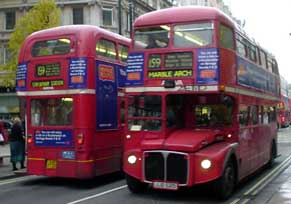 I made my last journey on the last Routemaster route a few weeks ago, back when the extraordinary was still ordinary. I was hoping to grab one of the top deck front seats but, even on a quiet Saturday at the far western end of Oxford Street, I was beaten to this prime location by a family of 4 and a bloke in a grey anorak. The bloke in the grey anorak conformed to every stereotype you might expect of a serial bus spotter. His anorak was weatherproof and toggled, his spectacles were thick and functional, his rucksack was that special Milletts shade of beigey-grey and his camera was the size of a small child. I carried out a quick subconscious check to make sure that I was wearing nothing similar. The family of 4, meanwhile, had evidently been dragged on board because Dad wanted to make one final journey on a Routemaster before time ran out. He allowed his two teenage children to sit in the front seat while he and his mute wife took up position immediately behind. Daughter was desperately unimpressed - "But I've been on this bus so many times Daddy oh look Selfridges!" - and preoccupied herself instead by shovelling seaweed and sushi into her mouth. Son was less obviously bored, but spent most of his time discussing Hollywood special effects - "Cor, Ice Age lights!!" - and the squash shoes he hoped to get for Christmas - "Mummy do not buy him new trainers he won't use them!".
A bittersweet mix of ancient and modern was visible from the top deck as we drove along. An old lady gestured wildly from the pavement as our driver sailed past without stopping, while a younger braver soul leapt confidently onto the rear platform. In Regent Street our progress along the bus lane was blocked by a gaggle of fragile rickshaws parked up outside Hamleys, poaching custom from glowering cabbies. Down Haymarket a retired couple sat glumly in a plush red booth in the window of an Angus Steak House, while just down the road some brighter young things sat on full display on Starbucks stools, nibbling paninis and sipping mochas. In Trafalgar Square a lone pigeon perched high atop Nelson's stone hat, her species almost extinct across the pedestrianised plaza below. And we earnt sideways smiles from our fellow passengers aboard every 159 passing by in the opposite direction, whilst looking down contemptuously on every over-long bendy bus stuck blocking the roadway.
 The conductor unwisely moved forward to check our tickets while our bus was cornering hard round the edge of Parliament Square. Centrifugal force caused him to lose his footing and he nearly (but not quite) fell on top of Family Dad. No harsh words were spoken, indeed there were broad smiles as if it were almost a privilege to be nearly flattened by an endangered species. We sped past the foot of Big Ben and crossed the Thames, the very last Routemaster route to penetrate south London. The ghastly squat concrete building in the centre of the roundabout on the east side of Westminster Bridge was finally being demolished - that's one 60s extinction that won't be missed. Dad pointed out the plaque on Charlie Chaplin's house, just up from Kennington Cross, although Son's silver screen knowledge didn't seem to stretch that far back.
A full hour after leaving Marble Arch we were queuing to enter Brixton. I could see that Daughter was less than excited by the retail opportunities available down this particular high street. Maybe she was put off by the police sign warning of rampant mobile phone thefts, or the old man in a wheelchair sat alone and mumbling outside KFC, or the Chinese lady singing Amazing Grace backed by a support team in 'Praise God' puffa jackets. Dad was more impressed by the sight of the old brick tramshed - "I really like trams, I do" - which, back in 1870, formed the southern terminus of London's very first tramway. Perhaps appropriately, today's final journeys on Route 159 will follow an identical route.
 We continued to climb Brixton Hill, zipping past another yet empty bus stop with every double-ding of the bell. A brace of Routemasters stuck their shiny red noses out of Brixton Bus Garage on the top of Streatham Hill. Come lunchtime today, as each 159 crew calls in here for its regular meal break, their brave old vehicles will be withdrawn from service one by one, forever. But we still had one last mile to travel down the Streatham High Road, past a panoply of shops, nightclubs and bowling alleys, accompanied part of the way by an elegaic Air on a G String ringtone. And finally, very finally, absolutely finally, to a bleak bus stop beside a graffitied phonebox on a dual carriageway opposite the Streatham Ice Arena. Time for us all, reluctantly, to disembark. I watched as the bus turned across the High Road and pulled up in front of the small satellite garage here, waiting patiently to make its return journey. I watched as Dad led his family across the street to take some final photographs of this transport of delight, purring quietly at the kerbside. And I watched as even 'unimpressed' Daughter whipped out her phone to snap one last close-up shot of the front of this iconic vehicle. That's Routemaster magic. Missing you already.
 159 links
• Route 159: anorak-level route information
• Route 159: timetable
• Route 159: last day of Routemaster service (December 2005)
• Route 159: yet more photos
The Last Routemaster

(large version here)
Monday, November 14, 2005
London's shortest place names
3: Bow, Ham, Kew, Lee
4: Hook, Nash, Soho
5: Acton, Cheam, Downe, Erith, Hayes, Penge, Upton
6: Arkley, Balham, Barnes, Barnet, Bexley, Camden, Cowley, Cudham, Ealing, Eltham, Fulham, Harrow, Hatton, Hendon, Heston, Hoxton, Ilford, Kenley, Kenton, Leyton, London, Malden, Merton, Morden, Newham, Osidge, Poplar, Pinner, Purley, Putney, Sidcup, Sipson, Sutton, Waddon
(n.b. I'm not allowing places which exist only as station names, eg Angel, Bank, Oval)
London's longest (one word) place names
11: Barkingside, Bexleyheath, Brondesbury, Chessington, Chislehurst, Clerkenwell, Cockfosters, Cricklewood, Edgwarebury, Freezywater, Gunnersbury, Hammersmith, Leytonstone, Locksbottom, Pentonville, Rotherhithe, Sanderstead, Snaresbrook, Southfields, Walthamstow, Westminster, Whitechapel
12: Southborough, Spitalfields
13: Harmondsworth, Knightsbridge
Sunday, November 13, 2005
The Lord Mayor's ShowAn English village show is always a quaint, traditional occasion, usually involving the local school orchestra and the anointing of a carnival queen who parades around the streets on the back of a lorry. The Lord Mayor's Show is very similar, except that the event is held in honour of a portly old bloke in a red cloak who parades around the streets in a horse-drawn gold coach. Welcome to the City of London's grandest day out.
The Lord Mayor's Show takes place every year on the second Saturday in November. The event has an uninterrupted history stretching back 790 years, which is bloody impressive really, even if all that happens is that the new Lord Mayor rides up to the City of Westminster to pay his respects to the sovereign and then rides home again. But the whole journey is wrapped up in such pomp and spectacle that half a million people turn out to line the route, nearly two miles in total from the Guildhall to Temple and back again. And I'd never been before, and the weather was nice, so I thought I'd go along. I gave the outward leg past St Paul's Cathedral a miss and took up position instead down on the Embankment near Blackfriars, just behind a group of conveniently short cub scouts.
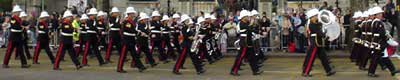
The parade is organised with military precision, taking precisely one hour and five minutes to pass each point along the route. Maybe that's why most of the participants appeared to have military connections, from mounted soldiers to bearskinned bandsmen. In fact if they'd withdrawn everybody who kills for a living from the parade, the whole event would have been considerably shorter. I was struck by the wide variety of historical fashion that passes for modern military uniform, and also noted that there appear to be some really lardy seamen in the navy these days. The event was an aural feast for everyone who relishes the three-note melodies of military band music. Every couple of minutes another crack team of cornets (or flutes or trumpets or accordions or big silver glockenspiels) strode past, competing to be heard above the sea shanties and other traditional tunes playing out to front and rear. Young musicians in over-sized uniforms performed like true professionals. Percussionists held their drumsticks high, like split-second moustaches. Buglers carefully sidestepped a suspicious puddle which had recently erupted from the underbelly of a large stallion. And hey, where else could you hear the Isle of Sheppey St John Ambulance Band and the Romford Drum & Trumpet Corps? It's unique stuff, this.
Whereas village shows usually feature a succession of floats organised by car dealers, an old people's home and the local sea cadets, the Lord Mayor's Show always manages something a little more exclusive. Many of the participants seemed to be celebrating centenaries this year - the Rotary Club and the AA, for example - or were in some way connected to the Lord Mayor himself. Charlie Dimmock and Michael Aspel were on the back of one charity's float, allegedly, although they were all dressed up for the Mad Hatter's Tea Party so I didn't recognise either of them. Some of the organisations taking part were just plain obscure, like the Old Bailey Judges Golfing Society (seen beaming from a vintage vehicle). There were also a couple of public schools blatantly touting for business, some sick animals in search of a home, and even a camel called Therese (honest).
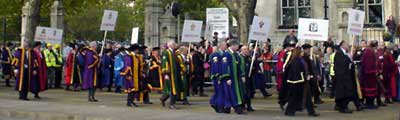
Much of the rest of the parade was taken up with City types. That's not the financial institutions (although a few were represented) but the archaic civic hierarchy of Guilds, Livery Companies and Aldermen. There are 107 Livery Companies recognised by the City, but only a few got to take part in this year's procession. The new Lord Mayor is a member of the Merchant Taylors, so they got a float, as did the equally medieval Blacksmiths, Pewterers and Leathersellers. The Distillers looked to be having a whale of a time on the back of their lorry (hic) while the Woolmen were probably regretting dressing up as yokels and shepherdesses for the day. But there were also some rather more unlikely guildsmen parading up and down in swirling cloaks and big floppy hats, because it seems any modern profession can be incorporated as a Livery Company these days. All hail the Worshipful Company of Hackney Carriage Drivers and (most recent of all) the Worshipful Company of Tax Advisers, not to mention a crowd of caped businessmen representing Management Consultants, Lightmongers and Information Technologists. Maybe next year we'll get Baristas, Clampers and Minimum Wage Cleaning Operatives.
Near the end of the procession I spotted the Pageantmaster - not a new Harry Potter character but the man responsible for organising all 64 floats and 5261 participants into one clockwork procession. He stood proud in his open carriage, beaming like a victorious army general, resplendent beneath a black feathery hat. And finally came David Brewer (the City of London's seven hundred and something-th Lord Mayor) in a gleaming gold coach pulled by five great shire horses. He waved his black-fringed tricorn hat out of the window at the passing crowds, evidently enjoying every second of this very special autumn afternoon, before heading sedately onwards towards Mansion House. David has a busy year ahead, acting as the City's ambassador at home and abroad, hosting big banquets and raising money for his nominated charity. Sounds like Dick Whittington had it easy.
Routemaster update: As part of the Mayoral procession, Transport For London gave us a sneak preview of the new heritage routes (starting tomorrow) by wheeling out one of their spruced-up fleet of surviving Routemasters. The bus was very red and very shiny, in a way that the old 38s weren't, and the poster on the side ("Take a trip on a London landmark") was unexpectedly tasteful. Come Monday morning, at 0930 precisely, this smart old workhorse will be transporting sightseers (and the odd late commuter) on route 15 between Trafalgar Square and Tower Hill. But only a handful of Routemasters have been rescued and restored in this way, and only to provide a token service on two curtailed routes between a few major tourist attractions. I guess it's better then scrapping the lot of them. But only just.
• Route 9: Aldwych, Trafalgar Square, Piccadilly Circus, Hyde Park Corner; Royal Albert Hall
• Route 15: Trafalgar Square, Aldwych, Fleet Street, St Paul's, Cannon Street, Tower Hill
Wednesday, November 09, 2005
London Telephone Exchange Codes
200 COOmbe End, 205 COLindale, 206 CONcord, 207 COPpermill, 208 COVent Garden, 209 BOWes Park, 220 ACOrn, 222 ABBey, 225 BALham, 226 CANonbury, 227 BARnet, 228 BATtersea, 229 BAYswater, 232 BECkenham, 233 ADDiscombe, 235 BELgravia, 236 CENtral, 237 BERmondsey, 238 ADVance, 239 BEXleyheath, 242 CHAncery, 243 CHErrywood, 244 CHIswick, 247 BIShopsgate, 248 CITy, 250 CLOcktower, 252 ALBert Dock, 253 CLErkenwell, 254 CLIssold, 257 ALPerton, 258 BLUebell, 262 AMBassador, 264 AMHerst, 270 CROydon, 272 ARChway, 273 CREscent, 274 BRIxton, 276 ARNold, 278 BRUnswick, 279 CRYstal Palace, 282 BUCkhurst, 283 AVEnue, 285 ATLas, 286 CUNningham, 287 BUShey Heath, 297 BYRon, 299 BYWood
300 FOOts Cray, 305 DOLlis Hill, 306 DOMinion, 307 FORest Hill, 308 FOUntain, 309 FOX Lane, 324 FAIrlands, 325 EALing, 326 DANson Park, 327 EASt, 334 EDGware, 335 FELtham, 336 EDMonton, 337 DERwent, 339 EDWard, 342 DICkens, 343 FIEld End, 345 DILigence, 346 FINchley, 348 FITzroy, 350 FLOral, 352 FLAxman, 353 FLEet Street, 354 ELGar, 356 ELMbridge, 357 ELStree, 358 ELTham, 362 EMBerbrook, 363 ENField, 367 EMPress, 368 ENTerprise, 370 FRObisher, 372 FRAnklin, 373 DREadnought, 373 FREmantle, 378 DRUMmond, 379 DRYden, 385 DUKe, 385 FULham, 386 DUNcan, 387 EUSton, 393 EWEll
400 GOOdmayes, 404 HOGarth, 405 HOLborn, 407 HOP, 408 HOUnslow, 409 HOWard, 423 HADley Green, 424 HAInault, 425 GALleon, 426 HAMpstead, 427 HARrow, 428 HATch End, 429 HAYes, 430 GEOrgian, 432 HEAdquarters, 436 HENdon, 437 GERrard, 442 GIBbon, 444 HIGhgate Wood, 445 HILlside, 447 GIPsy Hill, 448 HITher Green, 452 GLAdstone, 453 ILFord, 467 IMPerial, 470 GROsvenor, 472 GRAngewood, 473 GREenwich, 474 GRImsdyke, 475 ISLeworth, 482 IVAnhoe, 483 HUDson, 485 GULliver, 486 HUNter, 487 HURstway, 489 IVYdale, 493 HYDe Park
506 LONdon Wall, 507 LORds, 508 LOUghton, 509 LOWer Hook, 522 LABurnum, 523 LADbroke, 524 LAGoon, 525 LAKeside, 526 LANgham, 527 LARkswood, 528 LATimer, 532 KEAts, 533 LEE Green, 535 KELvin, 536 KENsington, 539 LEYtonstone, 542 LIBerty, 545 KILburn, 546 KINgston, 547 KIPling, 548 LIVingstone, 564 KNIghtsbridge, 577 LPR, 583 LUDgate Circus, 586 JUNiper, 587 LTR (RHQ), 593 LXD
600 MOOrgate, 602 NOBle, 605 MOLesey, 606 MONarch, 607 NORth, 608 MOUntview, 622 MACaulay, 624 MAIda Vale, 625 MALden, 626 MANsion House, 627 MARyland, 628 NATional, 629 MAYfair, 632 MEAdway, 635 MELville, 638 METropolitan, 639 NEW Cross, 645 MILl Hill, 646 MINcing Lane, 648 MITcham, 683 NUFfield, 685 MULberry, 686 MUNicipal, 687 MUSeum
703 RODney, 705 POLlards, 707 POPesgrove, 708 SOUthall, 709 ROYal, 720 SCOtt, 723 PADdington, 724 RAGlan, 725 PALmers Green, 726 SANderstead, 727 PARk, 728 RAVensbourne, 732 PECkham Rye, 733 REDpost, 734 REGent, 735 RELiance, 736 RENown, 737 PERivale, 738 SEVen Kings, 740 SHOreditch, 742 RIChmond, 743 SHEpherds Bush, 745 SILverthorn, 746 PINner, 747 RIPpleway, 748 RIVerside, 750 SLOane, 758 PLUmstead, 759 SKYport, 762 SNAresbrook, 770 PROspect, 772 SPArtan, 773 SPEedwell, 774 PRImrose, 777 SPRingpark, 780 STOnegrove, 782 STAmford Hill, 783 STEpney Green, 785 SULlivan, 786 SUNnyhill, 787 STReatham, 788 PUTney, 793 SYDenham, 794 SWIss Cottage
808 TOTtenham, 809 TOWnley, 822 TABard, 825 VALentine, 826 VANdyke, 828 TATe Gallery, 829 TCY, 833 TEDdington Lock, 836 TEMple Bar, 837 TERminus, 840 THOrnton Heath, 842 VICtoria, 843 TIDeway, 844 VIGilant, 845 VIKing, 847 VIRginia, 853 TLD, 863 UNDerhill, 870 TROjan, 872 TRAfalgar, 873 TREvelyan, 875 UPLands, 877 UPPer Clapton, 879 TSW, 883 TUDor, 885 TULse Hill, 887 TURnham Green, 894 TWIckenham Green
900 WOOlwich, 907 WORdsworth, 925 WALlington, 926 WANstead, 927 WARing Park, 928 WATerloo, 929 WAXlow, 935 WELbeck, 936 WEMbley, 937 WEStern, 943 WIDmore, 944 WHItehall, 945 WILlesden, 946 WIMbledon
Saturday, November 05, 2005
5/11: Plot
Four hundred years ago today, had all gone to plan, Guy Fawkes planned to destroy the Houses of Parliament and most of the country's nobility in one single catastrophic act of high treason. Instead he found himself locked away inside the Tower of London, beaten but as yet unbowed, the tables turned. Fawkes was secured in an upper room inside the Lieutenant's Lodgings, still insisting to his captors that his name was 'John Johnson', honest guv. Then the following day, on the direct orders of the King, he was taken down to the dark basement of the White Tower to be tortured in the hope that this might finally loosen his tongue. By November 9th Guido had admitted all, the shaky signature on his confession hinting at the brutality of the abuse that he had experienced. Fawkes spent the last three months of his life locked inside the Tower, denied the freedom he had hoped to deny others, before finally being led away to trial and execution. End of.
The Tower of LondonYou probably think of the Tower of London as a vastly overpriced tourist honeytrap, and you'd be right, but think of the place instead as central London's finest medieval castle and somehow the £14.50 entrance fee feels slightly more justified. The setting is nothing if not spectacular, tucked in beside the Thames alongside eponymous Tower Bridge. Here, ten centuries ago, William the Conqueror ordered the construction of a huge fortress to subdue the people of newly-invaded London. The sheer enormity of the White Tower was like nothing seen before in England, and the local population must have been duly cowed. Over the years the scale of the castle was enlarged, first with one high surrounding wall and then another, until eventually the structure contained a full 20 towers encircled by a deep protective moat. In medieval times the Tower doubled up as both military stronghold and royal residence, although its defences were never tested by any invasion and most kings and queens preferred to live elsewhere. From Tudor times the Tower became more of a prison and armoury, but within the walls were also to be found a mint, a royal zoo, a record office and a fiercely guarded treasure house. Few, if any, buildings anywhere in England are as diverse, or as historic.
I entered the Tower via the modern paved piazza on the western side (and not by boat through Traitors' Gate). The queues were pretty long, even first thing on a Sunday morning, and I suspected that I was one of the few visitors attending from my home country. A free guided tour of the Tower runs half-hourly from the main gate - a mass of eager tourists flocking round a single cheery Yeoman Warder - but I walked past to gain entry to the main part of the castle site before the majority of the day's visitors arrived. The central courtyard was almost deserted, save for a couple of gossipping Beefeaters and a few flapping ravens, and the experience was rather magical.
The start of the day was definitely the best time to view the Crown Jewels in the Waterloo Block. I sailed through the slalom of antechambers, barriers and film presentations (during busier periods the experience must be a little like queuing for an upmarket Disney ride), eventually passing through a thick vault door to view the collection itself. A wide variety of royal regalia was on display, from official coronation robes to obscenely ostentatious gold banqueting plate, but the centrepiece was the priceless set of bejewelled crowns, orbs and sceptres. These are viewed by standing on the world's slowest travelator and being carried gently by. It being quiet, I went past three times, just because I could. Most impressive were the enormous sparkling gemstones, including the legendary Koh-i-Noor diamond and the world's largest cut diamonds, Cullinan I and Cullinan II. The British Royal Family may have custody of these unique jewels only because of outdated historical privilege, but this collection surely makes Her Majesty the UK's official diamond geezer. But it's been more than fifty years now since much of the coronation regalia was last used, and at this rate it may be a couple more decades before King Charles gets to wear any of it in public.
Next I nipped across the courtyard to the White Tower. There were four floors to explore, most featuring exhibitions of royal armour and shining weaponry. I was duly impressed by the size of King Henry VIII's codpiece (surely he should have been embarrassed walking around with that mighty protruberance sticking out in front of him?), and also by some of the intricate equestrian armour. A special audio-visual exhibition on the top floor presented the story of the Gunpowder Plot, just in case I hadn't seen it enough on my previous travels, while in the basement (somewhere) was the very room where Guy Fawkes was taken to be so brutally tortured. Best of all however was the chance to walk around inside an ancient Norman castle in the very centre of London. I'm a great lover of twisty-turny medieval stone staircases, and there were several of these on the way round. William the Conqueror may not have been bound by modern accessibility legislation, but I was secretly pleased that no modern committee had ordered the renovation of the historic upper floors to include ramps for pushchairs or lifts for wheelchairs. Sorry, but some buildings are best left well alone.The courtyard was more crowded now. Tourists were busy filming the sentry outside the Jewel House, taking pictures of the ravens hopping about on the lawn and accosting Beefeaters to pose with them in a souvenir photo. Some were gathered around the scaffold on Tower Green where (only seven) prisoners were executed, while others enjoyed the dramatic presentations being staged to bring the Tower's history to life. Around every corner it seemed there was another doorway to explore. I squeezed into the Bloody Tower to see the room where two royal princes may once have been murdered, and braved another narrow staircase in the Beauchamp Tower to see graffiti scratched into the stone wall by desperate prisoners back in Tudor times. I explored Edward I's royal palace overlooking the river, now partially restored to resemble their original 13th century splendour. I found the well-concealed entrance to the eastern battlements, from which you can look down on the front doors, rooves (and washing lines) of the houses occupied by the Yeoman Warders and their families. And beneath the Bell Tower I captured this photograph of the very room in which Guy Fawkes was held during his time in the Tower (behind the upper right window). Here he'd have spent his last night on earth, praying to his Catholic God before being taken away to be hanged, disembowelled and chopped up into four meaty chunks. I counted myself rather more fortunate when, after thoroughly enjoying my time exploring the Tower of London, I was able to leave of my accord.
• The Tower of London (what to see)
• The history of the Tower of London
• Ten (more) flickr photos of the Tower
• Gunpowder Treason (exhibition in the White Tower)
Friday, November 04, 2005
The Gunpowder Plot was foiled not on the fifth of November but on the fourth, 400 years ago today. There were no black and yellow security barriers outside the Houses of Parliament in those days, no armed guards posted at every entrance and no compulsory bag searches before entry. All the conspirators had to do was to hire a cellar beneath the House of Lords, fill it with 1½ tons of gunpowder and wait. Unluckily (for them) the State Opening of Parliament was delayed by a month because of plague, during which time news of the 'secret' plot leaked out. Guy Fawkes and his barrels of explosive were therefore discovered just in time, significantly extending the life expectancy of Britain's ruling aristocracy in the process.
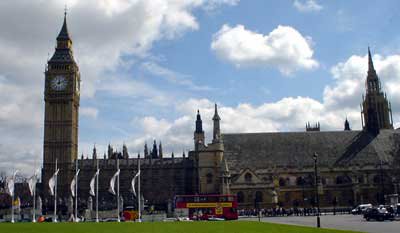
Houses of Parliament, Westminster
It's not widely known just how easy it is to gain entrance to the Palace of Westminster. You can write to your MP and ask to be taken round (although, given who my MP is, I think I'll wait a few years). You can queue up to see a debate in the Commons or the Lords (the latter has far shorter queues than the former). You can ask the fierce-looking policemen outside St Stephen's Entrance for permission to take a look round Westminster Hall (open daily at present for a Gunpowder 1605 exhibition). Or you can do what I did and take a tour of the main building during the summer recess (at only £7 per head, this must be one of London's best bargains). Admittedly the security checks are really quite strict (the stern lady in the black portakabin poked me with her electronic wand and gave me a very thorough patdown before issuing me with my official visitor's sticker). But once you're through, the chance to experience democracy first hand is really rather special.The official tour of the Houses of Parliament begins here in the Sovereign's Entrance, beneath the Victoria Tower. I was lucky and ended up in a tiny group of seven, just me and some backpacking tourists from Australia and Texas, showed round by Robina the Blue Badge Guide. She asked us to put away our cameras and then led us into the building, following the route the Queen takes when she comes to open Parliament. Even at nearly 80 Liz can still climb the initial grand staircase unaided, we were told, so there was no sign of a Stannah stairlift installed as yet. As we entered the Robing Room it was immediately obvious, if it hadn't been from outside, that this is not the original Palace of Westminster. A fire in 1834 succeeded where Guy Fawkes had not, destroying the medieval building and forcing an almost complete rebuild. What we were seeing was the uber-Gothic interior of a Victorian architect's wet dream - all fancy ornate woodwork and excessive over-decoration. The gold leaf plastered around the room, and the Chair of State in particular, looked as if it might well have cost the entire 19th century GDP of an exploited Empire colony.
Next to the Royal Gallery, an extremely long, high room lined with portraits and grand paintings. The two most prominent of these are huge canvases depicting, in great detail, the defeat of the French at Trafalgar and Waterloo. Comfy chairs are scattered along the full length of the room, as befits the country's most exclusive gentleman's club. It's just a short procession from here through the Prince's Chamber ante-room to the (oh my God I'm actually standing in the) House of Lords. This historic chamber is a lot more compact in real life than it looks on the television but also a lot grander, so long as you look at the big gold throne and the panelled walls and not the squashed red leather benches or the obtrusive dangling microphones. We got to sit on the steps at the far end, while Robina pondered out loud the various possible futures of this increasingly less important second chamber.
Continuing eastward, the subtle colour change of furniture from red to green signalled our passage from the Lords to the Commons. We'd arrived in the Central Lobby, the buzzing hub of the Palace and the classical backdrop you usually see behind TV political correspondents. Except it was a Saturday morning so the place was almost silent, apart from a clerk at the main desk and some yellow-helmeted workmen wheeling long low trollies, frustratedly trying to find a step-free exit from the building. The Members' Lobby nextdoor housed bronze busts of 20th century Prime Ministers, including recently departed Heath and Callaghan. My local MP merited only an empty pigeonhole.
We ventured onward towards the Commons chamber itself, where Black Rod fears to tread. The surrounding 'Aye' and 'No' lobbies were rebuilt after World War 2 following major bomb damage and therefore look disappointingly ordinary, more like a town hall library than the national seat of power. Robina sat us down in the Noes for a quick historical update, then led us into the (oh my God I'm actually standing in the) House of Commons. Our group got to line up along the Government backbenches, more usually occupied by Tony's semi-loyal hecklers, while the tour ahead of us took the place of Her Majesty's Opposition. Here we stood as unelected members of the public, right at the very heart of British democracy, facing one another across the Despatch Boxes. Alas we were not permitted to act like real MPs and shout 'hear hear' or fall asleep on the green-backed leather benches. Major building work was underway, with a huge new security screen being erected to prevent any more angry fathers hurling condoms full of purple flour (or worse) at the PM, so unfortunately much of the chamber was boarded off. Still, I can at least say I saw half of the most important room in the country.We retraced our steps and entered St Stephen's Chapel, site of the original (pre-fire) Parliament building. This is now used as the main entrance hall, a bit of a comedown from setting the nation's laws, but four brass studs still mark the corners of the spot where the Speaker's Chair once stood. And finally to the oldest part of the palace, Westminster Hall, where Robina took her leave. This is a mighty imposing structure. The walls are more than nine centuries old, the hammerbeam roof dates back to King Richard I, and the bland cafe alongside is so old that David Blunkett was Home Secretary at the time it was opened. The hall itself has seen great pomp and drama, including several coronation banquets, the trial of King Charles I and the Queen Mum's lying in state. And in January of 1606 the trial of Guy Fawkes was held here, back in the building he'd attempted, but failed, to destroy. Parliament exacted its retribution, and Fawkes was hung, drawn and quartered (along with three other conspirators) outside in Old Palace Yard. Death had come to Westminster, just not quite in the way the plotters had planned.
"Last of all came the great Devil of all, Guy Fawkes, who should have put fire to the powder. His body being weak with the torture and sickness he was scarce able to go up the ladder, yet, with much ado, by the help of the hangman, went high enough to break his neck by the fall. He made no speech, but with his crosses and idle ceremonies made his end upon the gallows and the block, to the great joy of all beholders that the land was ended of so wicked a villainy." (The Weekeley News, 31 January 1606)• The Houses of Parliament (how and when to visit)
• The Palace of Westminster (pdf guide to the guided tour)
• Five (more) flickr photos of the Houses of Parliament
• The Gunpowder Plot: Parliament & Treason 1605 (official site)
• Free Gunpowder Plot exhibition in Westminster Hall (until 18 November)
Thursday, November 03, 2005
Just 36 barrels of gunpowder, cunningly concealed beneath the Houses of Parliament, could very easily have changed the course of history. Even half that amount would have been sufficient to destroy the buildings above and, at the same time, all of Britain's top royalty, nobility and church leaders. In the end, of course, Guy Fawkes was discovered before he could light the fuse, and there are some who reckon his gunpowder was so far past its use-by-date that it wouldn't have gone off anyway. But, how exactly do you make gunpowder? Earlier this year I took a trip to a secret establishment on the outskirts of north London where I met up with some shadowy men who explained everything. No doubt my report below contravenes new Government legislation on the incitement of terrorism but, given that you've already downloaded it, you might as well read on...
Royal Gunpowder Mills, Waltham AbbeyBritain's largest gunpowder factory is, or rather was, located in the upper Lea Valley (roughly where the Greenwich meridian crosses the M25). The factory started out peacefully as a few water mills run by monks from nearby Waltham Abbey, but was converted to gunpowder production in the late 17th century when we went to war with the Dutch. That's slightly too late to have provided the gunpowder used by Guy Fawkes, but the process would have been very similar. Three main ingredients were required - 75% saltpetre (known to chemistry teachers as potassium nitrate), 15% sulphur and 10% charcoal. Mix them properly, and extremely carefully, and you have a recipe for destruction. By 1735 these were 'the largest and compleatest works in Great Britain', and they were snapped up by the Crown a few decades later. Explosives from the Royal Gunpowder Mills were instrumental in fighting the Napoleonic Wars, the Crimean War and the Boer War, and the factory and its workforce expanded enormously. The Mills' heyday was the First World War, during which hundreds of tons of Cordite were produced every week for use in the trenches of northern Europe. And that's when my great grandfather James worked here, as a 'Danger House Man' (whatever that was), so I had an extra special interest in going along to take a look.
Today the Royal Gunpowder Mills are one of those wonderfully semi-amateur museums run by volunteers with a passion for restoring our industrial heritage. In this case I suspect the place has attracted men who like playing with guns and blowing things up, but in a nice way. They've certainly got a fantastic (and enormous) site to play with. There are acres of woodland, with decaying industrial relics scattered amongst the trees (and plenty of wildlife frolicking inbetween). There are several long buildings formerly used as explosives factories (with very thick end walls so that, if the gunpowder ever blew up, the buildings next door didn't take the full force). There's an intricate network of canals and rivers (and yes, there is a steam railway in there somewhere too, just because these places always have one). Where else could you see a ''nitroglycerine nitrating house, or a 'guncotton drying stove', or even a rare Victorian cast iron aqueduct? Only here, I suspect.
The ladies selling tickets at the entrance were very pleased to see me, maybe because they hadn't been over-stretched by visitors that morning. But there were enough of us to fill the land train, essentially a big trailer on the back of a tractor, which took us on a guided tour of the less accessible parts of the site. In one of the old buildings, until recently a government laboratory, a white-coated 'scientist' took pleasure in explaining to the occasional visitor how rockets work. In another small room the walls were lined with 200 historic guns and rifles, each lovingly polished, and if you asked the curator nicely he'd let you go outside and fire blanks. And down on the central green a distinguished old gentleman was trying hard to persuade a young boy that the site offered many exciting attractions for modern youth, but I suspect you had to be a certain sort of child to enjoy the experience.
But I was really here at the Gunpowder Mills for their special Gunpowder Plot weekend (held, conveniently, back in September before the site closed down for the winter). The fine folk of Sir Marmaduke Rawdon's Regiment of Foote (a division of the English Civil War Society) were present to re-enact "Catesby's Last Stand" - a dramatic recreation the final moments of the doomed plotters. In practice this meant a bunch of bank managers, insurance clerks and primary school teachers all dressed up in period Stuart costume, strutting up and down on the central lawn wielding period weaponry and exclaiming loudly in ye olde English. Some of the pikesmen (and women) got to march about a bit, but the people having the most fun were those allowed to run amok with finely choreographed musket fire.
Bit of history: Following the discovery of the Gunpowder Plot, Thomas Catesby and the remaining conspirators made their escape from London by riding northwestward towards the Welsh Marches (map). Tired, wet and bedraggled they arrived at Holbeach House in Staffordshire on the evening of 7th November 1605 where, rather stupidly, they left their sodden ammunition in front of a log fire to dry out. Oops. The resulting explosion injured several of the plotters, who were therefore not at their best the following morning when the local sheriff came by to round them up. One single government bullet killed both Catesby and Thomas Percy, which was a bit of luck, and the surviving conspirators were then easily captured and taken back to London to await trial and execution.A bit of a sorry mess all round really, but a fantastic tale for re-enactment purposes. The battle action unfolded with all due spectacle. Everybody shouted where necessary and fell over as appropriate. The man at the back with the big red flag carried his big red flag impeccably. The special effects team relished their opportunity to waft smoke across the Essex countryside. The weekend wenches waved from the sidelines. The narrator tried his best to tell us what was going on (even though his microphone kept cutting out and he had to keep repeating everything... repeating everything). And the bloke playing Catesby hammed up his role magnificently, dying at the finale with a loud dramatic flourish. Plot defeated.
I wouldn't want to watch this sort of stuff every weekend (let alone take part), but the experience really did bring the past alive. I'm sure the other spectators would agree with me, even if we were heavily outnumbered by the actors and all their historic hangers on. It's a great shame that the event, and indeed the museum, weren't better attended, but then I guess most modern families would rather spend their weekends in the high street battlezone instead. They're missing out. And one day I really must thank my great-grandfather for inspiring me to pay a visit to his most fascinating workplace.
• Royal Gunpowder Mills (reopens next spring)
• Five flickr photos of the re-enacted battle
• The Gunpowder 400 Trail (UK-wide)

Saturday, October 29, 2005
38, the morning after
I took a ride on a bendy 38 this morning, just to see if it would be as awful as everybody had predicted. It was.
Joan the grey-haired trainee bendy bus driver started up her brand new vehicle and tried hard to ignore the instructor perched in the front passenger seat beside her. She edged oh-so-carefully (and oh-so-wide) round the first corner at the top of Clapton Pond, staring intently at the road lest she might accidentally hit some parked vehicle. Six potential passengers stood waiting at the first stop - or at least what had been the first stop until it was converted overnight into an extra 'stand' to provide additional parking space for the new 18 metre monsters, and so was the first stop no more. So Joan drove straight past them, even the lady with the suitcase, even the man with the walking stick, even the mother with a pushchair, and crept out ever so slowly onto the main road. The traffic was bad and the bus lane was blocked, so I was able to join Joan's driving lesson at the next stop, and I stayed with her all the way to Victoria.
The bus slowly filled as we slunk slowly south towards central Hackney. Two parents with a bulky pushchair relished their first opportunity to board the new accessible 38. The baby's elder sister, clad head to foot in rainbow coloured knitwear, seemed rather less impressed. I wondered whether the giant bendy bus would be able to negotiate the Narroway (the road is well named), but Joan took her time and successfully manoeuvred her craft round the sharp turn at the entrance and on down to the bus garage. An inspector poked his head in with a traffic update - "117's broken down at Holborn station, no gears" - before Joan pulled away. At the bottom of the road the bus paused, waiting for a gap in the traffic, its huge length completely blocking pedestrians trying to use the busy zebra crossing there. A bearded shopper stopped to look at us with a mixture of horror and disdain.
Joan turned every corner cautiously and with trepidation, as if she might just be about to steer us into the nearest crash barrier. This was always a distinct possibility. "It's lucky we're not in any hurry today," said the lady sat behind me, somewhat impatiently. At Mare Street a smiling Transport for London lackey (sporting a red "New bendy buses on Route 38" baseball cap) was handing out over-positive leaflets to waiting passengers. One couple boarded but decided a couple of stops later to get off again and take the much nicer non-bendy 242 into town instead. Never let it be said that bendy buses are a fare dodger's transport of delight, however. At Dalston Junction a crack team of (two) inspectors boarded, waved their paperwork at Joan and then proceeded to check our tickets, travelcards and Oysters. I don't think they caught anybody, but the rear of the bus was so far behind me that it was impossible to be sure.
Our snail's pace speed meant that large crowds were waiting by the time we reached Angel. Some were still queueing to use the ticket machine on the pavement as the bus pulled away. There are only 49 seats on a bendy bus, a third less than on the old Routemasters, so now there were a considerable number of people on their feet. On reaching Sadler's Wells the front of the bus was so packed with bodies that old ladies with walking sticks stood trapped at the front of the bus, unable to reach those willing to give up their seats behind. We hadn't quite reached the official standing capacity of 100 (very squashed) people, but I suspect the pushchair invasion had made this an unattainable total. So full was our 38 that Joan drove straight past those waiting patiently at Gray's Inn Road, silently thankful that nobody had wanted to get off. And this was a Saturday morning. Imagine the hell to come tomorrow morning during the vehicles' first rush hour.
We pulled up at the traffic lights outside Holborn station, our bus taking up the same amount of road space as the two old Routemasters I had seen on this very spot on Friday evening. And then, just before we got to Centre Point, Joan's worst nightmare came true - the road ahead was closed. She had to divert off the designated route, veering wide into Shaftesbury Avenue to join a queue of jammed traffic. It soon became apparent that, for several passengers, this was their worst nightmare too. Previously they'd have been able to hop off the Routemaster's rear platform and walk up to Oxford Street in no time at all. But no more. The doors of the new nanny-state bus stayed firmly closed, for safety reasons, and not even increasingly agitated ringing of the bell would open them. "Are you going to let us off!" yelled the angry citizens of Islington, not used to having their personal freedom curtailed, but Joan was unable to comply. It wasn't until we reached Chinatown, a fretful quarter of an hour later, that the bus half-emptied and the long walk back to the shops began.
As Piccadilly Circus approached, an elderly couple rose carefully from their seats and edged towards the doors. They should have sat tight. Joan's cornering skills still hadn't improved and, by the time she'd rounded the next bend, the traffic lights ahead of her had turned red. Even a milk float could have made it through in time. The same red light delay happened again at a second corner, and the old couple also enjoyed a rather too close-up view of one particular road sign in Jermyn Street (thankfully not quite damaged) before their four minutes of purgatory standing by the exit doors was complete. Personally I found it very hard to come to terms with the presence of bendy buses down Piccadilly. Not much more than 18 months ago every service down this historic street had been run using Routemasters, and now not one remained.Our bendy journey was now nearly at an end, but unfortunately there was one last traffic jam to come because the roads around Victoria were absolutely jammed with barely-moving traffic. Initially it was hard to tell that Joan had slowed down. A five year-old girl then scudded down the pavement beside us on a tiny silver scooter, overtaking us with ease. Again, there was no longer any means of escape for those trapped on board. Eventually, after fifteen minutes of slowly edging forward, Joan was finally able to pull up (unofficially) at a non-38 bus stop to let frustrated passengers disembark. There were now just six of us left on board, each taking up the equivalent of three metres of road space. With a second 38 immediately behind us and a third a few cars in front, a not insignificant proportion of the jam was being caused by the bendy buses themselves. Even when we reached the head of the queue of traffic at Victoria Street, Joan was unable to edge further forward without the great length of her vehicle obstructing the yellow box junction. The third time the lights turned green she risked moving onward, but there wasn't quite enough space for our bus on the other side of the road and she trapped a waiting number 82 bus unable to pass through our rear section.
One last painfully cautious left turn saw us arrive safely (just) into Victoria Bus Station. "That's it" said the instructor to Joan, reassuringly, as she pulled into the final stop a full hour and fifty minutes after setting off. One of the few remaining passengers hobbled out of the front doors with the aid of her walking stick, lighting up an urgently needed cigarette at the earliest possible opportunity. A couple of bus company staff stood gossipping in front of the bus station's tiny orange kiosk. One nodded towards Joan, still sat in the driving seat, and remarked "She's so slow and nervous it's unreal". Personally I was impressed that a lady who'd been used to driving nippy, manoeuvreable Routemasters had managed to transfer her skills to these lumbering, cumbersome, articulated behemoths. I even felt sorry for her as she sat there preparing for the long journey back to Hackney, but I decided the return trip wasn't for me. Good luck to Joan, and all who sail in her.
38 web tributes: • • • • • • • • • • • • • • • • • • • • • • • • • • • • • • • • • • • • • •